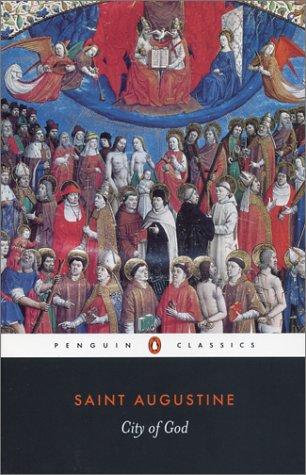
The City of God by Saint Augustine is a 1610 philosophy book about political theology, history and providence, justice and empire. The two cities — the City of God and the City of Man — are distinguished not by geography or institution but by love: one loves God above all, the other loves self.
Summary
The City of God was written between 413 and 426 CE, prompted by the sack of Rome by the Visigoths in 410. Pagan critics blamed the catastrophe on Rome's abandonment of the old gods in favor of Christianity, and Augustine wrote the book in direct response — first to refute that charge, then to offer a comprehensive alternative account of history, justice, and the human condition. It is his longest and most ambitious work, twenty-two books in all, and the founding text of Christian political thought in the West.
The first ten books are largely defensive. Augustine dismantles the claim that Rome's pagan gods had ever guaranteed the empire's security, marshaling historical examples to show that Rome suffered military disasters and moral degradation long before the Christian era. He is equally critical of the Roman philosophical tradition, arguing that even the Platonists — whom he respects most — cannot supply what the soul actually needs.
Books 11 through 22 turn constructive, laying out Augustine's "two cities" framework: the City of God, whose members love God above all else and order all other loves accordingly, and the City of Man, whose members are oriented toward self-love and earthly power. These two cities are not identical with the Church and the state, or with any historical institution. They run through every society, every family, every person. History, for Augustine, is the drama of these two cities intertwined until the Last Judgment separates them definitively. He traces this history from the fall of the angels through the Old Testament and Roman history to the final resurrection.
The book is enormous and uneven. Long stretches of direct polemic against pagan religion feel remote today. But the core arguments — that earthly power is never sufficient to satisfy human longing, that justice without transcendent ground is merely organized strength, that no political order should be identified with the Kingdom of God — retain their force. Augustine's insistence that Rome was never a true commonwealth in Cicero's sense, because it lacked genuine justice, remains one of the most searching critiques of political legitimacy in any era.
Talk to The City of God like its author wrote you back.
Get the ideas that fit your life — not generic summaries.
- Chat with the book
- Audiobook-style main ideas
- Adapts to your life and goals
- Helps you take action
Key takeaways
- 1.
The two cities — the City of God and the City of Man — are distinguished not by geography or institution but by love: one loves God above all, the other loves self.
- 2.
No earthly empire, including Rome, is equivalent to the Kingdom of God. Augustine warns against confusing any political order with divine sanction.
- 3.
Justice without reference to the true God is, for Augustine, merely organized power. A state that lacks genuine justice is, in his formulation, 'a great robbery.'
- 4.
History is meaningful but not straightforwardly progressive. Providence works through suffering and disaster as well as through triumph, and its purposes are not always legible to human observers.
- 5.
Peace — the peace of the earthly city — is real and worth preserving, but it is only a pale image of the true peace available in the City of God.
- 6.
Rome's fall was not caused by Christianity. Rome suffered moral catastrophe long before Christianity, and the gods it worshipped offered neither moral guidance nor reliable protection.
- 7.
The fall of the angels and the fall of Adam establish the two cities at the origin of history. Human political life is downstream of a theological event.
- 8.
Augustine argues that Christians should participate in earthly political life, accepting its imperfect peace, while keeping their ultimate loyalty elsewhere.
Discussion questions
Use these on your own, with a book club, or as chat starters in Superbook. Book club version, ready to copy or print →
- 1.
Augustine argues that no political order should be identified with the Kingdom of God. Where do you see that confusion being made today — by any political tradition?
- 2.
His definition of justice requires that God be given what is owed — meaning a society without proper theology cannot be truly just. Can you construct a secular account of justice that answers his challenge?
- 3.
The two cities are defined by loves, not by institutions. By Augustine's criterion, which city do you think you mostly inhabit?
- 4.
Augustine distinguishes Rome's earthly peace — real but limited — from true peace. Is that distinction practically useful, or does it make earthly politics seem inherently second-rate?
- 5.
The book was triggered by a military disaster that prompted blame-shifting toward Christians. How does that polemical origin shape what Augustine chooses to argue and what he leaves out?
- 6.
Books 11–22 trace a philosophy of history from creation to Last Judgment. What assumptions about history — that it has a direction, that suffering is providential — does that framework require, and which do you share?
- 7.
Augustine is harshly critical of Roman religion but respectful of Platonic philosophy. What is it about Platonism that he finds compatible with Christianity, and where does he part ways?
- 8.
The City of God is nearly 1,100 pages. If you read selections, which sections did you find most alive, and which most dated?
- 9.
Augustine says Christians can serve in armies and hold public office even in an unjust state. Does his argument for civic participation hold, or does it ask too much accommodation of imperfect institutions?
- 10.
How does Augustine's response to Rome's fall compare to how people today respond when an institution they trusted collapses?
- 11.
The book essentially argues that Christianity is not responsible for Rome's decline. Is that the kind of argument that can actually persuade critics, or does it only reinforce existing positions?
- 12.
What would it mean to live, in Augustine's terms, as a 'pilgrim' in the earthly city — participating fully but without ultimate attachment?
Themes
Frequently asked questions
-
What is The City of God about?
Augustine wrote it in response to the sack of Rome in 410 CE, refuting pagan claims that Christianity caused Rome's fall. It broadens into a comprehensive philosophy of history organized around the contrast between the earthly city (oriented toward self-love and power) and the City of God (oriented toward divine love).
-
Do I need to read all of The City of God?
Most readers read selections. Books 1–5 (refuting paganism) and Books 11–14 and 19–22 (the two cities and the end of history) are the most essential. Books 6–10 and 15–18 are detailed and often feel more like reference material than argument.
-
Is The City of God still relevant today?
The core argument — that no political order should be identified with divine sanction, and that justice requires more than organized power — remains one of the sharpest tools in political philosophy. It is regularly cited in debates about church-state relations, just war, and political theology.
-
How does The City of God relate to Augustine's Confessions?
The Confessions is personal and introspective; The City of God is political and historical. They share the same theological commitments but operate at opposite scales — one traces a single soul, the other traces all of human history.
-
What is Augustine's most controversial claim in the book?
Probably that a republic without genuine justice — defined as giving to God what is owed — is not truly a republic at all. It means no entirely secular political order has ever been fully legitimate on Augustine's terms, which continues to provoke both admiration and objection.