History · Book club
The Clash of Civilizations and the Remaking of World Order book club questions
Here are 12 book club questions for The Clash of Civilizations and the Remaking of World Order by Samuel P. Huntington, ordered to open easily and end somewhere worth arguing about. Copy them, print them, or bring them up one at a time.
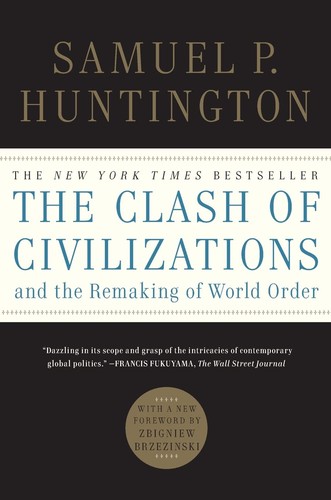
Samuel Huntington's The Clash of Civilizations and the Remaking of World Order, published in 1996, is an expansion of a 1993 Foreign Affairs essay that generated more response than almost any article in that journal's history.
Samuel P. Huntington · 1996 · 11h 30m
Full summary and key takeaways →The 12 questions
- 1.
Huntington claims cultural identity is a more fundamental driver of conflict than economic interest. Which recent conflicts or alliances do you think best test that claim?
- 2.
Critics argue his civilizational categories are too broad and internally diverse to be analytically useful. Where do you think the boundaries between civilizations actually run, and does the concept survive that criticism?
- 3.
His claim that Western values are not universal was controversial in 1996 and remains so. How do you think about the relationship between Western liberal values and genuine universalism?
- 4.
The book was widely cited after 9/11 as vindicated. Does the 'War on Terror' and its aftermath support or undermine Huntington's framework?
- 5.
Huntington argues modernization does not lead to Westernization. What examples of countries becoming more economically developed while becoming more culturally assertive come to mind?
- 6.
The book's prescription — that the West should accept its declining power and negotiate rather than dominate — was not followed. What do you think the consequences of that choice have been?
- 7.
How does Huntington's civilizational framework compare to the liberal internationalist view that economic interdependence and institutions create stable peace?
- 8.
The framework treats civilizations partly as defined by religion. How does that assumption hold up in increasingly secular societies, and in societies where religious identity is intensifying?
- 9.
Which of Huntington's predictions from 1996 have been most clearly confirmed, and which have been most clearly falsified by subsequent events?
- 10.
Critics argue the book can function as a self-fulfilling prophecy — if powerful people believe civilizational conflict is inevitable, their policies help produce it. How do you evaluate that critique?
- 11.
How does Huntington's framework apply to the rise of China since 1996? Did he correctly anticipate the nature of US-China competition?
- 12.
What would have to be true for Huntington to be fundamentally wrong about the future of international order? What alternative frameworks do you find more compelling?
How to run the discussion
- Pick six to eight, not all of them. An hour of real discussion covers fewer questions than anyone expects, and racing the list is what makes a book club feel like homework.
- Open with what people noticed, not what they concluded. Asking for a verdict first hardens opinions before anyone has heard each other.
- Let the disagreement run. The questions below that split a room are the ones worth the time; the ones everyone answers the same way can be skipped.
- Ask the quiet person a specific question. A direct, narrow question is far easier to answer than an open invitation to contribute.
Themes worth steering toward
If the conversation stalls, these are the threads that usually restart it.
Common questions
What are good book club questions for The Clash of Civilizations and the Remaking of World Order?
Here are 12 book club questions for The Clash of Civilizations and the Remaking of World Order by Samuel P. Huntington, ordered to open easily and end somewhere worth arguing about. The strongest openers ask what each reader noticed rather than what they concluded, and the discussion usually turns on geopolitics, cultural identity, international relations.
How long should a book club discussion of The Clash of Civilizations and the Remaking of World Order last?
Most groups run 60 to 90 minutes of actual discussion. That is roughly six to eight questions, not all of them, so pick the ones that suit your group rather than working down the list in order.
What are the main themes in The Clash of Civilizations and the Remaking of World Order?
Geopolitics, Cultural identity, International relations, Religion and politics, World order. Those are the threads most likely to divide a room, which makes them the useful places to steer a discussion that has gone quiet.
Picking the next one? See books like The Clash of Civilizations and the Remaking of World Order or questions for other book club picks.
