Psychology · Book club
The Coddling of the American Mind book club questions
Here are 12 book club questions for The Coddling of the American Mind by Greg Lukianoff and Jonathan Haidt, ordered to open easily and end somewhere worth arguing about. Copy them, print them, or bring them up one at a time.
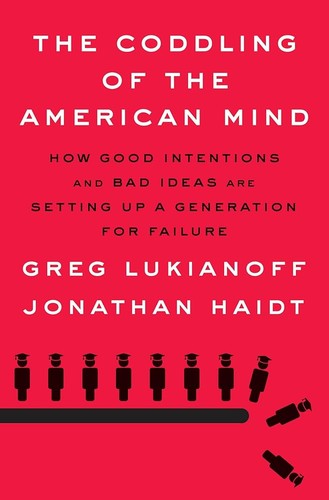
Greg Lukianoff and Jonathan Haidt argue that American universities — and the parents and institutions that feed them — have adopted three ideas they call the Great Untruths: that what doesn't kill you makes you weaker, that you should always trust your feelings, and that life is a battle between good people and evil people.
Greg Lukianoff and Jonathan Haidt · 2018 · 6h 15m
Full summary and key takeaways →The 12 questions
- 1.
Lukianoff and Haidt identify three Great Untruths. Which one do you think is most deeply embedded in institutions you've been part of?
- 2.
The book draws heavily on CBT to argue that emotional reasoning is often unreliable. When in your own life have you mistaken a feeling for a fact?
- 3.
What's the right amount of adversity to expose a child or student to? Where does the line sit between preparation and cruelty?
- 4.
The authors argue unsupervised play is critical for development. How much of it did you have growing up, and what did you learn from it that couldn't have been taught by an adult?
- 5.
Haidt and Lukianoff are critics of certain campus speech norms, but they're also critics of the political right's campus provocateurs. Does the book treat both sides with equal scrutiny, in your reading?
- 6.
The smartphone and social media diagnosis is prominent in the book. How does your own relationship with these platforms affect your mood, attention, and tolerance for disagreement?
- 7.
When does protecting someone from harm cross into preventing them from developing the capacity to handle harm? Is there a concrete example from your own experience?
- 8.
The book argues that administrators often act in ways that increase fragility because it reduces short-term conflict. What other institutions or systems have you seen make the same tradeoff?
- 9.
Lukianoff credits CBT with saving his life. Does the therapeutic framing strengthen the book's argument for you, or does it feel like it overreaches?
- 10.
The authors distinguish between physical safety and psychological safety. Do you think that distinction is as clean in practice as they suggest?
- 11.
What's a belief you hold that you've never had to seriously defend? What would happen if you had to?
- 12.
The book was published in 2018. Which of its predictions or diagnoses have aged well, and which look different now?
How to run the discussion
- Pick six to eight, not all of them. An hour of real discussion covers fewer questions than anyone expects, and racing the list is what makes a book club feel like homework.
- Open with what people noticed, not what they concluded. Asking for a verdict first hardens opinions before anyone has heard each other.
- Let the disagreement run. The questions below that split a room are the ones worth the time; the ones everyone answers the same way can be skipped.
- Ask the quiet person a specific question. A direct, narrow question is far easier to answer than an open invitation to contribute.
Themes worth steering toward
If the conversation stalls, these are the threads that usually restart it.
Common questions
What are good book club questions for The Coddling of the American Mind?
Here are 12 book club questions for The Coddling of the American Mind by Greg Lukianoff and Jonathan Haidt, ordered to open easily and end somewhere worth arguing about. The strongest openers ask what each reader noticed rather than what they concluded, and the discussion usually turns on overprotection, cognitive distortions, free speech.
How long should a book club discussion of The Coddling of the American Mind last?
Most groups run 60 to 90 minutes of actual discussion. That is roughly six to eight questions, not all of them, so pick the ones that suit your group rather than working down the list in order.
What are the main themes in The Coddling of the American Mind?
Overprotection, Cognitive distortions, Free speech, Campus culture, Resilience. Those are the threads most likely to divide a room, which makes them the useful places to steer a discussion that has gone quiet.
Picking the next one? See books like The Coddling of the American Mind or questions for other book club picks.
