Science · Book club
The Code Book: The Science of Secrecy from Ancient Egypt to Quantum Cryptography book club questions
Here are 12 book club questions for The Code Book: The Science of Secrecy from Ancient Egypt to Quantum Cryptography by Simon Singh, ordered to open easily and end somewhere worth arguing about. Copy them, print them, or bring them up one at a time.
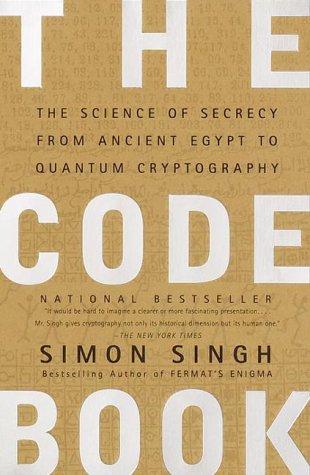
Simon Singh's The Code Book traces the history of cryptography from Caesar's cipher through the breaking of Enigma to the mathematics of public-key encryption and the looming possibility of quantum cryptography.
Simon Singh · 1999 · 8h 0m
Full summary and key takeaways →The 12 questions
- 1.
Singh describes cryptography as a perpetual arms race between encryption and cryptanalysis. Does that framing suggest that truly unbreakable encryption is impossible in principle, or just difficult in practice?
- 2.
The Arab mathematicians who invented frequency analysis did so in the context of Quran scholarship — analyzing letter patterns to date manuscripts. What does it tell us about the sources of scientific discovery that this method came from religious philology?
- 3.
The Vigenère cipher was considered unbreakable for three centuries. How does knowing that affect your confidence in any current security system that is described as unbreakable?
- 4.
Bletchley Park's work shortened the war but required keeping Ultra completely secret, which meant allowing some attacks to succeed that could have been prevented. How do you think about the ethics of that tradeoff?
- 5.
Public-key cryptography depends on the assumed difficulty of factoring large numbers. What does it mean to build global communications security on a mathematical conjecture rather than a proven theorem?
- 6.
The PGP chapter shows a private citizen deploying military-grade encryption in defiance of US export law. How do you think about the ethical dimensions of cryptographic freedom versus national security concerns today?
- 7.
Quantum cryptography uses physical laws to guarantee security rather than mathematical hardness. Does that feel like a qualitatively different kind of guarantee to you, or is it still an assumption that the underlying physics is correct?
- 8.
The book ends with the threat that quantum computers could break RSA. We are now in 2025 and quantum computing has advanced significantly. How has that threat materialized, and what has been done about it?
- 9.
Singh gives you enough mathematics to actually understand why RSA works. Did you engage with those sections, and if not, what was the barrier — the mathematics itself or the feeling that you didn't need it?
- 10.
Cryptography is increasingly invisible infrastructure — it runs beneath every secure website, every encrypted message, every payment. Does that invisibility make you more or less interested in understanding how it works?
- 11.
The history of broken ciphers shows that every system eventually falls. What should that history tell policymakers who are currently making decisions about encryption standards for the next twenty years?
- 12.
Singh weaves historical narrative with technical explanation throughout. When the technical sections appear, do they deepen the story for you or interrupt it?
How to run the discussion
- Pick six to eight, not all of them. An hour of real discussion covers fewer questions than anyone expects, and racing the list is what makes a book club feel like homework.
- Open with what people noticed, not what they concluded. Asking for a verdict first hardens opinions before anyone has heard each other.
- Let the disagreement run. The questions below that split a room are the ones worth the time; the ones everyone answers the same way can be skipped.
- Ask the quiet person a specific question. A direct, narrow question is far easier to answer than an open invitation to contribute.
Themes worth steering toward
If the conversation stalls, these are the threads that usually restart it.
Common questions
What are good book club questions for The Code Book: The Science of Secrecy from Ancient Egypt to Quantum Cryptography?
Here are 12 book club questions for The Code Book: The Science of Secrecy from Ancient Egypt to Quantum Cryptography by Simon Singh, ordered to open easily and end somewhere worth arguing about. The strongest openers ask what each reader noticed rather than what they concluded, and the discussion usually turns on cryptography, history of science, mathematics.
How long should a book club discussion of The Code Book: The Science of Secrecy from Ancient Egypt to Quantum Cryptography last?
Most groups run 60 to 90 minutes of actual discussion. That is roughly six to eight questions, not all of them, so pick the ones that suit your group rather than working down the list in order.
What are the main themes in The Code Book: The Science of Secrecy from Ancient Egypt to Quantum Cryptography?
Cryptography, History of science, Mathematics, Privacy, Technology. Those are the threads most likely to divide a room, which makes them the useful places to steer a discussion that has gone quiet.
Picking the next one? See books like The Code Book: The Science of Secrecy from Ancient Egypt to Quantum Cryptography or questions for other book club picks.
