History · Book club
The Color of Law: A Forgotten History of How Our Government Segregated America book club questions
Here are 12 book club questions for The Color of Law: A Forgotten History of How Our Government Segregated America by Richard Rothstein, ordered to open easily and end somewhere worth arguing about. Copy them, print them, or bring them up one at a time.
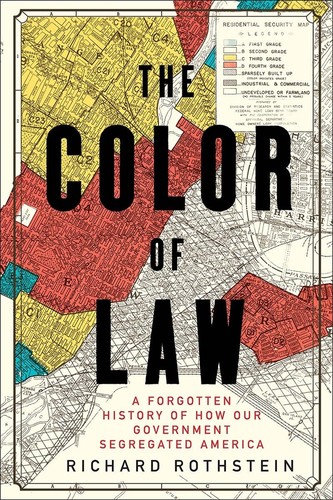
Richard Rothstein's The Color of Law makes a precise and uncomfortable argument: residential segregation in American cities was not the result of private prejudice or individual choice but of explicit, deliberate government policy at the federal, state, and local levels.
Richard Rothstein · 2017 · 5h 45m
Full summary and key takeaways →The 12 questions
- 1.
Rothstein distinguishes de jure from de facto segregation. Before reading the book, which did you think better described American residential patterns?
- 2.
The FHA redlining maps explicitly rated neighborhoods by racial composition. Who in the federal government made those decisions, and what does their institutional context tell you?
- 3.
The GI Bill is often cited as a major driver of middle-class wealth creation. Does Rothstein's account of its racially discriminatory administration change how you think about postwar prosperity?
- 4.
Rothstein focuses on government policy rather than private prejudice. Does that framing feel complete to you, or does it leave something important out?
- 5.
The wealth gap argument depends on the claim that homeownership in appreciating suburbs was the primary vehicle of middle-class wealth accumulation. Is that premise well established?
- 6.
The Supreme Court's 1948 Shelley v. Kraemer decision ruled racially restrictive covenants unenforceable. Rothstein argues they remained effective anyway. What does that tell you about the relationship between legal rights and practical reality?
- 7.
If Rothstein's argument is correct that this is de jure segregation, what obligations does that create? What kinds of remediation would follow?
- 8.
The book covers policies from the 1930s through the 1970s. At what point, if any, do you think historical government actions stop creating current obligations?
- 9.
Rothstein writes with restraint about policies that are obviously unjust. Does that rhetorical choice make the book more or less effective?
- 10.
Public housing in the book begins as a New Deal program partly intended for white working-class families and becomes associated almost exclusively with Black poverty. What policies drove that transformation?
- 11.
The book focuses on the federal level but also covers state and local governments. Which level of government appears most directly responsible in Rothstein's account?
- 12.
How does reading The Color of Law change how you look at suburban neighborhoods, property values, or the geography of your own city?
How to run the discussion
- Pick six to eight, not all of them. An hour of real discussion covers fewer questions than anyone expects, and racing the list is what makes a book club feel like homework.
- Open with what people noticed, not what they concluded. Asking for a verdict first hardens opinions before anyone has heard each other.
- Let the disagreement run. The questions below that split a room are the ones worth the time; the ones everyone answers the same way can be skipped.
- Ask the quiet person a specific question. A direct, narrow question is far easier to answer than an open invitation to contribute.
Themes worth steering toward
If the conversation stalls, these are the threads that usually restart it.
Common questions
What are good book club questions for The Color of Law: A Forgotten History of How Our Government Segregated America?
Here are 12 book club questions for The Color of Law: A Forgotten History of How Our Government Segregated America by Richard Rothstein, ordered to open easily and end somewhere worth arguing about. The strongest openers ask what each reader noticed rather than what they concluded, and the discussion usually turns on segregation, housing policy, racism.
How long should a book club discussion of The Color of Law: A Forgotten History of How Our Government Segregated America last?
Most groups run 60 to 90 minutes of actual discussion. That is roughly six to eight questions, not all of them, so pick the ones that suit your group rather than working down the list in order.
What are the main themes in The Color of Law: A Forgotten History of How Our Government Segregated America?
Segregation, Housing policy, Racism, Government policy, Inequality. Those are the threads most likely to divide a room, which makes them the useful places to steer a discussion that has gone quiet.
Picking the next one? See books like The Color of Law: A Forgotten History of How Our Government Segregated America or questions for other book club picks.
