Philosophy · Book club
The Consolations of Philosophy book club questions
Here are 11 book club questions for The Consolations of Philosophy by Alain de Botton, ordered to open easily and end somewhere worth arguing about. Copy them, print them, or bring them up one at a time.
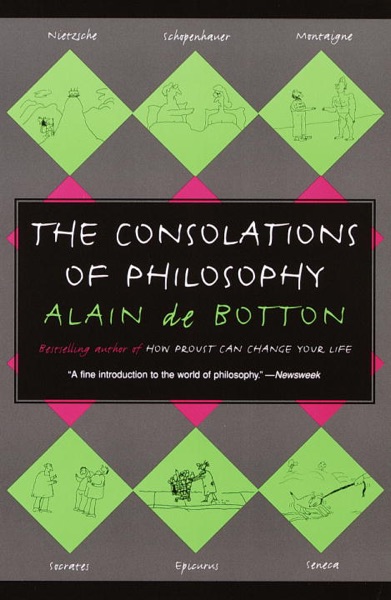
The Consolations of Philosophy takes six Western philosophers — Socrates, Epicurus, Seneca, Montaigne, Schopenhauer, and Nietzsche — and applies each to a particular kind of human suffering.
Alain de Botton · 2000 · 4h 45m
Full summary and key takeaways →The 11 questions
- 1.
De Botton pairs each philosopher with a specific kind of suffering. Which pairing do you find most and least convincing?
- 2.
Epicurus taught that friendship and modest circumstances produce more happiness than wealth. Does the evidence of your own life support or complicate that?
- 3.
Seneca's premeditatio malorum — mentally rehearsing what could go wrong — is framed as consolation for frustration. Does anticipating failure tend to reduce your suffering from it, or does it produce different anxieties?
- 4.
Montaigne's project was an honest account of his own ordinariness and imperfection. Is that kind of radical intellectual honesty rare? What makes it difficult?
- 5.
Academic philosophers often criticize de Botton's simplifications. Does it matter for the book's purposes whether the readings are scholarly accurate?
- 6.
The book argues that philosophy should be useful for ordinary suffering. Which philosophical tradition do you already draw on, consciously or not, in difficult situations?
- 7.
Nietzsche's amor fati is a difficult idea: loving not just accepting, but actively loving what is difficult. Is that psychologically realistic or a useful aspiration?
- 8.
De Botton chose six philosophers and six specific problems. What kind of suffering do you think is missing from his list, and which philosopher might have addressed it?
- 9.
The book's form — illustrated, essayistic, accessible — has been criticized as philosophy-lite. What is the relationship between accessibility and depth in writing about ideas?
- 10.
Socrates was executed for teaching his method. De Botton uses that as evidence that unpopularity does not indicate error. Is that a good argument, or a comforting one that happens not to be valid?
- 11.
Which of the six philosophers, as de Botton presents them, has most influenced how you already think, and which seems most foreign to your natural disposition?
How to run the discussion
- Pick six to eight, not all of them. An hour of real discussion covers fewer questions than anyone expects, and racing the list is what makes a book club feel like homework.
- Open with what people noticed, not what they concluded. Asking for a verdict first hardens opinions before anyone has heard each other.
- Let the disagreement run. The questions below that split a room are the ones worth the time; the ones everyone answers the same way can be skipped.
- Ask the quiet person a specific question. A direct, narrow question is far easier to answer than an open invitation to contribute.
Themes worth steering toward
If the conversation stalls, these are the threads that usually restart it.
Common questions
What are good book club questions for The Consolations of Philosophy?
Here are 11 book club questions for The Consolations of Philosophy by Alain de Botton, ordered to open easily and end somewhere worth arguing about. The strongest openers ask what each reader noticed rather than what they concluded, and the discussion usually turns on ancient wisdom, everyday suffering, self-examination.
How long should a book club discussion of The Consolations of Philosophy last?
Most groups run 60 to 90 minutes of actual discussion. That is roughly six to eight questions, not all of them, so pick the ones that suit your group rather than working down the list in order.
What are the main themes in The Consolations of Philosophy?
Ancient wisdom, Everyday suffering, Self-examination, Stoicism, Philosophy and practice. Those are the threads most likely to divide a room, which makes them the useful places to steer a discussion that has gone quiet.
Picking the next one? See books like The Consolations of Philosophy or questions for other book club picks.
