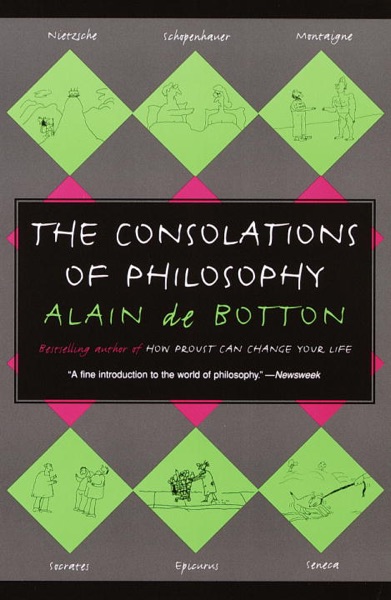
The Consolations of Philosophy by Alain de Botton is a 2000 philosophy book about ancient wisdom, everyday suffering, self-examination. Philosophy, as Socrates practiced it, teaches that reason and argument are more reliable guides to the good life than popular opinion — a consolation for those who find themselves unpopular or misunderstood.
Summary
The Consolations of Philosophy takes six Western philosophers — Socrates, Epicurus, Seneca, Montaigne, Schopenhauer, and Nietzsche — and applies each to a particular kind of human suffering. Socrates consoles for unpopularity; Epicurus for not having enough money; Seneca for frustration; Montaigne for inadequacy; Schopenhauer for a broken heart; Nietzsche for hardship. Alain de Botton's argument, implicit in the structure, is that philosophy is not an academic discipline but a practical tool that has been unnecessarily sequestered behind professional credentials and jargon.
De Botton writes with the essayist's freedom to digress, and the book's secondary pleasure is its texture: period illustrations, unexpected biographical details, and de Botton's own voice mediating between the philosopher's time and ours. His Epicurus, for instance, was misread by history as a hedonist when he actually taught that genuine happiness required friendship, freedom from ambition, and modest circumstances — a reread that sits oddly with how the word "epicurean" is now used.
The Seneca chapter is arguably the strongest. De Botton extracts from Seneca's letters a practical guide to frustration — the recognition that we suffer more from expectation than from events, and that building mental models of what can go wrong in advance (premeditatio malorum) reduces the shock when things do. The framing is Stoic but the application is specific enough to feel less like ancient wisdom and more like a checklist for Tuesday.
The book has critics in academic philosophy, who point out that de Botton simplifies — sometimes significantly — and that the readings of the philosophers, while entertaining, are not always defensible as scholarship. This is fair and largely beside the point. The Consolations of Philosophy is not written as scholarship; it is written as an invitation. The question is whether, having read it, readers are likely to go further into the underlying texts. The answer is often yes — and as introductions go, it is more readable than most.
Talk to The Consolations of Philosophy like its author wrote you back.
Get the ideas that fit your life — not generic summaries.
- Chat with the book
- Audiobook-style main ideas
- Adapts to your life and goals
- Helps you take action
Key takeaways
- 1.
Philosophy, as Socrates practiced it, teaches that reason and argument are more reliable guides to the good life than popular opinion — a consolation for those who find themselves unpopular or misunderstood.
- 2.
Epicurus did not teach hedonism but its near-opposite: that the good life requires modest needs, genuine friendship, and freedom from ambition, not luxury or wealth.
- 3.
Seneca's Stoic consolation for frustration rests on the idea that we suffer more from our expectations than from events. Adjusting expectations reduces suffering without changing circumstances.
- 4.
Montaigne's consolation for inadequacy is that intellectual and physical imperfection are universal. His essays explore the full range of ordinary human failure with unusual candor.
- 5.
Schopenhauer's account of romantic disappointment treats heartbreak as the experience of the will being thwarted — painful but intelligible, and survivable.
- 6.
Nietzsche's consolation for hardship is amor fati — love of fate — the idea that difficulties should be embraced as necessary conditions for the development of strength.
- 7.
Philosophy becomes more useful when separated from academic credential and applied directly to specific categories of ordinary experience — unpopularity, financial anxiety, loss, inadequacy.
Discussion questions
Use these on your own, with a book club, or as chat starters in Superbook. Book club version, ready to copy or print →
- 1.
De Botton pairs each philosopher with a specific kind of suffering. Which pairing do you find most and least convincing?
- 2.
Epicurus taught that friendship and modest circumstances produce more happiness than wealth. Does the evidence of your own life support or complicate that?
- 3.
Seneca's premeditatio malorum — mentally rehearsing what could go wrong — is framed as consolation for frustration. Does anticipating failure tend to reduce your suffering from it, or does it produce different anxieties?
- 4.
Montaigne's project was an honest account of his own ordinariness and imperfection. Is that kind of radical intellectual honesty rare? What makes it difficult?
- 5.
Academic philosophers often criticize de Botton's simplifications. Does it matter for the book's purposes whether the readings are scholarly accurate?
- 6.
The book argues that philosophy should be useful for ordinary suffering. Which philosophical tradition do you already draw on, consciously or not, in difficult situations?
- 7.
Nietzsche's amor fati is a difficult idea: loving not just accepting, but actively loving what is difficult. Is that psychologically realistic or a useful aspiration?
- 8.
De Botton chose six philosophers and six specific problems. What kind of suffering do you think is missing from his list, and which philosopher might have addressed it?
- 9.
The book's form — illustrated, essayistic, accessible — has been criticized as philosophy-lite. What is the relationship between accessibility and depth in writing about ideas?
- 10.
Socrates was executed for teaching his method. De Botton uses that as evidence that unpopularity does not indicate error. Is that a good argument, or a comforting one that happens not to be valid?
- 11.
Which of the six philosophers, as de Botton presents them, has most influenced how you already think, and which seems most foreign to your natural disposition?
Themes
Frequently asked questions
-
What is The Consolations of Philosophy about?
It takes six philosophers — Socrates, Epicurus, Seneca, Montaigne, Schopenhauer, and Nietzsche — and applies each to a specific kind of ordinary suffering. The book argues that philosophy is a practical tool, not just an academic discipline.
-
Is The Consolations of Philosophy worth reading?
Yes, as an introduction. The writing is engaging, the examples are well-chosen, and the book will send most readers toward at least one of the underlying texts. Scholars will find the readings simplified, but that is the point rather than a defect.
-
How long is it?
About 265 pages, roughly four and a half to five hours. It reads quickly, with generous illustration and de Botton's essayistic digressing style keeping the pace moving.
-
Is this appropriate for someone who has never read philosophy?
Ideal. De Botton assumes no prior knowledge and introduces each philosopher with enough biographical context to make the ideas feel like someone's actual thinking rather than abstract doctrine.
-
Which philosopher is most useful in everyday life, according to the book?
That depends on the reader's situation. Many readers find Seneca most immediately applicable — his consolation for frustration rests on adjusting expectations rather than circumstances, and that technique is both ancient and genuinely useful. Epicurus's reread tends to be the most surprising.