Talk to The Consolations of Philosophy like its author wrote you back.
Get the ideas that fit your life — not generic summaries.
- Chat with the book
- Audiobook-style main ideas
- Adapts to your life and goals
- Helps you take action
The Consolations of Philosophy, in detail
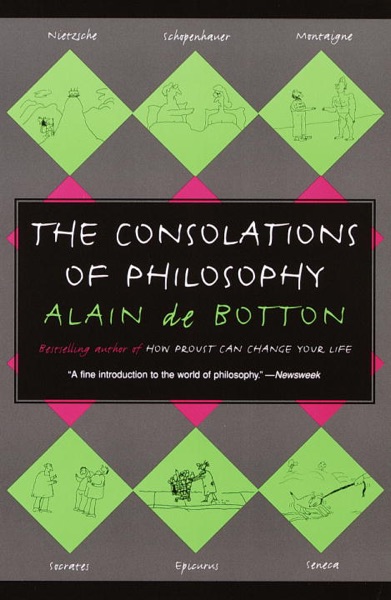
The Consolations of Philosophy takes six Western philosophers — Socrates, Epicurus, Seneca, Montaigne, Schopenhauer, and Nietzsche — and applies each to a particular kind of human suffering. Socrates consoles for unpopularity; Epicurus for not having enough money; Seneca for frustration; Montaigne for inadequacy; Schopenhauer for a broken heart; Nietzsche for hardship. Alain de Botton's argument, implicit in the structure, is that philosophy is not an academic discipline but a practical tool that has been unnecessarily sequestered behind professional credentials and jargon.
De Botton writes with the essayist's freedom to digress, and the book's secondary pleasure is its texture: period illustrations, unexpected biographical details, and de Botton's own voice mediating between the philosopher's time and ours. His Epicurus, for instance, was misread by history as a hedonist when he actually taught that genuine happiness required friendship, freedom from ambition, and modest circumstances — a reread that sits oddly with how the word "epicurean" is now used.
The Seneca chapter is arguably the strongest. De Botton extracts from Seneca's letters a practical guide to frustration — the recognition that we suffer more from expectation than from events, and that building mental models of what can go wrong in advance (premeditatio malorum) reduces the shock when things do. The framing is Stoic but the application is specific enough to feel less like ancient wisdom and more like a checklist for Tuesday.
The book has critics in academic philosophy, who point out that de Botton simplifies — sometimes significantly — and that the readings of the philosophers, while entertaining, are not always defensible as scholarship. This is fair and largely beside the point. The Consolations of Philosophy is not written as scholarship; it is written as an invitation. The question is whether, having read it, readers are likely to go further into the underlying texts. The answer is often yes — and as introductions go, it is more readable than most.
The big ideas
- 1.
Philosophy, as Socrates practiced it, teaches that reason and argument are more reliable guides to the good life than popular opinion — a consolation for those who find themselves unpopular or misunderstood.
- 2.
Epicurus did not teach hedonism but its near-opposite: that the good life requires modest needs, genuine friendship, and freedom from ambition, not luxury or wealth.
- 3.
Seneca's Stoic consolation for frustration rests on the idea that we suffer more from our expectations than from events. Adjusting expectations reduces suffering without changing circumstances.
