Literary fiction · Book club
The Corrections book club questions
Here are 12 book club questions for The Corrections by Jonathan Franzen, ordered to open easily and end somewhere worth arguing about. Copy them, print them, or bring them up one at a time.
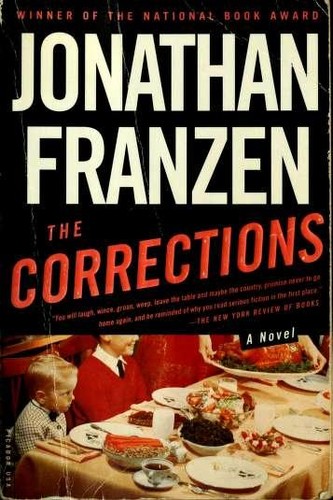
Jonathan Franzen's third novel, published in 2001 and winner of the National Book Award, follows the Lambert family across three adult children and their aging parents, Alfred and Enid, through the late 1990s.
Jonathan Franzen · 2001 · 14h 0m
Full summary and key takeaways →The 12 questions
- 1.
Enid is often read as the novel's villain — controlling, emotionally manipulative, unable to acknowledge Alfred's condition. By the end, do you still feel that way? What changes?
- 2.
Alfred is brilliant, difficult, and losing his mind. The novel asks you to grieve for him without quite liking him. Did it work for you?
- 3.
Each of the children has escaped St. Jude and built lives defined partly by what they're not. Which of the three do you think has made the most honest accounting of their inheritance?
- 4.
The Lithuanian section is the most stylistically unusual part of the book — Chip's picaresque adventure. Does it belong? What would the novel lose if it were cut?
- 5.
Franzen is satirizing the 1990s cultural moment — Prozac solving everything, the dot-com gold rush, the medicalization of behavior. Does that satire feel dated, or does it land as intended?
- 6.
The novel was accused of condescension toward Midwestern values. Is that criticism fair? Or is Franzen's portrait of St. Jude more complicated than that?
- 7.
The title is doing a lot of work. By the end, whose 'corrections' did you find most meaningful — Gary's, Chip's, Denise's, Enid's?
- 8.
Franzen gave a famous interview expressing ambivalence about Oprah's Book Club selection, which created a controversy about the audience for literary fiction. How does that context affect how you read the novel's ambitions?
- 9.
The last few pages, after the Christmas, are very spare compared to the novel's usual density. Why does the tonal shift work, or why doesn't it?
- 10.
Compared to a family novel like A Heartbreaking Work of Staggering Genius — also from around the same period — what is Franzen doing differently? Which is more honest about family?
- 11.
The novel is six hundred pages. Could it have been shorter? What would you cut?
- 12.
Alfred's hallucinations and dementia are rendered in prose that becomes formally unstable. Is that a gimmick or does it earn its difficulty?
How to run the discussion
- Pick six to eight, not all of them. An hour of real discussion covers fewer questions than anyone expects, and racing the list is what makes a book club feel like homework.
- Open with what people noticed, not what they concluded. Asking for a verdict first hardens opinions before anyone has heard each other.
- Let the disagreement run. The questions below that split a room are the ones worth the time; the ones everyone answers the same way can be skipped.
- Ask the quiet person a specific question. A direct, narrow question is far easier to answer than an open invitation to contribute.
Themes worth steering toward
If the conversation stalls, these are the threads that usually restart it.
Common questions
What are good book club questions for The Corrections?
Here are 12 book club questions for The Corrections by Jonathan Franzen, ordered to open easily and end somewhere worth arguing about. The strongest openers ask what each reader noticed rather than what they concluded, and the discussion usually turns on family dysfunction, american consumerism, aging and decline.
How long should a book club discussion of The Corrections last?
Most groups run 60 to 90 minutes of actual discussion. That is roughly six to eight questions, not all of them, so pick the ones that suit your group rather than working down the list in order.
What are the main themes in The Corrections?
Family dysfunction, American consumerism, Aging and decline, Identity and expectation, Generational conflict. Those are the threads most likely to divide a room, which makes them the useful places to steer a discussion that has gone quiet.
Picking the next one? See books like The Corrections or questions for other book club picks.
