Economics · Book club
The Dao of Capital book club questions
Here are 12 book club questions for The Dao of Capital by Mark Spitznagel, ordered to open easily and end somewhere worth arguing about. Copy them, print them, or bring them up one at a time.
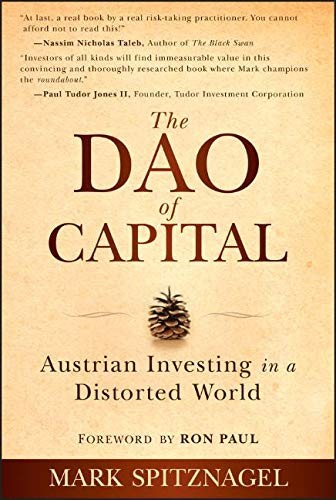
The Dao of Capital is Mark Spitznagel's argument for what he calls "roundabout" investing — the deliberate willingness to accept near-term losses or suboptimal returns in exchange for a position that will produce superior outcomes over a longer time horizon.
Mark Spitznagel · 2013 · 5h 15m
Full summary and key takeaways →The 12 questions
- 1.
Spitznagel argues that the willingness to underperform in the short term is the prerequisite for superior long-term outcomes. Can you think of examples in your own life where the roundabout path proved correct?
- 2.
How much of the Austrian economics framework did you find persuasive, and how much felt like theoretical scaffolding for a conclusion Spitznagel had already reached?
- 3.
Tail-risk hedging consistently loses small amounts of money in most market environments. How much would it take to convince you to hold an instrument that loses money most of the time?
- 4.
Spitznagel is deeply critical of central bank interest rate policy. Has the period since the book was published changed how you evaluate that critique?
- 5.
The book draws connections between Daoism, Austrian economics, and military strategy. Does that synthesis feel illuminating or forced?
- 6.
What does 'patient capital' look like in practice for an individual investor rather than a hedge fund? What institutional or psychological constraints make it difficult?
- 7.
Spitznagel argues most investors systematically underestimate tail risk. Do you agree? What evidence would you look for to test that claim?
- 8.
The roundabout principle suggests that accepting near-term disadvantage builds long-term advantage. Where in your professional or financial life have you failed to apply that principle?
- 9.
How does Spitznagel's approach compare to simply holding more cash or bonds as insurance against drawdowns? What's the difference in outcome and in logic?
- 10.
The book is dense and demanding. Did you find the difficulty proportionate to the value of the ideas, or does Spitznagel overcomplicate what could be stated more simply?
- 11.
Universa's tail-risk strategy performed dramatically well in 2020. Does one high-profile outcome validate the approach, or does it require a longer track record to assess?
- 12.
What would Spitznagel's roundabout principle applied to career strategy look like? Where might accepting a slower or less obvious path produce superior long-term outcomes?
How to run the discussion
- Pick six to eight, not all of them. An hour of real discussion covers fewer questions than anyone expects, and racing the list is what makes a book club feel like homework.
- Open with what people noticed, not what they concluded. Asking for a verdict first hardens opinions before anyone has heard each other.
- Let the disagreement run. The questions below that split a room are the ones worth the time; the ones everyone answers the same way can be skipped.
- Ask the quiet person a specific question. A direct, narrow question is far easier to answer than an open invitation to contribute.
Themes worth steering toward
If the conversation stalls, these are the threads that usually restart it.
Common questions
What are good book club questions for The Dao of Capital?
Here are 12 book club questions for The Dao of Capital by Mark Spitznagel, ordered to open easily and end somewhere worth arguing about. The strongest openers ask what each reader noticed rather than what they concluded, and the discussion usually turns on austrian economics, roundabout investing, tail risk.
How long should a book club discussion of The Dao of Capital last?
Most groups run 60 to 90 minutes of actual discussion. That is roughly six to eight questions, not all of them, so pick the ones that suit your group rather than working down the list in order.
What are the main themes in The Dao of Capital?
Austrian economics, Roundabout investing, Tail risk, Capital theory, Long-term thinking. Those are the threads most likely to divide a room, which makes them the useful places to steer a discussion that has gone quiet.
Picking the next one? See books like The Dao of Capital or questions for other book club picks.
