Economics · Book club
The Dhandho Investor book club questions
Here are 12 book club questions for The Dhandho Investor by Mohnish Pabrai, ordered to open easily and end somewhere worth arguing about. Copy them, print them, or bring them up one at a time.
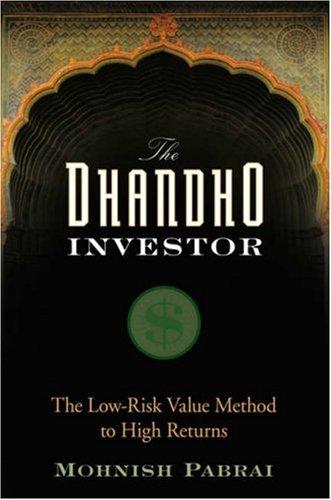
The Dhandho Investor is Mohnish Pabrai's application of value investing principles through the lens of "dhandho" — a Gujarati word roughly translating to business and wealth creation conducted with minimal risk.
Mohnish Pabrai · 2007 · 3h 45m
Full summary and key takeaways →The 12 questions
- 1.
Pabrai describes himself as a cloner of Buffett and Munger rather than an original thinker. Is that level of intellectual humility unusual in investing? Does it make his advice more or less credible?
- 2.
The Patel motel story is about operating a business, not buying stocks. What specifically transfers from that story to equity investing, and what does not?
- 3.
Pabrai advocates concentration — few, large bets in your highest-conviction ideas. What is the psychological cost of concentration when one of your few large positions declines 50%?
- 4.
The 'heads I win, tails I don't lose much' framework requires estimating both upside and downside. Where does that estimation most commonly go wrong?
- 5.
Pabrai's recommendation to copy great investors rather than develop original ideas is provocative. What would you lose if you simply ran a mechanical copy of Berkshire Hathaway's disclosed positions?
- 6.
The Kelly criterion tells you how much to bet given an edge and a payoff ratio. Have you ever sized a financial decision this formally? Would applying it change your behavior?
- 7.
Pabrai invests in distressed businesses in distressed industries. What is the specific risk in that approach — what goes wrong when the distress turns out to be permanent rather than temporary?
- 8.
The book covers Pabrai's successes in detail. How should you evaluate an investment framework when you can't see the full track record, including the failures?
- 9.
Dhandho principles work in private business. What barriers prevent most people from applying them to their actual small business decisions rather than to stock portfolios?
- 10.
Pabrai describes patience as a structural advantage. What conditions in your own financial and psychological situation would allow you to wait genuinely, rather than forcing decisions?
- 11.
Pabrai paid $650,100 to have lunch with Warren Buffett. What would you ask, and how would you evaluate whether it was worth the price?
- 12.
If you identified a distressed business in a distressed industry today, what three things would you check first to determine whether the distress was temporary or permanent?
How to run the discussion
- Pick six to eight, not all of them. An hour of real discussion covers fewer questions than anyone expects, and racing the list is what makes a book club feel like homework.
- Open with what people noticed, not what they concluded. Asking for a verdict first hardens opinions before anyone has heard each other.
- Let the disagreement run. The questions below that split a room are the ones worth the time; the ones everyone answers the same way can be skipped.
- Ask the quiet person a specific question. A direct, narrow question is far easier to answer than an open invitation to contribute.
Themes worth steering toward
If the conversation stalls, these are the threads that usually restart it.
Common questions
What are good book club questions for The Dhandho Investor?
Here are 12 book club questions for The Dhandho Investor by Mohnish Pabrai, ordered to open easily and end somewhere worth arguing about. The strongest openers ask what each reader noticed rather than what they concluded, and the discussion usually turns on value investing, risk and uncertainty, capital allocation.
How long should a book club discussion of The Dhandho Investor last?
Most groups run 60 to 90 minutes of actual discussion. That is roughly six to eight questions, not all of them, so pick the ones that suit your group rather than working down the list in order.
What are the main themes in The Dhandho Investor?
Value investing, Risk and uncertainty, Capital allocation, Business analysis, Investment concentration. Those are the threads most likely to divide a room, which makes them the useful places to steer a discussion that has gone quiet.
Picking the next one? See books like The Dhandho Investor or questions for other book club picks.
