Science · Book club
The Diamond Age book club questions
Here are 12 book club questions for The Diamond Age by Neal Stephenson, ordered to open easily and end somewhere worth arguing about. Copy them, print them, or bring them up one at a time.
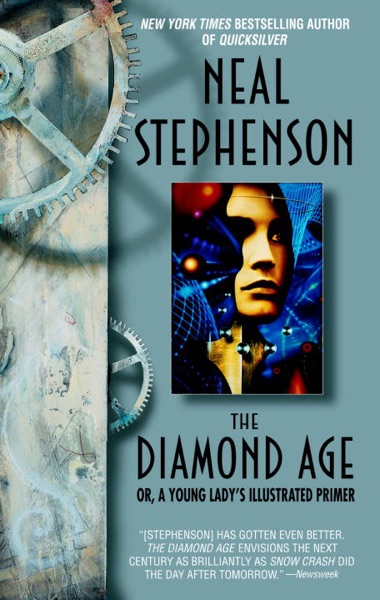
The Diamond Age, or A Young Lady's Illustrated Primer is a 1995 science fiction novel set in a near-future world where nanotechnology has solved most material scarcity but failed to eliminate inequality.
Neal Stephenson · 1995 · 12h 0m
Full summary and key takeaways →The 12 questions
- 1.
The Primer works because it adapts completely to Nell's individual situation. What would a real educational technology have to do to come close to that? What's currently stopping it?
- 2.
Stephenson suggests that the human element — Miranda's nightly labor — is what makes the Primer transformative. Do you agree, or does that sentimentalize something that might eventually be automated?
- 3.
The phyles are voluntary cultural associations rather than inherited identities. Is that a more appealing model of community than what we have now, or does it create new problems?
- 4.
Nell's Primer gives her advantages that no one else in her community has. Is that a story about the democratizing potential of technology or about how technology deepens inequality?
- 5.
The novel ends ambiguously. The Mouse Army and the young ractors seem to be building something new. What does Stephenson seem to think that is, and do you find his optimism earned?
- 6.
Dr. Hackworth creates the Primer illegally for Lord Finkle-McGraw's granddaughter. What does the novel say about whether such an advantage should be freely distributed?
- 7.
The neo-Victorians choose elaborate social constraints — manners, hierarchy, restraint — in a world of near-unlimited material possibility. Why does Stephenson seem to think those constraints are necessary?
- 8.
How does the Feed versus Source distinction in the novel map onto real questions about centralized versus decentralized infrastructure in our world?
- 9.
The government's mass Primer project fails to produce the same results as Nell's individual Primer. What lessons does Stephenson seem to be drawing about the limits of scaling education?
- 10.
Hackworth spends years among the Drummers, largely absent from the plot. What does Stephenson seem to be doing with that part of the story?
- 11.
The Diamond Age was published in 1995. Which of its predictions about technology and society look most accurate from where you stand today?
- 12.
Miranda never knows who Nell is until the end. How does that constraint — genuine caring relationship without conventional intimacy — function in the novel?
How to run the discussion
- Pick six to eight, not all of them. An hour of real discussion covers fewer questions than anyone expects, and racing the list is what makes a book club feel like homework.
- Open with what people noticed, not what they concluded. Asking for a verdict first hardens opinions before anyone has heard each other.
- Let the disagreement run. The questions below that split a room are the ones worth the time; the ones everyone answers the same way can be skipped.
- Ask the quiet person a specific question. A direct, narrow question is far easier to answer than an open invitation to contribute.
Themes worth steering toward
If the conversation stalls, these are the threads that usually restart it.
Common questions
What are good book club questions for The Diamond Age?
Here are 12 book club questions for The Diamond Age by Neal Stephenson, ordered to open easily and end somewhere worth arguing about. The strongest openers ask what each reader noticed rather than what they concluded, and the discussion usually turns on education, technology and society, class.
How long should a book club discussion of The Diamond Age last?
Most groups run 60 to 90 minutes of actual discussion. That is roughly six to eight questions, not all of them, so pick the ones that suit your group rather than working down the list in order.
What are the main themes in The Diamond Age?
Education, Technology and society, Class, Nanotechnology, Culture and identity. Those are the threads most likely to divide a room, which makes them the useful places to steer a discussion that has gone quiet.
Picking the next one? See books like The Diamond Age or questions for other book club picks.
