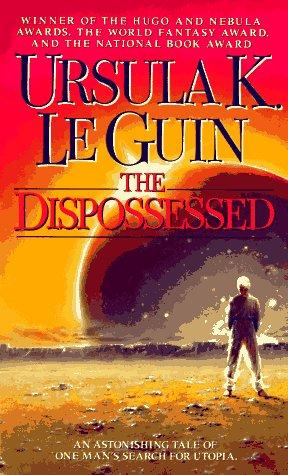
Talk to The Dispossessed like its author wrote you back.
Get the ideas that fit your life — not generic summaries.
- Chat with the book
- Audiobook-style main ideas
- Adapts to your life and goals
- Helps you take action
The Dispossessed, in detail
The Dispossessed follows Shevek, a physicist from the anarchist moon Anarres, who travels to the wealthy capitalist planet Urras — the world his society broke away from 170 years earlier. The novel alternates between timelines: Shevek's childhood and young adulthood on Anarres, where he fights for the intellectual freedom to pursue his physics against the subtle coercions of a society officially committed to freedom; and his voyage and stay on Urras, where he confronts a world of beauty, inequality, and political violence he was raised to regard as the enemy.
Le Guin's subtitle is "An Ambiguous Utopia," and she means both words. Anarres is a genuine attempt at anarchist society — no government, no property, mutual aid organized through voluntary syndicates — but the novel documents how any society, however idealistic its origins, develops informal mechanisms of conformity and control. Shevek's struggle is not against an oppressor but against the accumulated weight of social expectation on a world that officially has no authority to enforce it.
The alternating structure — past on Anarres, present on Urras — is elegant and thematically load-bearing. We see both worlds through Shevek's eyes, but the comparison is never simple. Urras has beauty, abundance, and intellectual richness Anarres lacks; it also has crushing poverty and inequality that make its glittering surface a lie. Neither world is right and neither is simply wrong. Le Guin wrote political fiction that refuses to become propaganda.
This is the most intellectually demanding of Le Guin's novels and also, many readers feel, the most satisfying. It works as pure science fiction, as political philosophy, and as a character study of someone trying to hold two worlds in his head simultaneously without resolving the tension cheaply. Readers who like their fiction to give them answers will be frustrated. Readers who want a novel that takes its questions seriously will find few better.
The big ideas
- 1.
Anarres shows that informal social pressure can be as coercive as law — a society without authority can still enforce conformity through shame, ostracism, and the assignment of undesirable work.
- 2.
Shevek's physics — a unified theory of time that reconciles sequence and simultaneity — is a structural metaphor for the novel's own form, which holds two timelines in tension without collapsing them.
- 3.
The wall on the first page — the wall around the spaceport, separating Anarres from all it rejected — is both literal and the novel's governing image: every choice to be free is also a choice to exclude.
