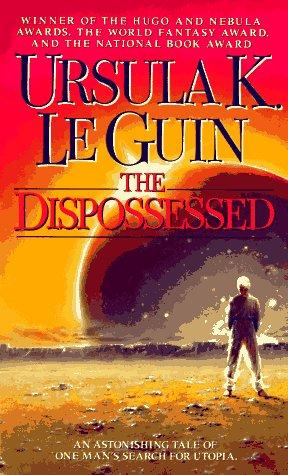
The Dispossessed by Ursula K. Le Guin is a 1974 science fiction book about anarchism and freedom, property and possession, scientific discovery. Anarres shows that informal social pressure can be as coercive as law — a society without authority can still enforce conformity through shame, ostracism, and the assignment of undesirable work.
Summary
The Dispossessed follows Shevek, a physicist from the anarchist moon Anarres, who travels to the wealthy capitalist planet Urras — the world his society broke away from 170 years earlier. The novel alternates between timelines: Shevek's childhood and young adulthood on Anarres, where he fights for the intellectual freedom to pursue his physics against the subtle coercions of a society officially committed to freedom; and his voyage and stay on Urras, where he confronts a world of beauty, inequality, and political violence he was raised to regard as the enemy.
Le Guin's subtitle is "An Ambiguous Utopia," and she means both words. Anarres is a genuine attempt at anarchist society — no government, no property, mutual aid organized through voluntary syndicates — but the novel documents how any society, however idealistic its origins, develops informal mechanisms of conformity and control. Shevek's struggle is not against an oppressor but against the accumulated weight of social expectation on a world that officially has no authority to enforce it.
The alternating structure — past on Anarres, present on Urras — is elegant and thematically load-bearing. We see both worlds through Shevek's eyes, but the comparison is never simple. Urras has beauty, abundance, and intellectual richness Anarres lacks; it also has crushing poverty and inequality that make its glittering surface a lie. Neither world is right and neither is simply wrong. Le Guin wrote political fiction that refuses to become propaganda.
This is the most intellectually demanding of Le Guin's novels and also, many readers feel, the most satisfying. It works as pure science fiction, as political philosophy, and as a character study of someone trying to hold two worlds in his head simultaneously without resolving the tension cheaply. Readers who like their fiction to give them answers will be frustrated. Readers who want a novel that takes its questions seriously will find few better.
Talk to The Dispossessed like its author wrote you back.
Get the ideas that fit your life — not generic summaries.
- Chat with the book
- Audiobook-style main ideas
- Adapts to your life and goals
- Helps you take action
Key takeaways
- 1.
Anarres shows that informal social pressure can be as coercive as law — a society without authority can still enforce conformity through shame, ostracism, and the assignment of undesirable work.
- 2.
Shevek's physics — a unified theory of time that reconciles sequence and simultaneity — is a structural metaphor for the novel's own form, which holds two timelines in tension without collapsing them.
- 3.
The wall on the first page — the wall around the spaceport, separating Anarres from all it rejected — is both literal and the novel's governing image: every choice to be free is also a choice to exclude.
- 4.
Property, Le Guin argues through Urras, is the mechanism by which a society exports its contradictions onto those who have none — the starving Urrasti underclass enables the glittering surface Shevek encounters.
- 5.
The Odonians who founded Anarres were not wrong to try; Le Guin is not a cynic. The novel insists the experiment is worth the difficulty, even while honestly documenting the difficulty.
- 6.
Shevek's relationship with Takver is the emotional center of the book — a partnership built on genuine equality between people in a society that makes equality structurally possible but not automatic.
- 7.
Scientific discovery in the novel is framed as inseparable from political freedom — the conditions that allow Shevek to think are as important as his intellectual gifts.
- 8.
The novel ends with an arrival, not a resolution. Le Guin refuses to tell us whether Shevek's choice changes anything — which is exactly consistent with her politics.
Discussion questions
Use these on your own, with a book club, or as chat starters in Superbook. Book club version, ready to copy or print →
- 1.
Anarres has no government and no property, but it still has social coercion. Does that undermine the anarchist argument, or is it just an honest account of what any society requires?
- 2.
Shevek leaves Anarres partly because he feels intellectually stifled. Is his frustration legitimate, or is he being selfish in a way the novel doesn't quite acknowledge?
- 3.
Urras is clearly meant to represent capitalist Earth in some respects. Which aspects of Urrasti society felt most contemporary when you read it?
- 4.
The alternating timeline structure means we always know Shevek leaves Anarres before we fully understand why. Does that dramatic irony work, or does it deflate tension?
- 5.
Takver and Shevek have an equal partnership, but Shevek is clearly the protagonist and Takver's interiority is given less space. Is that a tension in the novel's own politics?
- 6.
Le Guin said this was an 'ambiguous utopia.' Which aspects of Anarres did you find genuinely appealing, and which felt claustrophobic?
- 7.
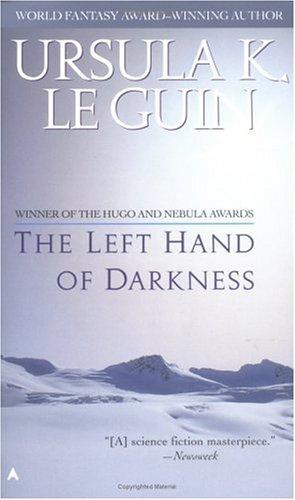
Compared to The Left Hand of Darkness, this novel is more explicitly ideological. Does that make it better or worse as a novel?
- 8.
Shevek's unified theory of time is never fully explained — we get the shape of the idea, not the equations. Did that frustrate you, or was the philosophical sketch enough?
- 9.
The Urrasti revolution Shevek witnesses is violently suppressed. Does that outcome feel like realism or like Le Guin hedging her bets?
- 10.
The wall is the novel's first and recurring image. By the end, do you think the wall is presented as necessary, tragic, or both?
- 11.
If you had to choose where to live — Anarres or Urras as Le Guin depicts them — which would you choose and why?
- 12.
The novel was published in 1974, during the Cold War. How much has that historical context dated it, and how much is still urgent?
Themes
Frequently asked questions
-
Is The Dispossessed worth reading if I'm not interested in politics?
The political philosophy is embedded rather than lecturing — you're reading a character study and a travel narrative that happen to illuminate anarchism vs. capitalism from the inside. Many readers who are skeptical of 'political fiction' find it gripping because Le Guin refuses to make either side simply right.
-
Is The Dispossessed hard to read?
The alternating timeline can be disorienting at first, and the physics subplot requires accepting that Le Guin's science is speculative. The prose is accessible. The difficulty is intellectual rather than stylistic — the novel asks you to hold contradictions rather than resolve them.
-
What is the book's political argument?
Le Guin is sympathetic to anarchism but honest about its costs and limits. The novel's argument is roughly: both systems fail their people in different ways; the anarchist experiment is worth pursuing despite its imperfections; ownership corrupts; conformity is the universal disease of social life.
-
Does The Dispossessed need to be read with The Left Hand of Darkness?
No — they are set in the same universe but are completely independent. Either works as a standalone. Many readers who love one find the other equally rewarding for different reasons.
-
Who shouldn't read this book?
Readers wanting fast-paced action or clear moral resolution will be frustrated. The pacing is deliberate and the novel ends with a door opening rather than a conclusion. That ambiguity is the point, but not everyone wants that from fiction.