Science · Book club
The Distracted Mind book club questions
Here are 11 book club questions for The Distracted Mind by Adam Gazzaley and Larry D. Rosen, ordered to open easily and end somewhere worth arguing about. Copy them, print them, or bring them up one at a time.
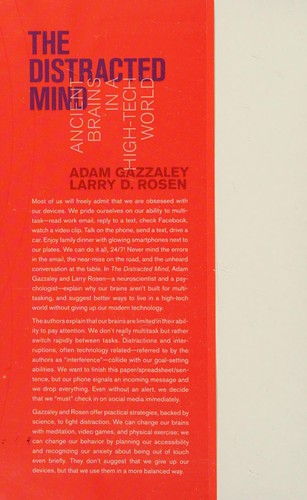
The Distracted Mind brings together two distinct research traditions — cognitive neuroscience and psychology of technology — to explain why modern humans find sustained attention so difficult and what can be done about it.
Adam Gazzaley and Larry D. Rosen · 2016 · 4h 40m
Full summary and key takeaways →The 11 questions
- 1.
Gazzaley argues that our cognitive control systems are mismatched with modern knowledge work demands. Do you experience this mismatch? In what specific situations is it most acute?
- 2.
The book distinguishes selective, sustained, and divided attention. Which of these is your weakest capacity? What do you observe about yourself when it fails?
- 3.
Notifications leave a residue of interference even after they're cleared. What would it feel like to remove all notifications from your phone for two weeks?
- 4.
Rosen's research documents habitual phone-checking at short intervals. How often do you estimate you check your phone? Have you ever actually measured it?
- 5.
The top-down attention training most supported by the research is mindfulness practice. Have you ever had a consistent mindfulness practice? What effect did it have on your focus?
- 6.
Open-plan offices are designed partly for collaboration but produce documented attention fragmentation. What does your physical work environment do to your ability to focus?
- 7.
Technology breaks — scheduled checking windows — are the book's main recommendation for managing smartphone pull. What would that look like in your specific work situation?
- 8.
Gazzaley's research on aging and cognitive control suggests that attention systems deteriorate over time but are also more plastic than previously thought. What does that suggest about investing in attention training now?
- 9.
The book notes that the same brain systems that maintain goals also process interruptions. What does that suggest about the design of productive work environments?
- 10.
What has changed most about your own capacity for sustained attention in the last five years? What do you attribute that to?
- 11.
If you applied the science in this book rigorously — the environmental controls, the scheduled checking, the mindfulness practice — what would the biggest barrier to implementation be?
How to run the discussion
- Pick six to eight, not all of them. An hour of real discussion covers fewer questions than anyone expects, and racing the list is what makes a book club feel like homework.
- Open with what people noticed, not what they concluded. Asking for a verdict first hardens opinions before anyone has heard each other.
- Let the disagreement run. The questions below that split a room are the ones worth the time; the ones everyone answers the same way can be skipped.
- Ask the quiet person a specific question. A direct, narrow question is far easier to answer than an open invitation to contribute.
Themes worth steering toward
If the conversation stalls, these are the threads that usually restart it.
Common questions
What are good book club questions for The Distracted Mind?
Here are 11 book club questions for The Distracted Mind by Adam Gazzaley and Larry D. Rosen, ordered to open easily and end somewhere worth arguing about. The strongest openers ask what each reader noticed rather than what they concluded, and the discussion usually turns on attention, distraction, neuroscience.
How long should a book club discussion of The Distracted Mind last?
Most groups run 60 to 90 minutes of actual discussion. That is roughly six to eight questions, not all of them, so pick the ones that suit your group rather than working down the list in order.
What are the main themes in The Distracted Mind?
Attention, Distraction, Neuroscience, Technology, Focus. Those are the threads most likely to divide a room, which makes them the useful places to steer a discussion that has gone quiet.
Picking the next one? See books like The Distracted Mind or questions for other book club picks.
