Business · Book club
The E-Myth Revisited book club questions
Here are 12 book club questions for The E-Myth Revisited by Michael E. Gerber, ordered to open easily and end somewhere worth arguing about. Copy them, print them, or bring them up one at a time.
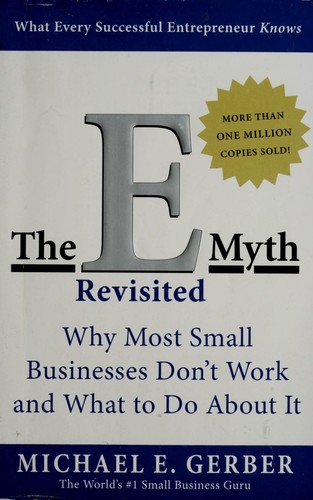
The E-Myth Revisited is Michael Gerber's diagnosis of why most small businesses fail — not because their owners lack technical skill, but because they confuse being good at a craft with knowing how to run a business.
Michael E. Gerber · 1995 · 4h 20m
Full summary and key takeaways →The 12 questions
- 1.
Gerber argues most business owners are Technicians at heart. Which of the three personalities dominates how you currently spend your time?
- 2.
What specific processes in your business (or a business you know) are locked in someone's head rather than documented anywhere?
- 3.
Think of a business that consistently delivers a predictable experience. What systems are behind that consistency you normally don't see?
- 4.
Gerber says the fatal assumption is that technical skill in the work qualifies you to run the business. Where have you seen this play out badly?
- 5.
What would you have to change about how you work today if your goal was that the business ran equally well without you?
- 6.
The book draws a sharp line between working in your business and working on it. In a typical week, which one takes up more of your time?
- 7.
If you were to build a franchise prototype of your current role or business, which five processes would be the hardest to document and why?
- 8.
Gerber says the adolescent phase of a business is when owners hit a wall because they can no longer do everything themselves. What signs warn you that phase is approaching?
- 9.
How does the franchising mindset apply to a service business or professional practice where the work is highly personalized?
- 10.
What's one system in your life outside of work — a morning routine, a meal plan, a filing system — that already runs without much conscious effort? What made it stick?
- 11.
Gerber frames the ideal business as one that delivers a consistent customer experience regardless of who is executing. What are the tradeoffs of that model?
- 12.
Is there a business you interact with regularly that clearly hasn't built Gerber's systems? What is the customer experience like as a result?
How to run the discussion
- Pick six to eight, not all of them. An hour of real discussion covers fewer questions than anyone expects, and racing the list is what makes a book club feel like homework.
- Open with what people noticed, not what they concluded. Asking for a verdict first hardens opinions before anyone has heard each other.
- Let the disagreement run. The questions below that split a room are the ones worth the time; the ones everyone answers the same way can be skipped.
- Ask the quiet person a specific question. A direct, narrow question is far easier to answer than an open invitation to contribute.
Themes worth steering toward
If the conversation stalls, these are the threads that usually restart it.
Common questions
What are good book club questions for The E-Myth Revisited?
Here are 12 book club questions for The E-Myth Revisited by Michael E. Gerber, ordered to open easily and end somewhere worth arguing about. The strongest openers ask what each reader noticed rather than what they concluded, and the discussion usually turns on entrepreneurship, systems thinking, small business.
How long should a book club discussion of The E-Myth Revisited last?
Most groups run 60 to 90 minutes of actual discussion. That is roughly six to eight questions, not all of them, so pick the ones that suit your group rather than working down the list in order.
What are the main themes in The E-Myth Revisited?
Entrepreneurship, Systems thinking, Small business, Operations, Franchising. Those are the threads most likely to divide a room, which makes them the useful places to steer a discussion that has gone quiet.
Picking the next one? See books like The E-Myth Revisited or questions for other book club picks.
