Science · Book club
The Emperor of All Maladies: A Biography of Cancer book club questions
Here are 12 book club questions for The Emperor of All Maladies: A Biography of Cancer by Siddhartha Mukherjee, ordered to open easily and end somewhere worth arguing about. Copy them, print them, or bring them up one at a time.
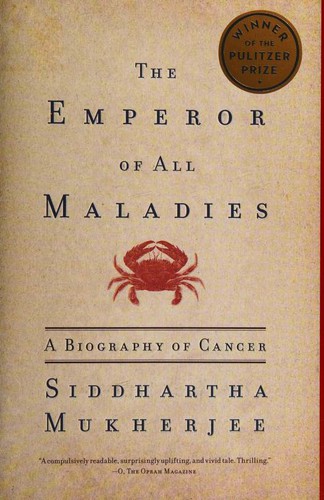
The Emperor of All Maladies is Siddhartha Mukherjee's account of cancer from antiquity to the present — its biology, its treatments, its false dawns, and the scientists and patients caught in the middle of each.
Siddhartha Mukherjee · 2010 · 11h 45m
Full summary and key takeaways →The 12 questions
- 1.
Mukherjee describes radical mastectomy as a treatment that caused enormous harm before its theoretical basis was disproven. How should medicine handle widespread practices that lack solid evidence?
- 2.
The war on cancer was a political declaration before it was a scientific strategy. When does government funding accelerate research, and when does it distort it?
- 3.
Cancer turned out to be not one disease but hundreds. How does this reframing change what it means to say we are 'winning' or 'losing' against cancer?
- 4.
Mukherjee's patients are present throughout the book. How did their presence change your reading of the scientific history?
- 5.
The discovery of Gleevec as a targeted therapy felt like proof of a new paradigm. Why hasn't that paradigm produced equally dramatic results for most other cancers?
- 6.
Prevention — the Pap smear, antismoking campaigns — seems more impactful than treatment in many cases. Why does medicine, and the public, tend to focus more on cures than on prevention?
- 7.
Mukherjee is an oncologist writing about a disease he treats daily. How does that position shape what he chooses to emphasize, and what he might leave out?
- 8.
Several scientists in the book were wrong for decades but still advanced the field in important ways. What does that suggest about how scientific progress actually works?
- 9.
The book ends without a resolution. Cancer has not been conquered. How do you sit with an account of a struggle that has no clear endpoint?
- 10.
Which figure in the history Mukherjee tells do you find most compelling — and which do you find hardest to sympathize with?
- 11.
Mukherjee writes about the emotional experience of giving a patient a terminal diagnosis. How should doctors communicate uncertainty when patients want certainty?
- 12.
If you or someone close to you has experienced cancer, did reading this book change how you understood that experience?
How to run the discussion
- Pick six to eight, not all of them. An hour of real discussion covers fewer questions than anyone expects, and racing the list is what makes a book club feel like homework.
- Open with what people noticed, not what they concluded. Asking for a verdict first hardens opinions before anyone has heard each other.
- Let the disagreement run. The questions below that split a room are the ones worth the time; the ones everyone answers the same way can be skipped.
- Ask the quiet person a specific question. A direct, narrow question is far easier to answer than an open invitation to contribute.
Themes worth steering toward
If the conversation stalls, these are the threads that usually restart it.
Common questions
What are good book club questions for The Emperor of All Maladies: A Biography of Cancer?
Here are 12 book club questions for The Emperor of All Maladies: A Biography of Cancer by Siddhartha Mukherjee, ordered to open easily and end somewhere worth arguing about. The strongest openers ask what each reader noticed rather than what they concluded, and the discussion usually turns on cancer, medical history, science.
How long should a book club discussion of The Emperor of All Maladies: A Biography of Cancer last?
Most groups run 60 to 90 minutes of actual discussion. That is roughly six to eight questions, not all of them, so pick the ones that suit your group rather than working down the list in order.
What are the main themes in The Emperor of All Maladies: A Biography of Cancer?
Cancer, Medical history, Science, Human resilience, Research. Those are the threads most likely to divide a room, which makes them the useful places to steer a discussion that has gone quiet.
Picking the next one? See books like The Emperor of All Maladies: A Biography of Cancer or questions for other book club picks.
