History · Book club
The End of History and the Last Man book club questions
Here are 12 book club questions for The End of History and the Last Man by Francis Fukuyama, ordered to open easily and end somewhere worth arguing about. Copy them, print them, or bring them up one at a time.
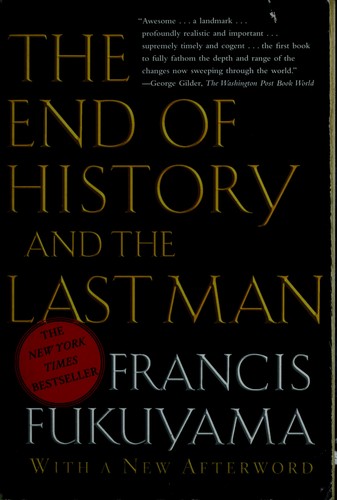
Francis Fukuyama's The End of History and the Last Man was published in 1992, following the collapse of the Soviet Union and the apparent triumph of liberal democracy as the world's dominant political model.
Francis Fukuyama · 1992 · 10h 0m
Full summary and key takeaways →The 12 questions
- 1.
Fukuyama claims no serious ideological alternative to liberal democracy remains. Does authoritarian capitalism — particularly the Chinese model — qualify as such an alternative? Why or why not?
- 2.
His argument rests on the Hegelian idea that history is driven by the struggle for recognition. Do you find that a more or less persuasive account of political motivation than economic interest?
- 3.
How should we read the book in light of the events of the past twenty years: the 2008 financial crisis, the rise of populist nationalism, Brexit, and the increasing authoritarianism of previously democratizing states?
- 4.
The 'last man' problem is Fukuyama's most uncomfortable idea. Do you see evidence in your own society that successful liberal democracy produces a kind of spiritless complacency he worried about?
- 5.
Fukuyama was widely mocked after 9/11 for claiming that ideological conflict was over. Is that criticism fair, or was it based on a misreading of his actual argument?
- 6.
He distinguishes between the end of ideological history and the continuation of conventional history. Is that distinction coherent? Can you separate the two cleanly?
- 7.
Which parts of the Hegelian framework — the struggle for recognition, thymos, the progressive unfolding of freedom — do you find most and least useful as political analysis tools?
- 8.
Fukuyama's 2022 book argues that the liberal international order is more fragile than he thought in 1992. Does that represent a fundamental revision of his thesis or just an adjustment?
- 9.
The book treats liberal democracy partly as a universal aspiration. How does that assumption hold up in societies where liberal democratic values were not generated internally but imported or imposed?
- 10.
What would a genuine ideological alternative to liberal democracy actually look like? What would it have to offer that liberalism cannot?
- 11.
How does Fukuyama's argument interact with Huntington's Clash of Civilizations thesis? Are they fundamentally incompatible, or do they describe different levels of analysis?
- 12.
Which is more prescient about the early twenty-first century — Fukuyama's optimism about liberal democracy's dominance or Huntington's pessimism about civilizational conflict?
How to run the discussion
- Pick six to eight, not all of them. An hour of real discussion covers fewer questions than anyone expects, and racing the list is what makes a book club feel like homework.
- Open with what people noticed, not what they concluded. Asking for a verdict first hardens opinions before anyone has heard each other.
- Let the disagreement run. The questions below that split a room are the ones worth the time; the ones everyone answers the same way can be skipped.
- Ask the quiet person a specific question. A direct, narrow question is far easier to answer than an open invitation to contribute.
Themes worth steering toward
If the conversation stalls, these are the threads that usually restart it.
Common questions
What are good book club questions for The End of History and the Last Man?
Here are 12 book club questions for The End of History and the Last Man by Francis Fukuyama, ordered to open easily and end somewhere worth arguing about. The strongest openers ask what each reader noticed rather than what they concluded, and the discussion usually turns on liberal democracy, political philosophy, geopolitics.
How long should a book club discussion of The End of History and the Last Man last?
Most groups run 60 to 90 minutes of actual discussion. That is roughly six to eight questions, not all of them, so pick the ones that suit your group rather than working down the list in order.
What are the main themes in The End of History and the Last Man?
Liberal democracy, Political philosophy, Geopolitics, Human nature, Ideology. Those are the threads most likely to divide a room, which makes them the useful places to steer a discussion that has gone quiet.
Picking the next one? See books like The End of History and the Last Man or questions for other book club picks.
