Economics · Book club
The End of Wall Street book club questions
Here are 12 book club questions for The End of Wall Street by Roger Lowenstein, ordered to open easily and end somewhere worth arguing about. Copy them, print them, or bring them up one at a time.
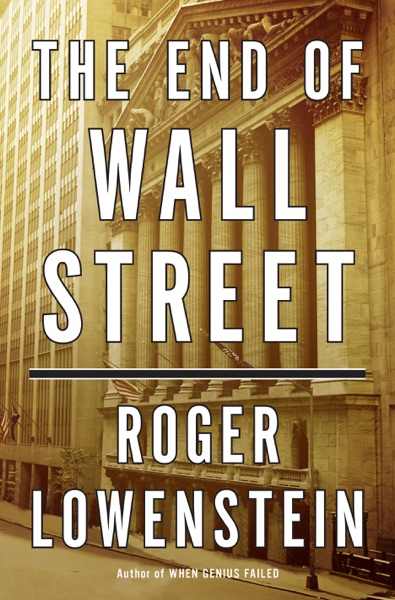
The End of Wall Street is Roger Lowenstein's account of the 2008 financial crisis, from the early signs of trouble in the mortgage market through the collapse of Lehman Brothers, the government interventions, and the immediate aftermath.
Roger Lowenstein · 2010 · 7h 0m
Full summary and key takeaways →The 12 questions
- 1.
Lowenstein argues the crisis was a systems failure, not primarily a story of individual greed. Does that distinction matter for how we think about accountability and reform?
- 2.
Rating agencies gave triple-A ratings to instruments that were, on examination, catastrophically risky. How should we think about the credibility of ratings agencies today?
- 3.
The deregulation philosophy that dominated Washington before 2008 had intellectual roots in serious economic thinking. How do mainstream intellectual frameworks become dangerous in practice?
- 4.
Greenspan testified after the crisis that he had found a 'flaw' in his ideology — that self-interest would not automatically lead banks to manage their own risk prudently. Was that a surprising conclusion, in retrospect?
- 5.
The decision to let Lehman fail and rescue AIG, in the same week, was not publicly justified as a principled distinction. How should regulators explain decisions of this scale in real time?
- 6.
The bailout protected AIG's counterparties at full value. If you had been making the decision, what would you have done differently, and what would the consequences have been?
- 7.
Bank employees who created mortgage-backed securities were paid based on volume rather than long-term performance of the instruments. How do you design incentive structures that do not punish short-term prudence?
- 8.
The crisis was global because the instruments were distributed globally through financial networks. Does that make financial regulation inherently national or does it require international coordination?
- 9.
The reforms adopted in the aftermath — Dodd-Frank, stress tests, higher capital requirements — are often described as insufficient. What would sufficient reform have required, politically?
- 10.
The homeowners who lost their houses and the bank employees whose pension funds collapsed were not the people who designed the risky instruments. How should we think about distributing the consequences of systemic failures?
- 11.
Lowenstein is skeptical of the claim that Lehman could not be saved. What would it have taken, and does it matter now?
- 12.
The 2008 crisis is now fifteen years past. Have the changes made since then addressed the specific failure modes Lowenstein identifies, or have new ones emerged?
How to run the discussion
- Pick six to eight, not all of them. An hour of real discussion covers fewer questions than anyone expects, and racing the list is what makes a book club feel like homework.
- Open with what people noticed, not what they concluded. Asking for a verdict first hardens opinions before anyone has heard each other.
- Let the disagreement run. The questions below that split a room are the ones worth the time; the ones everyone answers the same way can be skipped.
- Ask the quiet person a specific question. A direct, narrow question is far easier to answer than an open invitation to contribute.
Themes worth steering toward
If the conversation stalls, these are the threads that usually restart it.
Common questions
What are good book club questions for The End of Wall Street?
Here are 12 book club questions for The End of Wall Street by Roger Lowenstein, ordered to open easily and end somewhere worth arguing about. The strongest openers ask what each reader noticed rather than what they concluded, and the discussion usually turns on financial crisis, risk, banking.
How long should a book club discussion of The End of Wall Street last?
Most groups run 60 to 90 minutes of actual discussion. That is roughly six to eight questions, not all of them, so pick the ones that suit your group rather than working down the list in order.
What are the main themes in The End of Wall Street?
Financial crisis, Risk, Banking, Regulation, Greed. Those are the threads most likely to divide a room, which makes them the useful places to steer a discussion that has gone quiet.
Picking the next one? See books like The End of Wall Street or questions for other book club picks.
