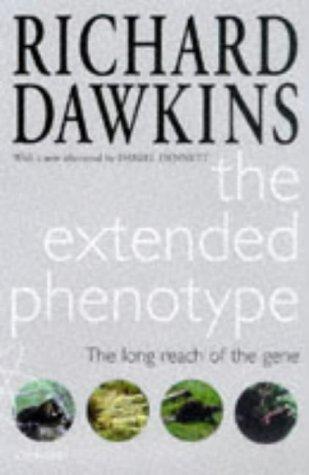
The Extended Phenotype by Richard Dawkins is a 1982 science book about genetics, evolution, gene-centered view. A gene's phenotype — its effects that natural selection can act on — is not limited to the organism that contains it. Genes can influence the world through artifacts, other organisms, and behavioral manipulation.
Summary
The Extended Phenotype is Richard Dawkins's most technical and, by his own account, most important book. Where The Selfish Gene popularized the gene's-eye view of evolution for general audiences, The Extended Phenotype works out the logical implications of that view more carefully and argues for the concept that gives the book its title: the idea that a gene's phenotype — its effects on the world — need not be limited to the body it inhabits. Genes can have effects that reach beyond the organism into the environment, and natural selection acts on those extended effects just as it acts on anatomical features.
The central examples of extended phenotypes are striking. A caddisfly larva builds a case of stones and pebbles around itself; genetic variation among larvae produces measurable variation in the cases. Selection acts on the cases as surely as it acts on the bodies inside them. Beavers build dams; the dam is an expression of the beaver's genes in the world. Parasites manipulate host behavior — a fluke that causes snails to grow thicker shells, a wasp that parasitizes a caterpillar and causes it to stand guard over the wasp's cocoon. In all these cases, a gene influences the world beyond the boundary of its host organism's skin.
Dawkins also argues for the concept of the extended organism: when a parasite manipulates a host's behavior to serve the parasite's reproductive interests, the functional boundary between organism and parasite becomes blurred. The parasite's genes are in effect running the host's body for their own replication. This dissolves the intuitive boundary between where one organism ends and another begins, and suggests that the individual organism is not the natural unit of biological analysis.
The Extended Phenotype is not easy reading. It assumes knowledge of evolutionary biology and engages with technical arguments in population genetics and comparative ethology. But readers willing to follow the argument will find one of the most rigorous defenses of gene-centered evolutionary thinking available.
Talk to The Extended Phenotype like its author wrote you back.
Get the ideas that fit your life — not generic summaries.
- Chat with the book
- Audiobook-style main ideas
- Adapts to your life and goals
- Helps you take action
Key takeaways
- 1.
A gene's phenotype — its effects that natural selection can act on — is not limited to the organism that contains it. Genes can influence the world through artifacts, other organisms, and behavioral manipulation.
- 2.
The extended phenotype concept includes cases like beaver dams, caddisfly cases, and parasite-manipulated host behavior, where genetic variation produces variation in structures or behaviors outside the organism's body.
- 3.
Parasites that manipulate host behavior illustrate how genes from one organism can effectively control the phenotype of another, blurring the functional boundary between organisms.
- 4.
The gene is the appropriate unit of selection not because genes are the physical agents of selection but because they are the units of inheritance — the things that are, or are not, copied into the next generation.
- 5.
Dawkins defends the gene's-eye view against objections from group selection and species selection, arguing that apparent group benefits are better explained as the summed effects of individual gene selection.
- 6.
Organisms are best understood as vehicles for gene replication rather than as the units evolution optimizes; this framing predicts cooperative behavior among relatives (who share genes) and conflict among non-relatives.
- 7.
The extended phenotype framework makes predictions about parasite evolution: parasites should evolve toward manipulating host behavior in ways that increase parasite transmission, regardless of the cost to the host.
- 8.
The book distinguishes the gene's-eye view as a logical perspective — a way of seeing what is happening — rather than as a claim about the physical mechanisms by which selection operates.
Discussion questions
Use these on your own, with a book club, or as chat starters in Superbook. Book club version, ready to copy or print →
- 1.
The extended phenotype concept says a gene's influence can reach beyond the organism. Which example in the book do you find most convincing?
- 2.
Dawkins frames organisms as 'vehicles' for gene replication. Does that metaphor feel right, or does it leave out something essential about what organisms are?
- 3.
Parasite manipulation of host behavior raises the question of where one organism ends and another begins. Does the concept of the individual organism remain useful under the extended phenotype framework?
- 4.
Group selection has been a recurring controversy in evolutionary biology. How persuasive do you find Dawkins's arguments against it?
- 5.
The extended phenotype framework is a perspective — a way of looking — not a mechanism. Can a perspective be scientifically right or wrong without making distinct empirical predictions?
- 6.
If beaver dams are an extended phenotype, what other human artifacts might be considered extended phenotypes of human genes?
- 7.
Dawkins says this is his most important book but The Selfish Gene was more widely read. Why do you think technical rigor and popular impact are so often in tension?
- 8.
The book argues that organisms are not the right level of analysis for evolutionary biology. How does that argument relate to debates about reductionism in science more broadly?
- 9.
Parasite-induced extended phenotypes — manipulating host behavior — resemble what we would call mind control if done by a person. Does applying that framework to biology change how you think about agency and autonomy?
- 10.
Has reading this book changed how you think about any aspect of your own behavior as potentially serving genetic interests rather than your own interests?
- 11.
How does Dawkins handle scientific uncertainty in this book compared to in The Selfish Gene or The Blind Watchmaker?
Themes
Frequently asked questions
-
Is The Extended Phenotype harder to read than The Selfish Gene?
Yes, considerably. The Selfish Gene was written for general readers and avoids technical arguments. The Extended Phenotype assumes familiarity with evolutionary biology, population genetics, and the arguments in The Selfish Gene. General readers can follow the central ideas but will find some chapters demanding.
-
What is the extended phenotype in simple terms?
The idea that a gene's effects on the world — its phenotype — can extend beyond the body of the organism carrying it. A beaver's dam, a caddisfly's stone case, or a parasite's manipulation of host behavior are all products of genes that selection can act on, just as it acts on the organism's anatomy.
-
How does it differ from The Selfish Gene?
The Selfish Gene introduces the gene's-eye view and makes it accessible. The Extended Phenotype works out the logical implications more rigorously and introduces the extended phenotype concept, which The Selfish Gene does not fully develop.
-
Should I read The Selfish Gene first?
Yes. The Extended Phenotype explicitly builds on The Selfish Gene and will be harder to follow without that foundation.
-
What is the most striking example in the book?
For many readers, the parasite manipulation examples — particularly the lancet liver fluke that causes ants to climb to the top of grass blades to be eaten by sheep, or the wasp that causes a caterpillar to protect the wasp's cocoon. These examples make the extended phenotype concept viscerally concrete.