On the Origin of Species by Charles Darwin is a 1859 science book about evolution, natural selection, biodiversity. Natural selection requires only three ingredients: heritable variation among individuals, differential survival and reproduction based on traits, and sufficient time. Given these, complex adaptation is inevitable.
Summary
On the Origin of Species, published in 1859, is the book in which Charles Darwin presented the theory of evolution by natural selection to the general reading public. Darwin had been accumulating evidence for over twenty years, beginning with his voyage on HMS Beagle and his observations of finches, tortoises, and other creatures in the Galápagos Islands. He delayed publication for decades partly out of caution and partly because he understood the theory's implications for natural theology. He published when Alfred Russel Wallace independently arrived at the same idea.
Darwin's core argument runs through careful accumulation of evidence rather than dramatic assertion. He begins with artificial selection — the breeding of pigeons, dogs, and livestock by humans — to establish that selective pressure on heritable variation produces marked change over generations. He then extends the same logic to nature: any organism that produces more offspring than the environment can support will see differential survival among those offspring based on their heritable traits. Over geological time, this process is sufficient to explain the full diversity of life.
The book addresses objections systematically. Darwin knew the fossil record of his day was incomplete and argued this was a function of preservation conditions rather than an absence of transitional forms. He devoted entire chapters to geographical distribution, embryology, and the structure of the eye — the organs that seemed most improbable as products of gradual accumulation — and gave the best arguments he could muster on each. The tone is that of a scientist presenting a case rather than a prophet announcing a revelation.
The Origin of Species is demanding reading: Victorian prose, dense argument, long illustrative catalogues of species. But it repays the effort. Reading Darwin directly, rather than through summaries, reveals how strong the case already was in 1859 and how clearly Darwin understood the objections he was facing. It is one of the most consequential books in the history of thought.
Talk to On the Origin of Species like its author wrote you back.
Get the ideas that fit your life — not generic summaries.
- Chat with the book
- Audiobook-style main ideas
- Adapts to your life and goals
- Helps you take action
Key takeaways
- 1.
Natural selection requires only three ingredients: heritable variation among individuals, differential survival and reproduction based on traits, and sufficient time. Given these, complex adaptation is inevitable.
- 2.
Artificial selection by breeders — producing radically different breeds of pigeon or dog within decades — demonstrated that selection on variation produces change faster than most naturalists had assumed possible.
- 3.
The fossil record supports gradual change over geological time, but its incompleteness was a genuine weakness in 1859 that Darwin acknowledged rather than concealed.
- 4.
Geographical distribution — why similar but distinct species appear on different islands, or why marsupials dominate Australia — makes sense under evolution but is inexplicable under special creation.
- 5.
Embryological similarities across very different species suggest common descent: a bat's wing, a whale's flipper, and a human arm are modifications of the same underlying structure.
- 6.
Complex structures like the eye can evolve incrementally because any improvement in light sensitivity, however small, confers a survival advantage — the question is never whether a partial eye is useful but whether it is useful enough to propagate.
- 7.
The struggle for existence is not necessarily violent or dramatic; it includes competition with drought, cold, and scarcity. Most selection operates through differential reproduction rather than direct combat.
- 8.
Darwin did not know about genetics or the molecular basis of heredity — those mechanisms came later — but the theory of natural selection does not depend on them and predicted them.
Discussion questions
Use these on your own, with a book club, or as chat starters in Superbook. Book club version, ready to copy or print →
- 1.
Darwin spent twenty years accumulating evidence before publishing. Was that caution admirable, or did it delay an important idea that humanity needed sooner?
- 2.
He starts with pigeon breeders rather than fossils. Why do you think he chose that opening, and how effective is it as a rhetorical strategy?
- 3.
What was the strongest objection Darwin acknowledged, and do you think he answered it adequately?
- 4.
The book says almost nothing about human evolution. Darwin avoided it deliberately. What does that tell you about the relationship between scientific argument and social context?
- 5.
How does reading Darwin directly change or confirm your understanding of evolutionary theory compared to how it was taught to you?
- 6.
Darwin's argument depends on deep geological time — millions of years. How does that timescale feel to you intuitively, and why is it so hard to internalize?
- 7.
The theory of natural selection was proposed simultaneously by Darwin and Wallace. What does that near-coincidence suggest about how scientific ideas emerge?
- 8.
Many people in 1859 found the theory disturbing because it displaced humans from a special position in creation. How do you think about human distinctiveness now?
- 9.
Darwin was careful to distinguish what he knew from what he inferred. How does that epistemic carefulness compare to how scientific claims are communicated today?
- 10.
Which piece of evidence in the book do you find most convincing, and which do you find weakest?
- 11.
The book was immediately widely read and widely attacked. What does that reception tell you about how society processes transformative scientific ideas?
- 12.
If Darwin were writing today, what evidence would he add that was unavailable to him in 1859?
Themes
Frequently asked questions
-
Is On the Origin of Species hard to read?
It is demanding by modern standards — long, densely argued Victorian prose with extensive catalogues of examples. It is not technically difficult in the way that a mathematics text is, but it rewards slow reading with annotation. Most readers take it in sections rather than straight through.
-
Do I need to read the original or is a modern summary enough?
Summaries capture the theory but miss Darwin's method: the accumulation of evidence, the acknowledgment of objections, the care with language. Reading the original shows you why the argument was persuasive in 1859 and how science builds a case. It is worth reading at least the first four chapters directly.
-
Did Darwin know about genetics?
No. Gregor Mendel published his pea-plant genetics experiments in 1866, but the work was obscure until its rediscovery around 1900, and the mechanism of heredity at the molecular level was not understood until the twentieth century. Darwin knew inheritance existed but not how it worked — and his theory did not require it.
-
What edition should I read?
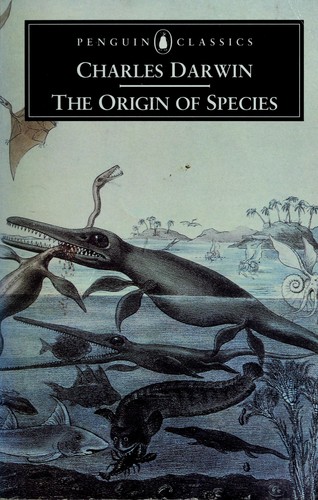
The first edition (1859) is often preferred by scholars because later editions incorporated responses to critics that weakened some arguments. The Penguin Classics edition with an introduction by John Burrow is widely used. Most print editions are of the sixth and final edition from 1872.
-
Is evolution still a theory?
In science, 'theory' means a well-tested explanatory framework supported by extensive evidence — not a guess. Evolution by natural selection is one of the most thoroughly confirmed theories in science, supported by genetics, paleontology, ecology, and molecular biology. The word carries different weight in scientific and everyday usage.