History · Book club
The Fate of Rome: Climate, Disease, and the End of an Empire book club questions
Here are 12 book club questions for The Fate of Rome: Climate, Disease, and the End of an Empire by Kyle Harper, ordered to open easily and end somewhere worth arguing about. Copy them, print them, or bring them up one at a time.
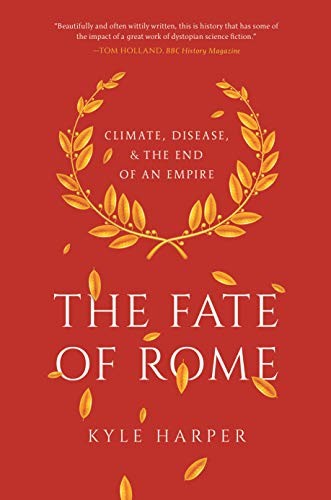
The Fate of Rome makes a revisionist argument about one of history's most debated questions.
Kyle Harper · 2017 · 8h 45m
Full summary and key takeaways →The 12 questions
- 1.
Harper argues that climate and disease have been underweighted in accounts of Rome's fall because they left fewer legible documentary traces. Does absence of evidence imply absence of importance, or does this suggest a broader problem with how history is written?
- 2.
The Roman Climate Optimum supported expansion; climatic deterioration helped end the empire. Does that deterministic logic leave room for agency — could different decisions have changed the outcome?
- 3.
Ancient DNA and paleoclimatology are new tools applied to old questions. What other historical questions do you think might be rewritten by scientific advances in the next generation?
- 4.
Harper suggests Rome's connected trade networks became vectors for pandemic spread. What does that observation suggest about the relationship between globalization and vulnerability today?
- 5.
The Antonine Plague coincided with the reign of Marcus Aurelius, whom historians often praise as Rome's best emperor. How does Harper's environmental lens change or complicate the traditional great-man narrative?
- 6.
The book implicitly compares Rome's fate to contemporary climate and pandemic risks. Is that comparison illuminating, or does it impose present concerns on a genuinely different historical situation?
- 7.
Harper emphasizes that Romans had no conceptual framework to understand climate change or germ theory. How much does that ignorance explain their response, and how much does it excuse it?
- 8.
Gibbon blamed Christianity and political failure; Harper blames climate and disease. These are not mutually exclusive. How would you integrate all these factors into a single account?
- 9.
How does the fate of Rome's western and eastern halves look different through Harper's environmental lens versus Gibbon's political lens?
- 10.
The book is written for both academic and general audiences. Does that dual audience create tensions in how the argument is presented?
- 11.
What does 'resilience' mean for a complex civilization, based on what you learn from Rome's experience? What made Rome more or less able to absorb shocks?
- 12.
If you were advising a Roman emperor in 200 CE with knowledge of what was coming, what could realistically be done to prepare?
How to run the discussion
- Pick six to eight, not all of them. An hour of real discussion covers fewer questions than anyone expects, and racing the list is what makes a book club feel like homework.
- Open with what people noticed, not what they concluded. Asking for a verdict first hardens opinions before anyone has heard each other.
- Let the disagreement run. The questions below that split a room are the ones worth the time; the ones everyone answers the same way can be skipped.
- Ask the quiet person a specific question. A direct, narrow question is far easier to answer than an open invitation to contribute.
Themes worth steering toward
If the conversation stalls, these are the threads that usually restart it.
Common questions
What are good book club questions for The Fate of Rome: Climate, Disease, and the End of an Empire?
Here are 12 book club questions for The Fate of Rome: Climate, Disease, and the End of an Empire by Kyle Harper, ordered to open easily and end somewhere worth arguing about. The strongest openers ask what each reader noticed rather than what they concluded, and the discussion usually turns on climate and civilization, pandemic disease, roman decline.
How long should a book club discussion of The Fate of Rome: Climate, Disease, and the End of an Empire last?
Most groups run 60 to 90 minutes of actual discussion. That is roughly six to eight questions, not all of them, so pick the ones that suit your group rather than working down the list in order.
What are the main themes in The Fate of Rome: Climate, Disease, and the End of an Empire?
Climate and civilization, Pandemic disease, Roman decline, Environmental history, Imperial collapse. Those are the threads most likely to divide a room, which makes them the useful places to steer a discussion that has gone quiet.
Picking the next one? See books like The Fate of Rome: Climate, Disease, and the End of an Empire or questions for other book club picks.
