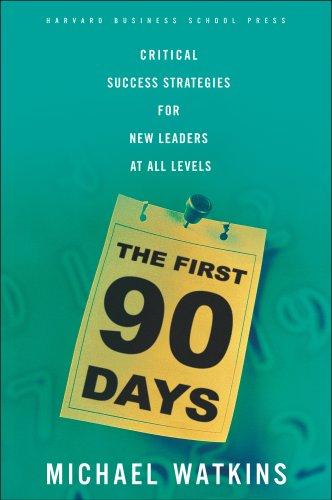
The First 90 Days by Michael D. Watkins is a 2003 business book about leadership transitions, career growth, organizational dynamics. Leadership transitions have predictable failure modes: moving too fast, importing strategies from previous roles, building relationships too narrowly, and misreading the type of situation you've inherited.
Summary
The First 90 Days is Michael Watkins's guide to leadership transitions — the critical period when a new leader either establishes the credibility, relationships, and early wins that set them up for long-term success, or falls into traps that undermine them for months or years. The book is based on research into why some leaders succeed and others fail in new roles, and is organized as a set of principles and practices for navigating the transition strategically rather than reactively.
Watkins argues that the vulnerabilities that sink new leaders are predictable. They come in too fast, making decisions before understanding the situation. They bring strategies that worked in previous roles without testing whether those strategies fit the new context. They build relationships narrowly, focusing on their direct team while neglecting lateral relationships. They fail to diagnose the type of situation they've inherited — whether it's a startup, a turnaround, an accelerated growth context, or a sustaining success — and apply the same approach regardless.
The book's most useful framework is the STARS model, which identifies five types of business situations: Startup (building from scratch), Turnaround (rescue), Accelerated growth (managing rapid expansion), Realignment (changing direction before crisis), and Sustaining success (maintaining high performance). Each requires a fundamentally different leadership approach, and the failure to diagnose which situation you're in is one of the most common transition errors.
The second half addresses the organizational politics of transition: how to understand who has influence, how to negotiate with your new boss about what success looks like, how to identify the organizational landmines left by your predecessor, and how to build a team that will actually execute rather than resist. The book is as much about organizational intelligence as it is about personal effectiveness.
Talk to The First 90 Days like its author wrote you back.
Get the ideas that fit your life — not generic summaries.
- Chat with the book
- Audiobook-style main ideas
- Adapts to your life and goals
- Helps you take action
Key takeaways
- 1.
Leadership transitions have predictable failure modes: moving too fast, importing strategies from previous roles, building relationships too narrowly, and misreading the type of situation you've inherited.
- 2.
The STARS framework identifies five transition contexts — Startup, Turnaround, Accelerated growth, Realignment, and Sustaining success — each requiring fundamentally different leadership approaches.
- 3.
Early wins are not just nice — they're strategically necessary. They establish credibility, build momentum, and demonstrate that you can deliver value in the new context.
- 4.
The first priority in a new role is learning: understanding the business, the culture, the key relationships, and the informal power structure before making significant changes.
- 5.
Negotiate your mandate. Many leaders fail because they don't explicitly agree with their boss on what success looks like in the first ninety days, the first year, and beyond.
- 6.
Building lateral relationships matters as much as building downward ones. New leaders who focus exclusively on their team while neglecting peers and senior stakeholders are setting up future obstacles.
- 7.
Identify the organizational landmines: unresolved conflicts, failed initiatives, inherited commitments, and toxic team members left by your predecessor. Most new leaders discover these through painful experience.
- 8.
The leader's transition is only complete when the team has adapted to the new leader's style and the organization has begun to deliver on the new leader's agenda. This often takes longer than leaders expect.
Discussion questions
Use these on your own, with a book club, or as chat starters in Superbook. Book club version, ready to copy or print →
- 1.
Think about the last major leadership transition you made. Which of Watkins's failure modes did you most fall into? What would you do differently?
- 2.
What's the STARS situation of your current role — Startup, Turnaround, Accelerated growth, Realignment, or Sustaining success? Are you leading it accordingly?
- 3.
Did you explicitly negotiate your mandate when you started your current role — what success would look like in ninety days, a year, and beyond? If not, what gap did that create?
- 4.
What do you wish you had learned faster in your last transition? What prevented you from learning it sooner?
- 5.
Who were the key lateral relationships you needed to build in your last transition, and how long did it take you to recognize that?
- 6.
What was the biggest 'landmine' left by your predecessor that you discovered through experience rather than investigation? How could you have found it sooner?
- 7.
What early win did you identify and pursue in your last transition? Did it accomplish what you hoped?
- 8.
Watkins says leaders often fail because they import strategies that worked in previous roles. Where do you see this happening in your organization?
- 9.
How long does it actually take to feel effective in a new senior leadership role? What's the gap between when you're expected to be effective and when you actually are?
- 10.
What do you wish your organization did differently to support leadership transitions? What would make new leaders more effective faster?
- 11.
The book is specifically about transitions. Does the framework also apply to long-tenured leaders who need to adapt to changing organizational contexts without a formal transition?
Themes
Frequently asked questions
-
Is The First 90 Days worth reading?
Yes, particularly for anyone about to start a new senior role or transition into a leadership position. It's one of the most practically useful books for navigating the specific vulnerabilities of transitions, and the STARS framework is a genuinely helpful diagnostic tool.
-
How long does it take to read The First 90 Days?
Around five hours for the 272-page book. It's structured clearly and can also be read in sections relevant to your current situation.
-
Can The First 90 Days be applied to internal promotions, not just external hires?
Yes, and Watkins specifically addresses internal transitions, which have their own failure modes — particularly the tendency to assume you already understand the culture and relationships, when in fact the elevation to a new level changes the dynamics significantly.
-
Who should read The First 90 Days?
Anyone starting a new leadership role at any level, HR professionals designing onboarding programs, and managers who want to understand why some of their new hires struggle despite strong credentials.
-
What's the single most important thing to do in the first ninety days?
Watkins would say: learn first, then act. Most leaders feel pressure to demonstrate decisiveness and capability by making changes quickly. The leaders who succeed over the long term are those who invest the first month in genuine listening and understanding — and then make targeted, well-informed early moves that build credibility without triggering unnecessary resistance.