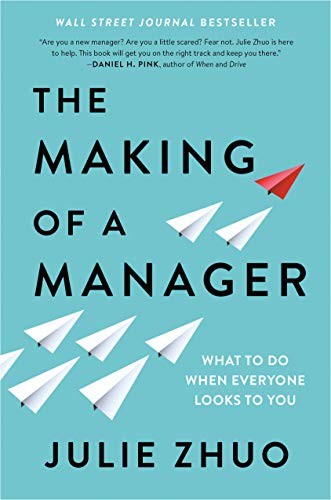
The Making of a Manager by Julie Zhuo is a 2019 business book about management, leadership, feedback. The manager's job is to get great outcomes from a team, not to do all the work yourself. Shifting to this mindset is the hardest part of the transition.
Summary
The Making of a Manager is Julie Zhuo's account of what it actually means to manage people, written from her experience going from individual contributor to VP of Design at Facebook in her twenties. The book is candid about the gap between what management looks like from the outside — making decisions, running meetings, setting direction — and what it actually demands, which is mostly helping other people do their best work.
Zhuo's central argument is that management is a skill, not a personality trait, and that the transition from peer to manager is consistently harder than new managers expect because none of the skills that made you good at your previous job are the skills you now need. The job of a manager, she says, is to get great outcomes from a team — and the levers for that are hiring the right people, setting clear expectations, giving honest feedback, and creating the conditions for growth.
The book is structured around the challenges Zhuo actually faced: giving feedback that lands, running meetings that don't waste everyone's time, hiring without letting bias drive the decision, managing people you didn't choose, and building enough trust that people tell you what's actually wrong. She's particularly good on the feedback problem — the tendency to soften criticism until the message disappears, and the slow damage that does to a team that doesn't know where it stands.
What distinguishes this book from most management literature is the honesty. Zhuo describes her early management years with genuine self-criticism, and the advice that follows is grounded in real failures rather than retrospective wisdom. It won't give you a complete theory of leadership, but for someone three to eighteen months into their first management role, it reads like an honest mentor sitting across the table.
Talk to The Making of a Manager like its author wrote you back.
Get the ideas that fit your life — not generic summaries.
- Chat with the book
- Audiobook-style main ideas
- Adapts to your life and goals
- Helps you take action
Key takeaways
- 1.
The manager's job is to get great outcomes from a team, not to do all the work yourself. Shifting to this mindset is the hardest part of the transition.
- 2.
Management is a skill that can be learned. Early struggles are normal and don't predict long-term performance.
- 3.
Feedback is the core tool of management. The most common failure is softening feedback until the message is lost — the person leaves thinking everything is fine.
- 4.
Trust is built through small, consistent actions over time, not through big gestures. The 1:1 is where most of that building happens.
- 5.
Clear expectations are the foundation of good performance management. If someone is underperforming, start by asking whether they actually knew what great looked like.
- 6.
Your team's calibration matters as much as your own. If your team thinks B work is A work, the whole group drifts down together.
- 7.
Hiring is the highest-leverage thing a manager does. A great hire compounds for years; a bad one absorbs disproportionate management energy.
- 8.
Your job isn't to be liked — it's to help your team grow and succeed. Sometimes those are the same; sometimes they're not.
Discussion questions
Use these on your own, with a book club, or as chat starters in Superbook. Book club version, ready to copy or print →
- 1.
Zhuo says the hardest part of becoming a manager is shifting your measure of success from what you personally accomplish to what your team accomplishes. How far along is your own mindset shift?
- 2.
Think of feedback you should have given that you softened until the message disappeared. What were you protecting — the other person or yourself?
- 3.
What's the clearest thing you've ever communicated to a direct report about what great work looks like? How did you know it landed?
- 4.
Zhuo describes trust as built in small daily moments, not in formal 1:1 agendas. What do you actually do in your 1:1s, and is it serving the relationship?
- 5.
Have you ever hired someone you later realized you hired because you liked them rather than because they were the right person? What did you miss?
- 6.
When someone on your team underperforms, what's the first question you ask yourself? Is it about them, or about whether you set them up correctly?
- 7.
Zhuo is candid about mistakes she made as a new manager. What's a mistake you've made managing people that you wouldn't make today?
- 8.
She argues that your job isn't to be liked. How do you distinguish between being appropriately direct and being unnecessarily harsh?
- 9.
What does it feel like to manage someone who is better at your old job than you are? Have you experienced that — and how did you handle it?
- 10.
How often do you explicitly tell your team what they're doing well, not just what needs to change? Why is that harder than it sounds?
- 11.
Zhuo says you can often tell within a few weeks whether a team is operating well. What signals do you use to diagnose whether a team is healthy or struggling?
- 12.
What would change about your management if you spent the next month treating every 1:1 as the most important conversation you'd have that week?
Themes
Frequently asked questions
-
Is The Making of a Manager worth reading?
Yes, especially for first-time or early-stage managers. It's one of the most honest books about the actual experience of managing people — the anxiety, the feedback mistakes, the hiring misjudgments. It won't give you a complete management philosophy but it will give you a realistic picture of what the job demands.
-
How long does it take to read The Making of a Manager?
Around four to five hours for the 288-page book. Zhuo writes in a conversational style that reads quickly. It's a good weekend book — readable in two or three sittings.
-
Who should read The Making of a Manager?
New managers and anyone within two years of their first management role. Also useful for individual contributors who are considering moving into management and want an honest preview of what they're signing up for.
-
What's the most actionable idea in The Making of a Manager?
The advice on giving clear, direct feedback. Zhuo walks through why we soften feedback, how that backfires, and what it looks like to say something hard in a way the other person can actually use. That alone is worth the read.
-
How does this compare to other management books like Radical Candor?
Both cover feedback and direct communication, but Zhuo's book is more personal and narrative where Kim Scott's is more framework-driven. They complement each other well. Read The Making of a Manager first if you want the lived-experience lens; read Radical Candor if you want a cleaner model to apply.