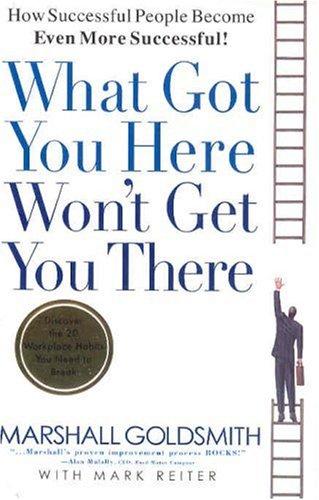
What Got You Here Won't Get You There by Marshall Goldsmith is a 2007 business book about leadership, behavior change, career growth. The habits that produce early career success often become liabilities at senior levels, where influence replaces execution and collaboration replaces individual performance.
Summary
What Got You Here Won't Get You There is Marshall Goldsmith's counter-intuitive argument about career plateaus: the behaviors that drive early success in organizations actively work against you once you reach a senior level. Goldsmith, one of the most sought-after executive coaches in the world, writes from decades of coaching Fortune 500 executives and watching the same patterns derail otherwise brilliant people.
The book catalogs twenty habits that distinguish high-potential executives who plateau from those who keep growing — not habits of incompetence, but habits of success gone wrong. These include winning too much (needing to be right in every situation), adding too much value (compulsively improving others' ideas so they stop sharing), making exclamatory comments that pass for feedback, failing to give appropriate recognition, and not listening because the leader already knows the answer. None of these behaviors feel wrong from the inside — they feel like the confidence and decisiveness that got the person where they are.
Goldsmith's method is feedforward: rather than processing the past, he asks colleagues what one or two things the leader could do differently in the future that would make the biggest positive difference. This sidesteps defensiveness about past behavior and focuses energy on actionable change. The complementary practice is systematic apology — going to each stakeholder and saying, without justification, what you've done and what you intend to do differently.
The book is direct about what behavioral change actually requires: it's not insight or intention but follow-through, and follow-through requires making the change visible to others. Goldsmith argues that leaders who announce what they're working on and then check in regularly with colleagues have dramatically higher success rates than those who try to change in private.
Talk to What Got You Here Won't Get You There like its author wrote you back.
Get the ideas that fit your life — not generic summaries.
- Chat with the book
- Audiobook-style main ideas
- Adapts to your life and goals
- Helps you take action
Key takeaways
- 1.
The habits that produce early career success often become liabilities at senior levels, where influence replaces execution and collaboration replaces individual performance.
- 2.
The twenty habits of successful people who plateau include needing to win every argument, adding unsolicited value to others' ideas, withholding recognition, and not listening because the answer seems obvious.
- 3.
Feedback about the past triggers defensiveness. Feedforward — input about what could change in the future — is more actionable and less threatening.
- 4.
Behavioral change without visible accountability rarely sticks. Telling people what you're working on and following up regularly doubles the likelihood of sustained change.
- 5.
The most dangerous response to any feedback is to add a 'but' that explains the behavior. Justification prevents change more reliably than any other single habit.
- 6.
Apologize without justification. 'I'm sorry I did X, and here's what I'm going to do differently' is dramatically more effective than 'I'm sorry I did X, but here's why I did it.'
- 7.
Most behavioral problems at the executive level are not problems of skill, knowledge, or intelligence — they're problems of interpersonal behavior that is invisible to the person doing it.
- 8.
Listen to your self-promotion. The number of times you use 'I' in a sentence, the degree to which you redirect conversations back to your own experience — these are behaviors others notice before you do.
Discussion questions
Use these on your own, with a book club, or as chat starters in Superbook. Book club version, ready to copy or print →
- 1.
Which of Goldsmith's twenty habits do you most recognize in yourself? Be specific.
- 2.
Think about a time you 'added value' to someone's idea when what they really wanted was to be heard. What did your contribution cost the other person?
- 3.
Goldsmith says needing to win every argument is one of the most common derailing habits in senior leaders. What does winning every argument signal to the people you work with?
- 4.
Have you ever made a justification that prevented you from actually changing something you knew you should change? What did the justification feel like from the inside?
- 5.
The book recommends apologizing without justification. Try drafting one in your mind right now for something you've done recently. How hard is it to leave out the 'but'?
- 6.
What behavior of yours do you think is most visible to your colleagues and least visible to you? How would you find out?
- 7.
Goldsmith argues that behavioral change requires going public — telling people what you're working on. Why is private change less likely to stick?
- 8.
How often do you give recognition to the people around you? What's the observable effect of that on how people behave around you?
- 9.
Think about someone whose behavior regularly frustrates you. Is there a possibility that you exhibit the same behavior in a different context?
- 10.
The feedforward process asks for input on the future rather than judgment of the past. What's the most useful feedforward you've ever received?
- 11.
Goldsmith says the coaches he works with are not failures — they're the most successful people in their organizations. What does that say about who is and isn't open to behavioral coaching?
- 12.
Which of the twenty habits is most costly in your organization's senior leadership? What's the downstream effect on the people below them?
Themes
Frequently asked questions
-
Is What Got You Here Won't Get You There worth reading?
Yes, especially for anyone in a senior role who feels like they should be performing better than they are, or who has received repeated feedback about their interpersonal behavior without knowing what to do about it. The twenty habits are painfully recognizable, and the behavioral change methodology is practical.
-
How long does it take to read What Got You Here Won't Get You There?
Around four hours for the 236-page book. It's organized clearly and the twenty habits chapters can be read quickly. Many executives read it in a single sitting.
-
What is feedforward and how does it differ from feedback?
Feedforward asks people what they would suggest you do differently in the future, rather than judging what you did in the past. It sidesteps the defensiveness that feedback about past behavior typically triggers, and focuses the energy on change rather than explanation or justification.
-
What are the most common habits Goldsmith sees in executives?
Needing to win every argument, adding unsolicited value to others' ideas, claiming credit inappropriately, not listening, and withholding recognition. These are the habits that appear most frequently across the executives Goldsmith has coached.
-
Is executive coaching necessary to apply the ideas in this book?
No. The feedforward practice can be run informally with any group of trusted colleagues. The apology methodology requires no coach. The most important thing the book gives you is a specific list of behaviors to audit in yourself — which you can do without any external support.