Cooking · Book club
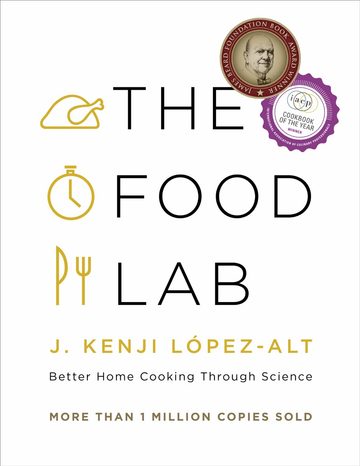
The Food Lab: Better Home Cooking Through Science book club questions
Here are 12 book club questions for The Food Lab: Better Home Cooking Through Science by J. Kenji López-Alt, ordered to open easily and end somewhere worth arguing about. Copy them, print them, or bring them up one at a time.
The 12 questions
- 1.
Kenji tests kitchen rules instead of trusting them. Which cooking rule have you followed for years without ever checking whether it's true?
- 2.
The book argues temperature matters more than time. Do you cook by the clock, and where has that led you astray?
- 3.
Which myth in the book most surprised you, and had you been doing it the old way all along?
- 4.
Kenji's method is to change one variable at a time. How could you apply that experimental habit to a dish you keep trying to improve?
- 5.
Do you own an instant-read thermometer? If not, what has kept you guessing at doneness instead of measuring it?
- 6.
The book leans heavily on American comfort food. Which dishes from your own cooking would you love to see given the same experimental treatment?
- 7.
Reverse-searing trades a little speed for control. Where in your cooking would you happily make that trade for a more reliable result?
- 8.
Kenji is comfortable saying a beloved technique is pointless. Are you willing to abandon a method you're attached to if the evidence says it doesn't help?
- 9.
Weighing ingredients is more accurate than measuring by volume. What actually stops you from using a scale — habit, or something else?
- 10.
The book is a reference to dip into, not read straight through. How do you decide which parts of a cookbook are worth your attention?
- 11.
Understanding why is meant to free you from recipes. Can you name a technique you now grasp well enough to improvise with?
- 12.
Kenji trained as both a scientist and a chef. How might treating your everyday cooking as a series of experiments change the way you learn?
How to run the discussion
- Pick six to eight, not all of them. An hour of real discussion covers fewer questions than anyone expects, and racing the list is what makes a book club feel like homework.
- Open with what people noticed, not what they concluded. Asking for a verdict first hardens opinions before anyone has heard each other.
- Let the disagreement run. The questions below that split a room are the ones worth the time; the ones everyone answers the same way can be skipped.
- Ask the quiet person a specific question. A direct, narrow question is far easier to answer than an open invitation to contribute.
Themes worth steering toward
If the conversation stalls, these are the threads that usually restart it.
Common questions
What are good book club questions for The Food Lab: Better Home Cooking Through Science?
Here are 12 book club questions for The Food Lab: Better Home Cooking Through Science by J. Kenji López-Alt, ordered to open easily and end somewhere worth arguing about. The strongest openers ask what each reader noticed rather than what they concluded, and the discussion usually turns on food science, cooking technique, myth-busting.
How long should a book club discussion of The Food Lab: Better Home Cooking Through Science last?
Most groups run 60 to 90 minutes of actual discussion. That is roughly six to eight questions, not all of them, so pick the ones that suit your group rather than working down the list in order.
What are the main themes in The Food Lab: Better Home Cooking Through Science?
Food science, Cooking technique, Myth-busting, Experimentation, Home cooking. Those are the threads most likely to divide a room, which makes them the useful places to steer a discussion that has gone quiet.
Picking the next one? See books like The Food Lab: Better Home Cooking Through Science or questions for other book club picks.
