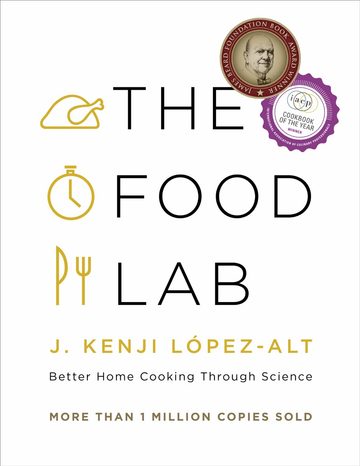
The Food Lab: Better Home Cooking Through Science by J. Kenji López-Alt is a 2015 cooking book about food science, cooking technique, myth-busting. Searing meat does not seal in juices. Browning builds flavor through the Maillard reaction; it does nothing to lock in moisture, which escapes regardless.
Summary
The Food Lab is J. Kenji López-Alt's argument that the fastest way to cook better at home is to understand the science of what actually happens to food when you heat it, salt it, and rest it. Rather than asking readers to trust tradition, he treats the kitchen as a laboratory: he runs controlled experiments, changing one variable at a time, and reports what the evidence shows. The book grew out of his long-running Serious Eats column of the same name.
Much of its reputation comes from myth-busting. Searing does not seal in juices, he demonstrates — browning is a flavor reaction, not a moisture barrier. Doneness is a matter of internal temperature, not cooking time, which is why he champions the reverse sear: cooking a steak gently in a low oven before a final hard sear, for even edge-to-edge results. Along the way he settles arguments about boiling eggs, brining chicken, emulsifying a foolproof mayonnaise with an immersion blender, and why you shouldn't bother adding oil to pasta water.
The book is enormous — nearly a thousand pages — and organized like a reference manual by category: eggs and breakfast, stocks and soups, steaks and chops, ground meat, chicken, vegetables, braises, and sauces. Each section pairs tested recipes with the reasoning behind them, plus step-by-step photos and notes on the tools — an instant-read thermometer, a scale, cast iron — that make precision possible. You are meant to dip in, not read it cover to cover.
It is best for curious home cooks who want to know why a technique works and enjoy a nerdy, footnoted voice. The limits are real: it is heavy on American comfort food — eggs, burgers, roast chicken, mac and cheese — rather than global cuisine, and a few methods assume gear like a thermometer or a sous-vide setup. But as a single reference that replaces folklore with evidence, it has few rivals.
The lab method
Kenji’s approach is to treat cooking as an empirical question. Instead of accepting inherited wisdom, he isolates one variable — the starting temperature of an egg, whether a steak is seared before or after roasting — holds everything else constant, and compares the results. What survives testing becomes the recommended method; what doesn’t gets discarded, however traditional.
Myths the book overturns
- Searing does not seal in juices. It creates flavor through browning, but moisture escapes regardless; the sealing story is simply false.
- Time is a poor proxy for doneness. Internal temperature is what actually matters, which is why a thermometer beats a clock.
- Resting meat isn’t optional theater — it lets the juices redistribute, and the book shows how much you lose by cutting in too early.
- Adding oil to pasta water does nothing useful; salting it generously does.
Techniques worth stealing
The reverse sear
Cook a thick steak gently in a low oven until it’s nearly at target temperature, then sear it hard at the end. The result is even, edge-to-edge doneness with a deep crust — the opposite of the grey band you get from searing first.
Temperature over time
An inexpensive instant-read thermometer is, in Kenji’s telling, the highest-leverage tool in the kitchen. Cook to a number rather than a minute count and results stop being a gamble.
The two-minute mayonnaise
Because an emulsion is a mechanical process, an immersion blender in a narrow cup makes foolproof mayonnaise in minutes — a clean example of how understanding the mechanism removes the fear from a supposedly hard technique.
Salting ahead
Salting meat well in advance, sometimes called dry brining, seasons it all the way through and improves texture, where a last-second sprinkle only reaches the surface.
How the book is organized
Nearly a thousand pages are arranged by category, each blending tested recipes with the reasoning behind them:
- Eggs and breakfast — the science of scrambling, boiling, and poaching.
- Stocks, soups, and stews.
- Steaks, chops, and other fast-cooking foods.
- Ground meat — burgers, meatballs, meatloaf.
- Chicken — roasting, frying, brining.
- Vegetables, braises, and sauces — emulsions, gravies, and the tough cuts that reward low, slow heat.
Who it’s for — and who it isn’t
- Best for curious cooks who want to know why, and who enjoy a nerdy, footnoted, myth-busting voice.
- Heavy on American comfort food — eggs, burgers, roast chicken, mac and cheese — rather than global cuisine.
- A reference, not a novel. You dip in for the dish in front of you; almost no one reads all thousand pages straight through.
Talk to The Food Lab: Better Home Cooking Through Science like its author wrote you back.
Get the ideas that fit your life — not generic summaries.
- Chat with the book
- Audiobook-style main ideas
- Adapts to your life and goals
- Helps you take action
Key takeaways
- 1.
Searing meat does not seal in juices. Browning builds flavor through the Maillard reaction; it does nothing to lock in moisture, which escapes regardless.
- 2.
Temperature, not time, tells you when food is done. An inexpensive instant-read thermometer is the single most useful upgrade for most home cooks.
- 3.
The reverse sear — low oven first, hard sear last — produces a steak that is evenly cooked from edge to edge with a deep crust, avoiding the grey band.
- 4.
Salting meat well in advance seasons it throughout and improves texture, unlike a last-second sprinkle that only hits the surface.
- 5.
A foolproof mayonnaise takes two minutes with an immersion blender, because the method, not luck, controls the emulsion.
- 6.
Weigh ingredients rather than measuring by volume for anything where precision matters. A kitchen scale is both faster and far more consistent.
- 7.
Most folk kitchen wisdom should be tested, not trusted. Changing one variable at a time reveals which steps actually matter and which are just ritual.
- 8.
Understanding the mechanism beats memorizing the recipe. Once you know why a technique works, you can adapt it to whatever you happen to be cooking.
Discussion questions
Use these on your own, with a book club, or as chat starters in Superbook. Book club version, ready to copy or print →
- 1.
Kenji tests kitchen rules instead of trusting them. Which cooking rule have you followed for years without ever checking whether it's true?
- 2.
The book argues temperature matters more than time. Do you cook by the clock, and where has that led you astray?
- 3.
Which myth in the book most surprised you, and had you been doing it the old way all along?
- 4.
Kenji's method is to change one variable at a time. How could you apply that experimental habit to a dish you keep trying to improve?
- 5.
Do you own an instant-read thermometer? If not, what has kept you guessing at doneness instead of measuring it?
- 6.
The book leans heavily on American comfort food. Which dishes from your own cooking would you love to see given the same experimental treatment?
- 7.
Reverse-searing trades a little speed for control. Where in your cooking would you happily make that trade for a more reliable result?
- 8.
Kenji is comfortable saying a beloved technique is pointless. Are you willing to abandon a method you're attached to if the evidence says it doesn't help?
- 9.
Weighing ingredients is more accurate than measuring by volume. What actually stops you from using a scale — habit, or something else?
- 10.
The book is a reference to dip into, not read straight through. How do you decide which parts of a cookbook are worth your attention?
- 11.
Understanding why is meant to free you from recipes. Can you name a technique you now grasp well enough to improvise with?
- 12.
Kenji trained as both a scientist and a chef. How might treating your everyday cooking as a series of experiments change the way you learn?
Themes
Frequently asked questions
-
What is The Food Lab about?
It explains the science behind everyday cooking. J. Kenji López-Alt runs controlled kitchen experiments to test techniques, bust myths, and arrive at reliable, optimized methods for dishes like steak, eggs, and roast chicken.
-
Is The Food Lab good for beginners?
It can be, but it's dense. Beginners will learn a huge amount about why techniques work, though the nearly-thousand-page size and nerdy tone suit patient cooks. Those who mainly want quick weeknight recipes may find it heavy.
-
Is The Food Lab worth buying?
For cooks who want to understand mechanisms rather than just follow steps, yes — it works as a lifelong reference. If you mostly want fast, global weeknight meals, a more focused cookbook may serve you better.
-
Do I need special equipment to use The Food Lab?
Mostly no, but a few standout methods rely on an instant-read thermometer, a kitchen scale, and cast iron. Kenji argues those inexpensive tools do more for your cooking than almost anything else.
-
How is The Food Lab different from Salt, Fat, Acid, Heat?
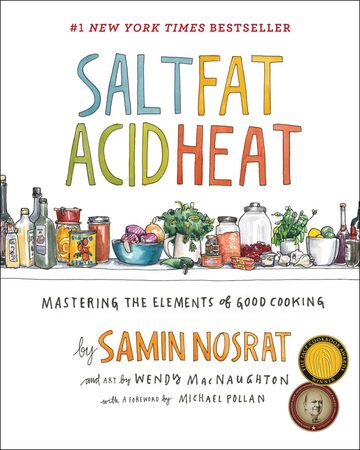
The Food Lab is experimental and recipe-focused, optimizing specific dishes through testing. Salt, Fat, Acid, Heat teaches broad intuition through four guiding elements. Many cooks own both, because they solve different problems.