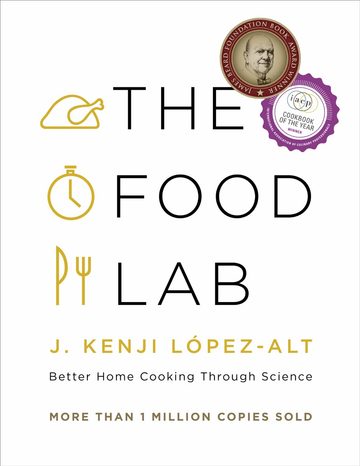
Talk to The Food Lab: Better Home Cooking Through Science like its author wrote you back.
Get the ideas that fit your life — not generic summaries.
- Chat with the book
- Audiobook-style main ideas
- Adapts to your life and goals
- Helps you take action
The Food Lab: Better Home Cooking Through Science, in detail
The Food Lab is J. Kenji López-Alt's argument that the fastest way to cook better at home is to understand the science of what actually happens to food when you heat it, salt it, and rest it. Rather than asking readers to trust tradition, he treats the kitchen as a laboratory: he runs controlled experiments, changing one variable at a time, and reports what the evidence shows. The book grew out of his long-running Serious Eats column of the same name.
Much of its reputation comes from myth-busting. Searing does not seal in juices, he demonstrates — browning is a flavor reaction, not a moisture barrier. Doneness is a matter of internal temperature, not cooking time, which is why he champions the reverse sear: cooking a steak gently in a low oven before a final hard sear, for even edge-to-edge results. Along the way he settles arguments about boiling eggs, brining chicken, emulsifying a foolproof mayonnaise with an immersion blender, and why you shouldn't bother adding oil to pasta water.
The book is enormous — nearly a thousand pages — and organized like a reference manual by category: eggs and breakfast, stocks and soups, steaks and chops, ground meat, chicken, vegetables, braises, and sauces. Each section pairs tested recipes with the reasoning behind them, plus step-by-step photos and notes on the tools — an instant-read thermometer, a scale, cast iron — that make precision possible. You are meant to dip in, not read it cover to cover.
It is best for curious home cooks who want to know why a technique works and enjoy a nerdy, footnoted voice. The limits are real: it is heavy on American comfort food — eggs, burgers, roast chicken, mac and cheese — rather than global cuisine, and a few methods assume gear like a thermometer or a sous-vide setup. But as a single reference that replaces folklore with evidence, it has few rivals.
The big ideas
- 1.
Searing meat does not seal in juices. Browning builds flavor through the Maillard reaction; it does nothing to lock in moisture, which escapes regardless.
- 2.
Temperature, not time, tells you when food is done. An inexpensive instant-read thermometer is the single most useful upgrade for most home cooks.
- 3.
The reverse sear — low oven first, hard sear last — produces a steak that is evenly cooked from edge to edge with a deep crust, avoiding the grey band.
