History · Book club
The Forever War book club questions
Here are 11 book club questions for The Forever War by Dexter Filkins, ordered to open easily and end somewhere worth arguing about. Copy them, print them, or bring them up one at a time.
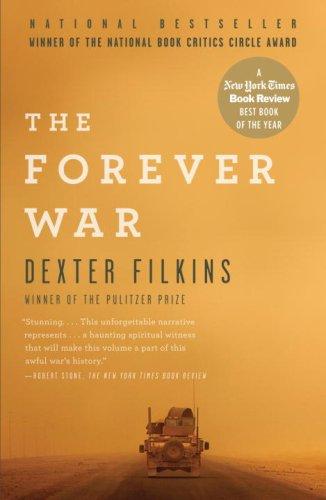
Dexter Filkins spent more than a decade covering the wars in Afghanistan and Iraq for the New York Times, and The Forever War is his attempt to render what he witnessed in a form that is closer to literature than journalism.
Dexter Filkins · 2008 · 5h 45m
Full summary and key takeaways →The 11 questions
- 1.
Filkins chooses to write scenes rather than make arguments. What does that formal choice gain, and what does it sacrifice?
- 2.
The book covers Afghanistan before and after the Taliban's fall. How does the Taliban's public brutality in the 1990s compare to how you understood it before reading the book?
- 3.
Filkins describes the psychological pull of the war zone. What does it say about human psychology that people can become attached to conditions of extreme danger?
- 4.
The interpreters and local employees appear throughout the book in conditions of exceptional vulnerability. What moral obligations did that vulnerability create for the journalists and soldiers they worked with?
- 5.
The battle of Fallujah is the book's most intense section. What ethical questions does that kind of urban combat raise for the soldiers carrying it out?
- 6.
Filkins rarely editorializes about American policy. Does the accumulation of scenes carry an implicit argument, or does it genuinely leave the reader to draw their own conclusions?
- 7.
The book was published in 2008. How does it read differently now that both wars have formally ended and their long-term outcomes are clearer?
- 8.
Filkins describes the difficulty of reintegrating into civilian life after years of war reporting. What parallel experiences exist in other professions that involve sustained exposure to trauma?
- 9.
The title The Forever War suggests a cycle with no resolution. Do you think that framing was accurate, and does it remain accurate now?
- 10.
What responsibility does journalism bear for shaping public understanding of wars that most citizens will never see directly?
- 11.
Which specific scene in the book stayed with you longest, and what does that tell you about how you process information about war?
How to run the discussion
- Pick six to eight, not all of them. An hour of real discussion covers fewer questions than anyone expects, and racing the list is what makes a book club feel like homework.
- Open with what people noticed, not what they concluded. Asking for a verdict first hardens opinions before anyone has heard each other.
- Let the disagreement run. The questions below that split a room are the ones worth the time; the ones everyone answers the same way can be skipped.
- Ask the quiet person a specific question. A direct, narrow question is far easier to answer than an open invitation to contribute.
Themes worth steering toward
If the conversation stalls, these are the threads that usually restart it.
Common questions
What are good book club questions for The Forever War?
Here are 11 book club questions for The Forever War by Dexter Filkins, ordered to open easily and end somewhere worth arguing about. The strongest openers ask what each reader noticed rather than what they concluded, and the discussion usually turns on war, journalism, afghanistan and iraq.
How long should a book club discussion of The Forever War last?
Most groups run 60 to 90 minutes of actual discussion. That is roughly six to eight questions, not all of them, so pick the ones that suit your group rather than working down the list in order.
What are the main themes in The Forever War?
War, Journalism, Afghanistan and Iraq, Violence and chaos, American foreign policy. Those are the threads most likely to divide a room, which makes them the useful places to steer a discussion that has gone quiet.
Picking the next one? See books like The Forever War or questions for other book club picks.
