Economics · Book club
The Four Pillars of Investing book club questions
Here are 12 book club questions for The Four Pillars of Investing by William J. Bernstein, ordered to open easily and end somewhere worth arguing about. Copy them, print them, or bring them up one at a time.
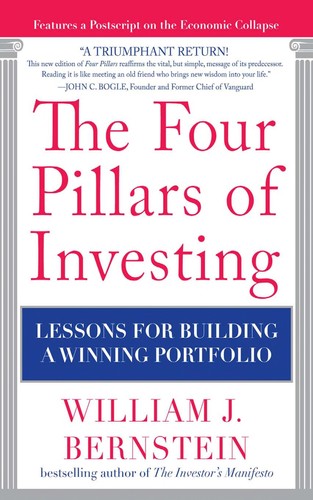
The Four Pillars of Investing is William Bernstein's rigorous guide to building and managing an investment portfolio, organized around the four things every serious investor needs to understand: investment theory, investment history, the psychology of investing, and the investment business.
William J. Bernstein · 2002 · 5h 45m
Full summary and key takeaways →The 12 questions
- 1.
Bernstein says most investors significantly overestimate their risk tolerance until they experience a real bear market. How did you actually behave during the most significant market decline you have personally experienced?
- 2.
The history pillar shows that markets can lose most of their value and take decades to recover. Does knowing that change your asset allocation, or do you think it won't happen in your investing lifetime?
- 3.
Bernstein is skeptical of investment advisors whose compensation depends on the products they sell. Have you ever had an advisor whose advice was clearly influenced by their compensation structure?
- 4.
The four pillars framework suggests that most investors lack at least one — either the theory, the history, the psychological self-awareness, or the understanding of how the industry works. Which pillar is weakest in your own case?
- 5.
Bernstein argues that complexity in financial products almost always benefits the seller. Can you think of a financial product you own or have been offered where the complexity genuinely benefited you?
- 6.
The asset allocation section discusses the value premium — small-cap and value stocks providing higher historical returns. Do you believe that premium will persist, and does your portfolio reflect that view?
- 7.
The book was published in 2002, during the dot-com bust. How has the landscape Bernstein describes — the efficiency of markets, the behavior of investors, the structure of the industry — changed since then?
- 8.
Bernstein writes for investors who are willing to manage their own portfolios without advisors. What would you need to know to feel confident doing that, and do you currently have it?
- 9.
The international diversification recommendation is one of the more contested elements of Bernstein's framework. Has international diversification actually improved outcomes for investors over the past two decades?
- 10.
The psychology section covers the behavioral errors that cost investors money. Which of the errors Bernstein describes — overconfidence, herding, panic selling, chasing performance — most accurately describes your own history?
- 11.
Bernstein is a neurologist who self-educated in investing. Does that background make him more or less credible as a guide to portfolio construction than someone with formal finance training?
- 12.
If you were designing a curriculum to teach individual investors everything they need to manage their own money, which of the four pillars would you spend the most time on, and why?
How to run the discussion
- Pick six to eight, not all of them. An hour of real discussion covers fewer questions than anyone expects, and racing the list is what makes a book club feel like homework.
- Open with what people noticed, not what they concluded. Asking for a verdict first hardens opinions before anyone has heard each other.
- Let the disagreement run. The questions below that split a room are the ones worth the time; the ones everyone answers the same way can be skipped.
- Ask the quiet person a specific question. A direct, narrow question is far easier to answer than an open invitation to contribute.
Themes worth steering toward
If the conversation stalls, these are the threads that usually restart it.
Common questions
What are good book club questions for The Four Pillars of Investing?
Here are 12 book club questions for The Four Pillars of Investing by William J. Bernstein, ordered to open easily and end somewhere worth arguing about. The strongest openers ask what each reader noticed rather than what they concluded, and the discussion usually turns on asset allocation, investment theory, market history.
How long should a book club discussion of The Four Pillars of Investing last?
Most groups run 60 to 90 minutes of actual discussion. That is roughly six to eight questions, not all of them, so pick the ones that suit your group rather than working down the list in order.
What are the main themes in The Four Pillars of Investing?
Asset allocation, Investment theory, Market history, Portfolio construction, Investment industry. Those are the threads most likely to divide a room, which makes them the useful places to steer a discussion that has gone quiet.
Picking the next one? See books like The Four Pillars of Investing or questions for other book club picks.
