History · Book club
The Fourth Turning book club questions
Here are 12 book club questions for The Fourth Turning by William Strauss & Neil Howe, ordered to open easily and end somewhere worth arguing about. Copy them, print them, or bring them up one at a time.
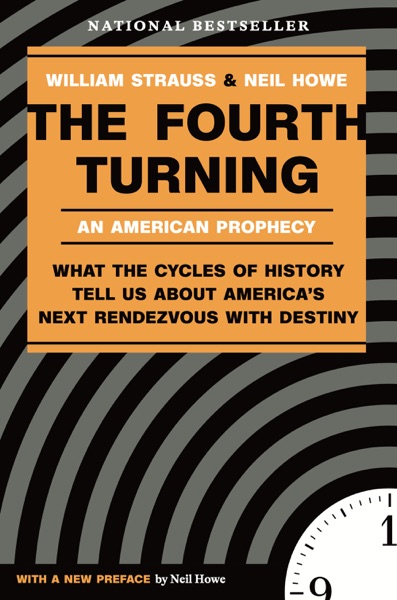
The Fourth Turning is William Strauss and Neil Howe's 1997 argument that Anglo-American history moves in recurring eighty-to-one-hundred-year cycles, each composed of four "turnings" corresponding to distinct social moods.
William Strauss & Neil Howe · 1997 · 8h 40m
Full summary and key takeaways →The 12 questions
- 1.
The book predicted a Fourth Turning crisis peaking around 2020. Which events since 1997 look most like confirmation of the model, and which fit least well?
- 2.
Strauss and Howe argue that generational character is shaped by the social mood of formative years, not just by individual experience. To what extent does your own generation's character match their archetype?
- 3.
The model implies that history is cyclical and that individual agency is constrained by generational position. How do you reconcile that with your own sense of historical possibility?
- 4.
The book's Anglo-American focus is explicit. Does the framework export to other societies? If not, what does that limit tell us about its underlying claims?
- 5.
Fourth Turnings, in the model, are characterized by a 'regeneracy' — a moment when civic unity reforms around a shared crisis. Can you identify anything in recent history that looks like a genuine regeneracy?
- 6.
Prophets, the generation shaped during a High, are characterized as idealistic and moralistic — driving Awakenings later in life. Does that description fit your understanding of the Baby Boom generation?
- 7.
The model predicts that Millennials will play the Hero role — subordinating individual ambition to collective survival during the Crisis. Does that seem plausible given what you know of that generation?
- 8.
The book was written in 1997 and the authors acknowledge their predictions could be wrong. How should we calibrate our confidence in theories that make long-range historical predictions?
- 9.
Strauss and Howe argue that institutional trust can only be rebuilt after a Crisis forces collective sacrifice. Is there an alternative path to civic renewal that doesn't require catastrophe?
- 10.
The framework treats generations as relatively homogeneous. How much variation within generations undermines the predictive value of generational archetypes?
- 11.
Critics argue the authors are pattern-matching and that the historical cycles are an artifact of how they frame the data. How would you distinguish a genuine historical cycle from sophisticated confirmation bias?
- 12.
If the Fourth Turning model is broadly correct, what does it imply about the decisions you should be making in the next decade — personally, professionally, or politically?
How to run the discussion
- Pick six to eight, not all of them. An hour of real discussion covers fewer questions than anyone expects, and racing the list is what makes a book club feel like homework.
- Open with what people noticed, not what they concluded. Asking for a verdict first hardens opinions before anyone has heard each other.
- Let the disagreement run. The questions below that split a room are the ones worth the time; the ones everyone answers the same way can be skipped.
- Ask the quiet person a specific question. A direct, narrow question is far easier to answer than an open invitation to contribute.
Themes worth steering toward
If the conversation stalls, these are the threads that usually restart it.
Common questions
What are good book club questions for The Fourth Turning?
Here are 12 book club questions for The Fourth Turning by William Strauss & Neil Howe, ordered to open easily and end somewhere worth arguing about. The strongest openers ask what each reader noticed rather than what they concluded, and the discussion usually turns on historical cycles, generational theory, social change.
How long should a book club discussion of The Fourth Turning last?
Most groups run 60 to 90 minutes of actual discussion. That is roughly six to eight questions, not all of them, so pick the ones that suit your group rather than working down the list in order.
What are the main themes in The Fourth Turning?
Historical cycles, Generational theory, Social change, Crisis, Civic renewal. Those are the threads most likely to divide a room, which makes them the useful places to steer a discussion that has gone quiet.
Picking the next one? See books like The Fourth Turning or questions for other book club picks.
