Self-help · Book club
The Gap and the Gain book club questions
Here are 12 book club questions for The Gap and the Gain by Dan Sullivan and Benjamin Hardy, ordered to open easily and end somewhere worth arguing about. Copy them, print them, or bring them up one at a time.
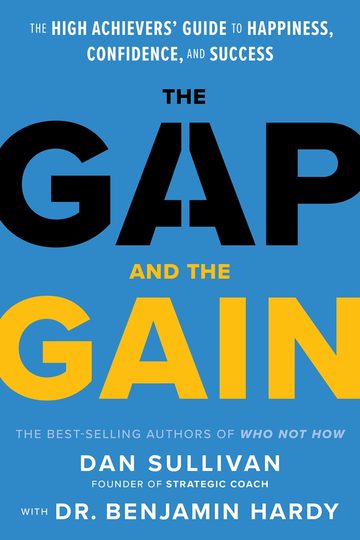
The Gap and the Gain is Dan Sullivan and Benjamin Hardy's argument for a specific and counterintuitive reorientation of how high achievers measure their progress.
Dan Sullivan and Benjamin Hardy · 2021 · 3h 45m
Full summary and key takeaways →The 12 questions
- 1.
Can you identify a specific area of your life where you consistently measure yourself against the gap rather than the gain? What would it feel like to flip that?
- 2.
Sullivan argues that the ideal is useful for direction but not for evaluation. Is that distinction clean in practice, or do you find the two functions bleed together?
- 3.
The book is written primarily for high achievers and entrepreneurs. Do you think gap measurement is actually more prevalent in that population, or is it human universal?
- 4.
Hardy contributes psychological research on how people represent their past. Does knowing there's empirical support for the idea change how you receive it?
- 5.
The gap-measuring problem seems related to social comparison — evaluating yourself against other people's visible achievements. Are those the same problem or different ones?
- 6.
Measuring backward requires knowing where you started. How well do you actually remember your earlier baselines in the areas that matter most to you?
- 7.
Sullivan says he's coached this idea for decades. Does its origin in an entrepreneurial coaching practice strengthen or limit its applicability to your own life?
- 8.
The book argues that memory is constructed, not retrieved — that you can develop a habit of remembering your past in gain terms. Does that feel like healthy reframing or selective distortion?
- 9.
Is there a risk that the gain orientation leads to settling — declaring victory too soon and losing the productive dissatisfaction that drives continued effort?
- 10.
What is a concrete daily or weekly practice that would shift you from gap to gain measurement in one area you care about?
- 11.
The book is fairly repetitive, which is common in books that originated from coaching or speaking. Did the repetition reinforce the idea for you or make the book feel padded?
- 12.
What's the difference between measuring the gain and simply avoiding honest assessment of your current performance?
How to run the discussion
- Pick six to eight, not all of them. An hour of real discussion covers fewer questions than anyone expects, and racing the list is what makes a book club feel like homework.
- Open with what people noticed, not what they concluded. Asking for a verdict first hardens opinions before anyone has heard each other.
- Let the disagreement run. The questions below that split a room are the ones worth the time; the ones everyone answers the same way can be skipped.
- Ask the quiet person a specific question. A direct, narrow question is far easier to answer than an open invitation to contribute.
Themes worth steering toward
If the conversation stalls, these are the threads that usually restart it.
Common questions
What are good book club questions for The Gap and the Gain?
Here are 12 book club questions for The Gap and the Gain by Dan Sullivan and Benjamin Hardy, ordered to open easily and end somewhere worth arguing about. The strongest openers ask what each reader noticed rather than what they concluded, and the discussion usually turns on mindset, achievement and fulfillment, self-improvement.
How long should a book club discussion of The Gap and the Gain last?
Most groups run 60 to 90 minutes of actual discussion. That is roughly six to eight questions, not all of them, so pick the ones that suit your group rather than working down the list in order.
What are the main themes in The Gap and the Gain?
Mindset, Achievement and fulfillment, Self-improvement, Measuring progress, Psychological wellbeing. Those are the threads most likely to divide a room, which makes them the useful places to steer a discussion that has gone quiet.
Picking the next one? See books like The Gap and the Gain or questions for other book club picks.
