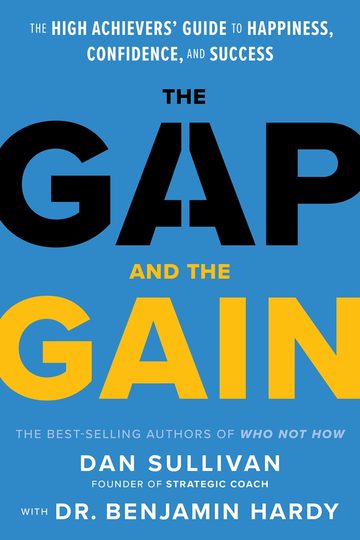
The Gap and the Gain by Dan Sullivan and Benjamin Hardy is a 2021 self-help book about mindset, achievement and fulfillment, self-improvement. The gap is the distance between where you are and your ideal. The gain is the distance between where you are and where you started. Measuring against the gap produces chronic dissatisfaction; measuring against the gain produces confidence.
Summary
The Gap and the Gain is Dan Sullivan and Benjamin Hardy's argument for a specific and counterintuitive reorientation of how high achievers measure their progress. The gap is the distance between where you are and your ideal — the horizon you're perpetually moving toward. The gain is the distance between where you are and where you started. Sullivan's central claim, developed from his coaching practice with entrepreneurs over several decades, is that most driven people measure themselves against the gap and suffer for it, when they could measure themselves against the gain and find motivation without misery.
The argument is not that people should lower their standards or stop pursuing ambitious ideals. The ideal — a constantly receding horizon — is described as a useful tool for direction. But if you evaluate your daily progress against it, you will always feel behind. By definition, you never close the gap. Measuring backward, against your own past starting points, reveals how much has actually changed — and that recognition produces confidence and motivation rather than the chronic dissatisfaction of gap-measuring.
The book's second major contribution is the distinction between in-gain experiences and in-gap experiences, and the claim that this distinction is partly a matter of habit. People who are chronically dissatisfied despite significant success have often habituated themselves to gap measurement as the only legitimate way to think about their lives. Hardy contributes psychological research on gratitude, self-determination, and the relationship between how people represent their past and how they approach the future.
Sullivan and Hardy are writing primarily for entrepreneurs and high achievers — people who are driven enough that the gap is a genuine psychological problem, not a motivational prescription. Readers who struggle with motivation rather than with chronic dissatisfaction may find the framework less immediately applicable. The book is short, readable, and repetitive in the way that many coaching-derived books are, but the central idea is clear, well-supported, and practically useful for anyone who has experienced success while feeling consistently behind.
Talk to The Gap and the Gain like its author wrote you back.
Get the ideas that fit your life — not generic summaries.
- Chat with the book
- Audiobook-style main ideas
- Adapts to your life and goals
- Helps you take action
Key takeaways
- 1.
The gap is the distance between where you are and your ideal. The gain is the distance between where you are and where you started. Measuring against the gap produces chronic dissatisfaction; measuring against the gain produces confidence.
- 2.
The ideal is a useful directional tool, not a measuring stick. It tells you which way to walk, but evaluating your current position against it is a category error.
- 3.
High achievers are disproportionately susceptible to gap measurement because the drive to pursue ideals is the same trait that makes them measure themselves against those ideals.
- 4.
Gratitude for the gain is not complacency. Recognizing how far you've come is compatible with continued ambition — it just changes the emotional register of your progress.
- 5.
Memory is not passive retrieval; it's active construction. Choosing to remember and represent your past in gain terms is a trainable habit, not a fixed personality trait.
- 6.
The most damaging version of gap measurement is measuring yourself against other people's idealized presentations of their lives, rather than your own starting points.
- 7.
Consistent backward measurement — taking stock of your actual gains regularly — builds psychological stability that makes it easier to persist through future difficulty.
Discussion questions
Use these on your own, with a book club, or as chat starters in Superbook. Book club version, ready to copy or print →
- 1.
Can you identify a specific area of your life where you consistently measure yourself against the gap rather than the gain? What would it feel like to flip that?
- 2.
Sullivan argues that the ideal is useful for direction but not for evaluation. Is that distinction clean in practice, or do you find the two functions bleed together?
- 3.
The book is written primarily for high achievers and entrepreneurs. Do you think gap measurement is actually more prevalent in that population, or is it human universal?
- 4.
Hardy contributes psychological research on how people represent their past. Does knowing there's empirical support for the idea change how you receive it?
- 5.
The gap-measuring problem seems related to social comparison — evaluating yourself against other people's visible achievements. Are those the same problem or different ones?
- 6.
Measuring backward requires knowing where you started. How well do you actually remember your earlier baselines in the areas that matter most to you?
- 7.
Sullivan says he's coached this idea for decades. Does its origin in an entrepreneurial coaching practice strengthen or limit its applicability to your own life?
- 8.
The book argues that memory is constructed, not retrieved — that you can develop a habit of remembering your past in gain terms. Does that feel like healthy reframing or selective distortion?
- 9.
Is there a risk that the gain orientation leads to settling — declaring victory too soon and losing the productive dissatisfaction that drives continued effort?
- 10.
What is a concrete daily or weekly practice that would shift you from gap to gain measurement in one area you care about?
- 11.
The book is fairly repetitive, which is common in books that originated from coaching or speaking. Did the repetition reinforce the idea for you or make the book feel padded?
- 12.
What's the difference between measuring the gain and simply avoiding honest assessment of your current performance?
Themes
Frequently asked questions
-
What is The Gap and the Gain about?
The argument that high achievers suffer from measuring themselves against an ideal (the gap) instead of against their own starting points (the gain) — and that shifting to backward measurement produces confidence and fulfillment without sacrificing ambition.
-
Is The Gap and the Gain worth reading?
If you're a driven person who experiences chronic dissatisfaction despite genuine success, yes. The central idea is simple, well-illustrated, and immediately applicable. If your problem is motivation rather than satisfaction, you'll likely find it less relevant.
-
How long is The Gap and the Gain?
Around 240 pages. At average reading pace it takes about three to four hours. Many readers finish it in a single sitting. The core idea is stated early; the rest of the book reinforces and extends it.
-
Who wrote The Gap and the Gain?
Dan Sullivan, founder of the Strategic Coach program, developed the original framework from decades of coaching entrepreneurs. Benjamin Hardy, an organizational psychologist and author, co-wrote the book, contributing psychological research and case studies.
-
What's the most actionable idea in The Gap and the Gain?
The practice of 'measuring backward': at regular intervals, take stock of how far you've come since a specific past point — not compared to some ideal, but compared to where you actually were. Write down three wins, however small. That habit, applied consistently, is the mechanism the book describes.