Economics · Book club
The Geometry of Wealth book club questions
Here are 12 book club questions for The Geometry of Wealth by Brian Portnoy, ordered to open easily and end somewhere worth arguing about. Copy them, print them, or bring them up one at a time.
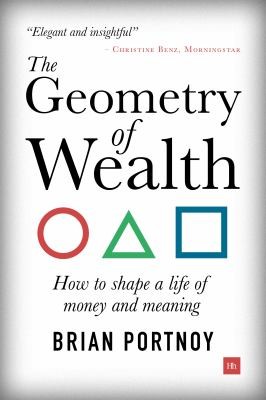
The Geometry of Wealth is Brian Portnoy's attempt to rebuild the relationship between money and happiness on more defensible psychological foundations.
Brian Portnoy · 2018 · 4h 0m
Full summary and key takeaways →The 12 questions
- 1.
Portnoy distinguishes being rich from being wealthy. Using his definition — funded contentment — are you wealthy by your own assessment? What would need to change for you to say yes?
- 2.
He argues that meaning must come before money decisions. Have you ever made a major financial decision — career, house, investment — without first being clear about what it was for?
- 3.
Hedonic adaptation says we return to baseline happiness regardless of gains or losses. Can you identify a financial achievement that delivered less lasting satisfaction than you expected?
- 4.
What is the minimum amount of money you need to feel adequate in your social context? Where did that number come from, and is it yours or borrowed from comparison?
- 5.
Autonomy — choosing how to spend your time — is a strong predictor of well-being. How much of your current financial behavior is aimed at purchasing more autonomy? How much at other things?
- 6.
Portnoy says most financial advice starts at markets (investment strategy) when it should start at meaning (life design). What is your life design, stated clearly enough to make financial decisions from?
- 7.
The book covers basic financial competency as a foundation often missing. Savings, emergency fund, insurance, debt management — do you have all four genuinely in order?
- 8.
He argues that chasing relative wealth is a reliable path to chronic dissatisfaction. Who are you currently comparing yourself to financially, and is that comparison helping you?
- 9.
Which of the three stages — meaning, money, or markets — is most underdeveloped in your own financial life?
- 10.
Portnoy is an investment professional who argues investment strategy matters less than most investors believe. How does that credential affect how you receive the argument?
- 11.
If you wrote down the five things that most reliably produce contentment in your daily life, how much of your current spending is in service of those five things?
- 12.
The book implies that most financial planning conversations happen in the wrong order. If you were designing a financial planning engagement from scratch, how would you sequence the questions?
How to run the discussion
- Pick six to eight, not all of them. An hour of real discussion covers fewer questions than anyone expects, and racing the list is what makes a book club feel like homework.
- Open with what people noticed, not what they concluded. Asking for a verdict first hardens opinions before anyone has heard each other.
- Let the disagreement run. The questions below that split a room are the ones worth the time; the ones everyone answers the same way can be skipped.
- Ask the quiet person a specific question. A direct, narrow question is far easier to answer than an open invitation to contribute.
Themes worth steering toward
If the conversation stalls, these are the threads that usually restart it.
Common questions
What are good book club questions for The Geometry of Wealth?
Here are 12 book club questions for The Geometry of Wealth by Brian Portnoy, ordered to open easily and end somewhere worth arguing about. The strongest openers ask what each reader noticed rather than what they concluded, and the discussion usually turns on wealth psychology, life design, financial purpose.
How long should a book club discussion of The Geometry of Wealth last?
Most groups run 60 to 90 minutes of actual discussion. That is roughly six to eight questions, not all of them, so pick the ones that suit your group rather than working down the list in order.
What are the main themes in The Geometry of Wealth?
Wealth psychology, Life design, Financial purpose, Behavioral finance, Happiness. Those are the threads most likely to divide a room, which makes them the useful places to steer a discussion that has gone quiet.
Picking the next one? See books like The Geometry of Wealth or questions for other book club picks.
