Philosophy · Book club
The Gift: Imagination and the Erotic Life of Property book club questions
Here are 12 book club questions for The Gift: Imagination and the Erotic Life of Property by Lewis Hyde, ordered to open easily and end somewhere worth arguing about. Copy them, print them, or bring them up one at a time.
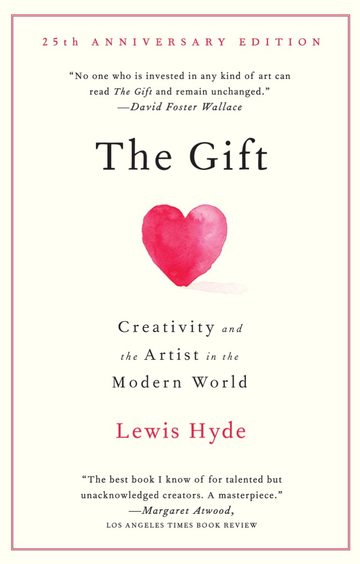
The Gift is Lewis Hyde's argument that creative work operates under a different logic than market exchange, and that misunderstanding this difference does serious damage to artists and to the culture that depends on them.
Lewis Hyde · 1983 · 6h 45m
Full summary and key takeaways →The 12 questions
- 1.
Hyde argues that gifts must keep moving to retain their gift-nature. Have you experienced creative or intellectual work that felt like it died when it became primarily commercial?
- 2.
The book draws on anthropological accounts of potlatches and kula rings. Do you find these non-Western gift economies illuminating as models for thinking about art — or does the comparison feel strained?
- 3.
Hyde distinguishes between gifts given freely and gifts given with expectation of return. Where do you find this distinction in your own creative or professional relationships?
- 4.
The contrast between Whitman and Pound is central to the second half. Having read Hyde's account, does it change how you read either poet — or does it feel like it fits his argument a little too neatly?
- 5.
Hyde says artists live in two economies simultaneously and must negotiate between them. What does that negotiation actually look like in creative fields you know — and who navigates it well?
- 6.
The book was published in 1983 and spread by word of mouth for decades. Does this pattern of distribution — gift-like, slow, person-to-person — change how you think about it?
- 7.
Hyde argues that thinking of talent as something you own tends to corrupt the work. Do you agree? Are there cases where artists who are openly commercial produce work that feels gift-like?
- 8.
What's the difference, in Hyde's terms, between an artist who makes work for money and an artist who makes work that eventually earns money? Is the distinction meaningful?
- 9.
The book ends by asking what social forms could support artists without converting their work entirely into commodity. What answers do you find compelling in 2026 — patronage, public funding, platforms?
- 10.
If creative work is a gift that must be given to remain alive, what are the obligations that come with receiving something — a book, a piece of music, a painting — that was made that way?
- 11.
Hyde's framework applies primarily to individual artists. Does it scale — does it have anything to say about open-source software, Wikipedia, or other collaborative gift-like projects?
- 12.
Which figure in contemporary culture do you think best embodies Hyde's gift logic — and who best embodies the Pound-like trap?
How to run the discussion
- Pick six to eight, not all of them. An hour of real discussion covers fewer questions than anyone expects, and racing the list is what makes a book club feel like homework.
- Open with what people noticed, not what they concluded. Asking for a verdict first hardens opinions before anyone has heard each other.
- Let the disagreement run. The questions below that split a room are the ones worth the time; the ones everyone answers the same way can be skipped.
- Ask the quiet person a specific question. A direct, narrow question is far easier to answer than an open invitation to contribute.
Themes worth steering toward
If the conversation stalls, these are the threads that usually restart it.
Common questions
What are good book club questions for The Gift: Imagination and the Erotic Life of Property?
Here are 12 book club questions for The Gift: Imagination and the Erotic Life of Property by Lewis Hyde, ordered to open easily and end somewhere worth arguing about. The strongest openers ask what each reader noticed rather than what they concluded, and the discussion usually turns on creativity and gift economies, art and commerce, cultural exchange.
How long should a book club discussion of The Gift: Imagination and the Erotic Life of Property last?
Most groups run 60 to 90 minutes of actual discussion. That is roughly six to eight questions, not all of them, so pick the ones that suit your group rather than working down the list in order.
What are the main themes in The Gift: Imagination and the Erotic Life of Property?
Creativity and gift economies, Art and commerce, Cultural exchange, Property and ownership, The nature of talent. Those are the threads most likely to divide a room, which makes them the useful places to steer a discussion that has gone quiet.
Picking the next one? See books like The Gift: Imagination and the Erotic Life of Property or questions for other book club picks.
