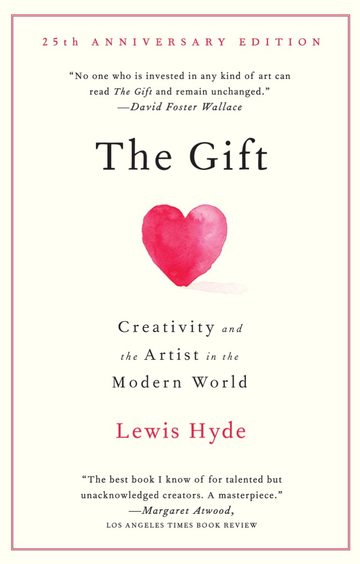
The Gift: Imagination and the Erotic Life of Property by Lewis Hyde is a 1983 philosophy book about creativity and gift economies, art and commerce, cultural exchange. Gift economies operate on different logic than markets: value is created and preserved by being passed on, not accumulated. A gift that stops circulating loses its gift-nature.
Summary
The Gift is Lewis Hyde's argument that creative work operates under a different logic than market exchange, and that misunderstanding this difference does serious damage to artists and to the culture that depends on them. The book works in two registers: anthropological and biographical. In the first half, Hyde examines gift economies — systems of circulation in which value moves by being given rather than sold — drawing on ethnographic accounts of potlatches, Polynesian exchange networks, and folk tales about gifts that multiply when shared and wither when hoarded. In a gift economy, value flows when it moves. A gift that stops moving, that gets converted into a commodity and sold, loses its gift-nature. Hyde's claim is that this logic governs genuine creative work.
The second half applies this framework to two poets: Walt Whitman and Ezra Pound. Whitman's life and poetry become an illustration of what it looks like to work in alignment with gift logic — giving freely, seeing talent as something received and passed on rather than owned. Pound's life, and his catastrophic failures, become an illustration of what happens when a person of genuine creative gifts tries to operate in commodity terms — possessing, controlling, withholding, demanding. The comparison is illuminating even for readers who don't come to the book with an interest in either poet.
Hyde doesn't argue that artists should be poor. The book acknowledges that artists live in two economies — the gift economy of creative work and the market economy of rent and groceries — and that the tension between them is real and often painful. His argument is that artists who lose track of the gift dimension of their work, who begin to think primarily in terms of market value, tend to produce worse work and to suffer from a particular kind of spiritual bankruptcy.
The Gift has accumulated an unusual reputation. It sold modestly when first published but spread by word of mouth, particularly among working artists, for decades. It is a book people give to each other — appropriately enough — and return to at different stages of a creative life. It asks large questions about why making things matters, and it answers them with enough intellectual seriousness and historical richness to justify its ambition.
Talk to The Gift: Imagination and the Erotic Life of Property like its author wrote you back.
Get the ideas that fit your life — not generic summaries.
- Chat with the book
- Audiobook-style main ideas
- Adapts to your life and goals
- Helps you take action
Key takeaways
- 1.
Gift economies operate on different logic than markets: value is created and preserved by being passed on, not accumulated. A gift that stops circulating loses its gift-nature.
- 2.
Creative work participates in gift logic: the artist receives a talent or inspiration, works with it, and puts it into the world — returning something to the commons from which it came.
- 3.
The tension between gift and commodity is structural for artists: creative work demands gift logic, but artists live in a market economy and must negotiate both simultaneously.
- 4.
Gifts given with strings attached — with expectation of return or control over how they're used — aren't true gifts. The same is true of creative work that is primarily strategic.
- 5.
Whitman's poetry enacts gift logic: it gives without reserve, circulates freely, and treats the poet's own body and experience as something to be offered rather than owned.
- 6.
Pound's failure illustrates what happens when a person of genuine creative gifts tries to possess and control culture — to convert gifts into personal property — rather than participate in their circulation.
- 7.
Talent itself is a gift in Hyde's account: something received, not earned, which carries an obligation to develop and pass on rather than merely exploit.
- 8.
Art markets and patronage systems are attempts to create institutional bridges between gift and commodity economies — none fully resolves the tension, but some manage it better than others.
Discussion questions
Use these on your own, with a book club, or as chat starters in Superbook. Book club version, ready to copy or print →
- 1.
Hyde argues that gifts must keep moving to retain their gift-nature. Have you experienced creative or intellectual work that felt like it died when it became primarily commercial?
- 2.
The book draws on anthropological accounts of potlatches and kula rings. Do you find these non-Western gift economies illuminating as models for thinking about art — or does the comparison feel strained?
- 3.
Hyde distinguishes between gifts given freely and gifts given with expectation of return. Where do you find this distinction in your own creative or professional relationships?
- 4.
The contrast between Whitman and Pound is central to the second half. Having read Hyde's account, does it change how you read either poet — or does it feel like it fits his argument a little too neatly?
- 5.
Hyde says artists live in two economies simultaneously and must negotiate between them. What does that negotiation actually look like in creative fields you know — and who navigates it well?
- 6.
The book was published in 1983 and spread by word of mouth for decades. Does this pattern of distribution — gift-like, slow, person-to-person — change how you think about it?
- 7.
Hyde argues that thinking of talent as something you own tends to corrupt the work. Do you agree? Are there cases where artists who are openly commercial produce work that feels gift-like?
- 8.
What's the difference, in Hyde's terms, between an artist who makes work for money and an artist who makes work that eventually earns money? Is the distinction meaningful?
- 9.
The book ends by asking what social forms could support artists without converting their work entirely into commodity. What answers do you find compelling in 2026 — patronage, public funding, platforms?
- 10.
If creative work is a gift that must be given to remain alive, what are the obligations that come with receiving something — a book, a piece of music, a painting — that was made that way?
- 11.
Hyde's framework applies primarily to individual artists. Does it scale — does it have anything to say about open-source software, Wikipedia, or other collaborative gift-like projects?
- 12.
Which figure in contemporary culture do you think best embodies Hyde's gift logic — and who best embodies the Pound-like trap?
Themes
Frequently asked questions
-
What is The Gift by Lewis Hyde about?
It argues that creative work operates under gift-economy logic — value that circulates by being given rather than sold — and that artists who lose sight of this, who think primarily in commodity terms, tend to produce worse work and to suffer for it. Hyde develops the argument through anthropology and a long comparison between Walt Whitman and Ezra Pound.
-
Is The Gift worth reading if you're not an artist?
Yes. The book's insights about gift economies, the nature of talent, and the tension between giving and owning have wide application. It's particularly useful for anyone who has wondered why certain work feels alive and other work feels transactional — and who has noticed that distinction doesn't map neatly onto whether something is commercially successful.
-
How long does it take to read The Gift?
Around six to seven hours. At roughly 300 pages it's not long, but it rewards slow reading — the anthropological section in particular is dense with examples. Many readers come back to it at different stages of their creative lives.
-
What does Hyde mean by 'erotic life of property' in the subtitle?
He uses 'erotic' in a broad sense, drawing on Plato — meaning something like vital, connective, life-giving. The claim is that property, when it participates in gift logic, has an erotic quality: it connects people, generates surplus, circulates energy. Property that is hoarded and controlled loses this quality and becomes merely owned.
-
Who should read The Gift?
Anyone seriously engaged in creative work — writers, visual artists, musicians, designers — particularly those wrestling with how to sustain a creative practice in a market economy. It's also useful for anyone thinking about philanthropy, open-source culture, or the relationship between cultural production and money.