Business · Book club
The Goal: A Process of Ongoing Improvement book club questions
Here are 11 book club questions for The Goal: A Process of Ongoing Improvement by Eliyahu M. Goldratt and Jeff Cox, ordered to open easily and end somewhere worth arguing about. Copy them, print them, or bring them up one at a time.
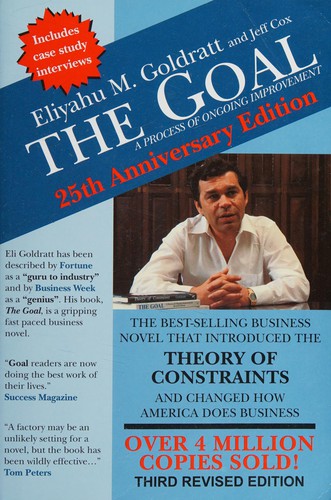
The Goal is a business novel — written as fiction to make operational management ideas accessible — that introduced the Theory of Constraints to a broad audience.
Eliyahu M. Goldratt and Jeff Cox · 1984 · 6h 40m
Full summary and key takeaways →The 11 questions
- 1.
What is the constraint in a system you work within or manage? Is it a physical bottleneck, a policy, or a measurement that directs behavior toward local rather than global efficiency?
- 2.
Goldratt says improving non-constraints doesn't improve the system. Have you seen investment in efficiency improvements that didn't help — or that actually hurt — overall throughput?
- 3.
The novel form is unusual for a business book. What did reading The Goal as fiction do to your understanding of the ideas compared to reading them as analysis?
- 4.
Goldratt uses a hiking trip with Boy Scouts as the analogy for dependent processes and statistical fluctuations. Where else in business or life do you see dependent processes compounding in the same way?
- 5.
The Theory of Constraints focuses on throughput, inventory, and operating expense. How does this differ from standard cost accounting, and when does the difference matter most?
- 6.
Goldratt argues that idle time at a non-constraint is not waste. That directly contradicts most management instincts about utilization. When is that counterintuitive claim most important to act on?
- 7.
The five focusing steps assume you can identify the constraint. What makes constraint identification difficult in complex or non-manufacturing systems?
- 8.
How does the Theory of Constraints apply to software development? What is the constraint in a typical software development pipeline, and how would you exploit it?
- 9.
Goldratt's Jonah refuses to give Alex the answers and instead asks questions. What's the pedagogical argument for that approach, and does it match your experience of how people actually learn?
- 10.
The book was first published in 1984 and set in a manufacturing plant. What has changed about its relevance since then, and what has stayed the same?
- 11.
What would it mean to apply the Theory of Constraints to a professional services firm, a marketing department, or your own personal workflow?
How to run the discussion
- Pick six to eight, not all of them. An hour of real discussion covers fewer questions than anyone expects, and racing the list is what makes a book club feel like homework.
- Open with what people noticed, not what they concluded. Asking for a verdict first hardens opinions before anyone has heard each other.
- Let the disagreement run. The questions below that split a room are the ones worth the time; the ones everyone answers the same way can be skipped.
- Ask the quiet person a specific question. A direct, narrow question is far easier to answer than an open invitation to contribute.
Themes worth steering toward
If the conversation stalls, these are the threads that usually restart it.
Common questions
What are good book club questions for The Goal: A Process of Ongoing Improvement?
Here are 11 book club questions for The Goal: A Process of Ongoing Improvement by Eliyahu M. Goldratt and Jeff Cox, ordered to open easily and end somewhere worth arguing about. The strongest openers ask what each reader noticed rather than what they concluded, and the discussion usually turns on operations, strategy, systems thinking.
How long should a book club discussion of The Goal: A Process of Ongoing Improvement last?
Most groups run 60 to 90 minutes of actual discussion. That is roughly six to eight questions, not all of them, so pick the ones that suit your group rather than working down the list in order.
What are the main themes in The Goal: A Process of Ongoing Improvement?
Operations, Strategy, Systems thinking, Manufacturing, Continuous improvement. Those are the threads most likely to divide a room, which makes them the useful places to steer a discussion that has gone quiet.
Picking the next one? See books like The Goal: A Process of Ongoing Improvement or questions for other book club picks.
