Philosophy · Book club
The Good Ancestor book club questions
Here are 11 book club questions for The Good Ancestor by Roman Krznaric, ordered to open easily and end somewhere worth arguing about. Copy them, print them, or bring them up one at a time.
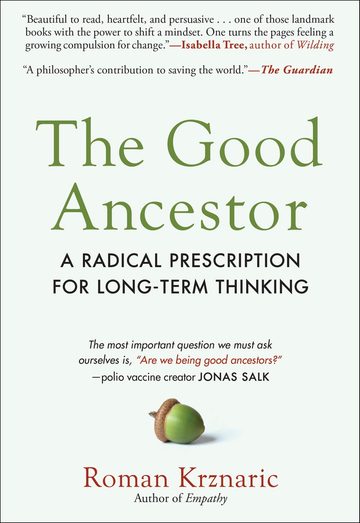
The Good Ancestor is Roman Krznaric's case for extending our sense of moral and practical obligation across time — not just to the people alive today but to those who will come after us.
Roman Krznaric · 2020 · 5h 0m
Full summary and key takeaways →The 11 questions
- 1.
Krznaric argues that democratic politics structurally rewards short-term thinking. Do you agree? Can you think of examples from your own country that support or complicate this?
- 2.
Cathedral thinking involves committing to projects whose completion you won't see. What is the most cathedral-like project you've been involved in? How did the long horizon change how you worked on it?
- 3.
The Iroquois seven-generation principle means considering impacts seven generations out. What decision in your own life or work would look different if you applied that standard?
- 4.
The book argues that future people should be treated as rights-holders, not just interests to be considered. What would that actually require of governments? And what would it require of individuals?
- 5.
Krznaric distinguishes holistic forecasting — imagining multiple futures — from extrapolation. When you think about the future of your field or country, are you extrapolating or genuinely imagining alternatives?
- 6.
The deep time perspective — situating yourself in a lineage going back hundreds of thousands of years — sounds abstract. Has thinking about deep time ever actually changed how you acted? If not, why not?
- 7.
Legacy is offered as a motivational tool: thinking about how your actions look from a century out. Is that motivating or paralyzing for you? What is the difference between a healthy legacy mindset and anxiety about the future?
- 8.
Short-termism has structural causes. If individual mindset changes aren't enough, what institutional changes would be most likely to lengthen time horizons in the places that matter most?
- 9.
The Finland nuclear waste repository — designed to warn people 100,000 years in the future — is one of the book's most striking examples. What does it reveal about the difficulty of long-term thinking at civilizational scale?
- 10.
Krznaric is optimistic that we can change. Is that optimism earned? What evidence would shift your assessment of whether long-term thinking can actually be institutionalized?
- 11.
Which of Krznaric's six pathways feels most applicable to your own situation? What would you have to change to make it a habit?
How to run the discussion
- Pick six to eight, not all of them. An hour of real discussion covers fewer questions than anyone expects, and racing the list is what makes a book club feel like homework.
- Open with what people noticed, not what they concluded. Asking for a verdict first hardens opinions before anyone has heard each other.
- Let the disagreement run. The questions below that split a room are the ones worth the time; the ones everyone answers the same way can be skipped.
- Ask the quiet person a specific question. A direct, narrow question is far easier to answer than an open invitation to contribute.
Themes worth steering toward
If the conversation stalls, these are the threads that usually restart it.
Common questions
What are good book club questions for The Good Ancestor?
Here are 11 book club questions for The Good Ancestor by Roman Krznaric, ordered to open easily and end somewhere worth arguing about. The strongest openers ask what each reader noticed rather than what they concluded, and the discussion usually turns on long-term thinking, future generations, time horizon.
How long should a book club discussion of The Good Ancestor last?
Most groups run 60 to 90 minutes of actual discussion. That is roughly six to eight questions, not all of them, so pick the ones that suit your group rather than working down the list in order.
What are the main themes in The Good Ancestor?
Long-term thinking, Future generations, Time horizon, Civilizational responsibility, Systems change. Those are the threads most likely to divide a room, which makes them the useful places to steer a discussion that has gone quiet.
Picking the next one? See books like The Good Ancestor or questions for other book club picks.
