Talk to The Grand Design like its author wrote you back.
Get the ideas that fit your life — not generic summaries.
- Chat with the book
- Audiobook-style main ideas
- Adapts to your life and goals
- Helps you take action
The Grand Design, in detail
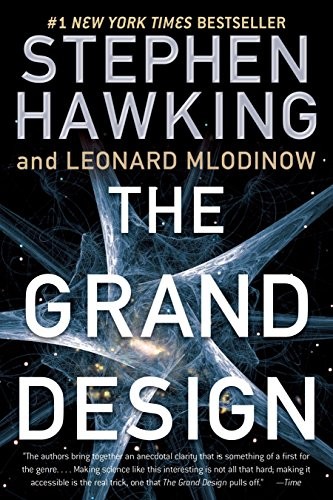
The Grand Design is Stephen Hawking and Leonard Mlodinow's short, provocative book about the deepest questions in physics: Why is there something rather than nothing? Why do the laws of physics have the specific form they do? What is the nature of physical reality? The book was notable on publication for its opening declaration that philosophy is dead — that the great questions once belonging to philosophy now belong to science — and for its argument that God is not necessary to explain why the universe exists.
The book introduces M-theory, the current best candidate for a unified description of the fundamental laws of physics, as a candidate for a "theory of everything." M-theory encompasses eleven dimensions, multiple membranes of different dimensionalities, and an enormous landscape of possible universes — each with different physical laws. The argument for the multiverse follows: if M-theory generates all these possible universes spontaneously from quantum fluctuations, and if we exist in one of the relatively rare universes whose laws are compatible with life, then the fine-tuning of our universe's laws requires no explanation beyond this quantum generative process and the anthropic selection effect.
The authors also introduce the concept of "model-dependent realism": the view that there is no single description of physical reality that is model-independent. Different models — classical mechanics, quantum mechanics, general relativity — all describe the same underlying reality but none is uniquely correct. A model is good if it is consistent, elegant, and produces accurate predictions; asking whether it is "really true" is a question without a definite answer.
The book is very short, richly illustrated, and accessible to general readers. Some professional physicists felt it oversimplified M-theory, which remains incomplete and contested. The philosophical claim — that philosophy is dead — was widely criticized by philosophers. But as a concise introduction to modern cosmology's deepest ideas, it serves its purpose well.
The big ideas
- 1.
M-theory, which encompasses string theory as a special case, is currently the best candidate for a unified description of all physical laws; it predicts an enormous number of possible universes with different laws.
- 2.
The fine-tuning of physical constants for life can be explained anthropically: in a multiverse, we necessarily exist in a universe compatible with life, so its apparent fine-tuning requires no further explanation.
- 3.
Model-dependent realism: there is no single model-independent description of reality. A model is useful if it is consistent, elegant, and predictive, and asking whether it is uniquely 'true' is ill-defined.
