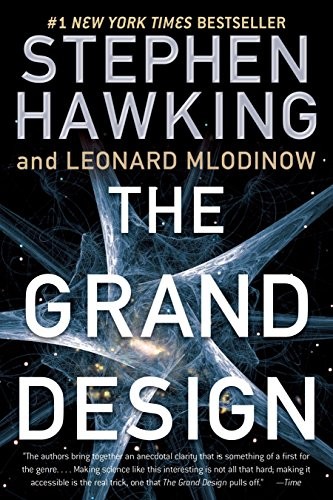
The Grand Design by Stephen Hawking and Leonard Mlodinow is a 2010 science book about cosmology, quantum mechanics, laws of physics. M-theory, which encompasses string theory as a special case, is currently the best candidate for a unified description of all physical laws; it predicts an enormous number of possible universes with different laws.
Summary
The Grand Design is Stephen Hawking and Leonard Mlodinow's short, provocative book about the deepest questions in physics: Why is there something rather than nothing? Why do the laws of physics have the specific form they do? What is the nature of physical reality? The book was notable on publication for its opening declaration that philosophy is dead — that the great questions once belonging to philosophy now belong to science — and for its argument that God is not necessary to explain why the universe exists.
The book introduces M-theory, the current best candidate for a unified description of the fundamental laws of physics, as a candidate for a "theory of everything." M-theory encompasses eleven dimensions, multiple membranes of different dimensionalities, and an enormous landscape of possible universes — each with different physical laws. The argument for the multiverse follows: if M-theory generates all these possible universes spontaneously from quantum fluctuations, and if we exist in one of the relatively rare universes whose laws are compatible with life, then the fine-tuning of our universe's laws requires no explanation beyond this quantum generative process and the anthropic selection effect.
The authors also introduce the concept of "model-dependent realism": the view that there is no single description of physical reality that is model-independent. Different models — classical mechanics, quantum mechanics, general relativity — all describe the same underlying reality but none is uniquely correct. A model is good if it is consistent, elegant, and produces accurate predictions; asking whether it is "really true" is a question without a definite answer.
The book is very short, richly illustrated, and accessible to general readers. Some professional physicists felt it oversimplified M-theory, which remains incomplete and contested. The philosophical claim — that philosophy is dead — was widely criticized by philosophers. But as a concise introduction to modern cosmology's deepest ideas, it serves its purpose well.
Talk to The Grand Design like its author wrote you back.
Get the ideas that fit your life — not generic summaries.
- Chat with the book
- Audiobook-style main ideas
- Adapts to your life and goals
- Helps you take action
Key takeaways
- 1.
M-theory, which encompasses string theory as a special case, is currently the best candidate for a unified description of all physical laws; it predicts an enormous number of possible universes with different laws.
- 2.
The fine-tuning of physical constants for life can be explained anthropically: in a multiverse, we necessarily exist in a universe compatible with life, so its apparent fine-tuning requires no further explanation.
- 3.
Model-dependent realism: there is no single model-independent description of reality. A model is useful if it is consistent, elegant, and predictive, and asking whether it is uniquely 'true' is ill-defined.
- 4.
Because the law of gravity exists, the universe can and did create itself from nothing; the question 'who lit the fuse' does not require a creator as an answer, in Hawking's account.
- 5.
Quantum mechanics applies to the whole universe; the universe as a quantum object can be described by a wavefunction, and its origins can be described by quantum gravity even without a definite spacetime.
- 6.
The apparent laws of nature — the specific values of physical constants — vary across different bubble universes in the multiverse; ours is one that permits the evolution of observers.
- 7.
Classical science, including Newton's mechanics, describes the macro world well but breaks down at quantum and cosmological scales; a theory of everything must recover classical behavior as a limit.
- 8.
Philosophy of science — questions about the nature of scientific knowledge, what counts as explanation, whether scientific theories are 'true' — is not dead but has become more entangled with physics than ever.
Discussion questions
Use these on your own, with a book club, or as chat starters in Superbook. Book club version, ready to copy or print →
- 1.
Hawking declares philosophy dead, claiming physicists have taken over its great questions. Is that declaration well-founded, or does it misunderstand what philosophy does?
- 2.
Model-dependent realism holds that asking whether a model is 'really true' is ill-defined. Does that seem right to you, or does it concede too much to relativism?
- 3.
If the multiverse explains fine-tuning by anthropic selection, does that count as a scientific explanation or as a category of explanation that science should not use?
- 4.
The book argues God is not necessary to explain the universe. Is that a scientific argument or a philosophical one, and does the distinction matter?
- 5.
M-theory predicts many things but cannot yet be directly tested because the energy scales involved are far beyond any accelerator. Does an untestable theory have scientific standing?
- 6.
Hawking argues the universe created itself from the law of gravity. What does 'create itself' mean, and does the presence of physical laws already assume something rather than nothing?
- 7.
The book is very short and readable. Does brevity help or hurt an argument about the deepest questions in physics?
- 8.
How does model-dependent realism compare to scientific realism — the view that successful scientific theories describe how the world actually is?
- 9.
If you can imagine a universe with different physical laws, what does that say about the laws in our universe — are they necessary or contingent?
- 10.
Which idea in the book surprised you most, and which did you find least convincing?
- 11.
The book was co-authored by Hawking and Mlodinow. Does knowing that affect how you read it compared to A Brief History of Time?
Themes
Frequently asked questions
-
Do I need to have read A Brief History of Time first?
No. The Grand Design covers some of the same cosmological background but from a different angle. It focuses more on the philosophy of physics and the multiverse argument than on the history of cosmology. Either book works as a standalone.
-
Is M-theory a proven theory?
No. M-theory is a candidate for unification that has not been experimentally confirmed and cannot yet be directly tested. It is mathematically rich and solves certain theoretical problems, but its status as a description of the actual universe is genuinely uncertain.
-
What does it mean that the universe created itself?
Hawking argues that because the law of gravity generates negative energy, the net energy of the universe can be zero, and quantum mechanics allows zero-energy configurations to fluctuate spontaneously into existence. The 'creation' is a quantum event, not a classical causal sequence.
-
Why is this book controversial among philosophers?
Because the claim that philosophy is dead, and the model-dependent realism position, are themselves philosophical claims that need philosophical defense. Critics argue Hawking and Mlodinow are doing philosophy badly while claiming not to need it.
-
How long is it?
Short — under 200 pages, about three to four hours at average pace. It is the most accessible of the three major Hawking popular books and well-illustrated.