Self-help · Book club
The Great Mental Models book club questions
Here are 12 book club questions for The Great Mental Models by Shane Parrish, ordered to open easily and end somewhere worth arguing about. Copy them, print them, or bring them up one at a time.
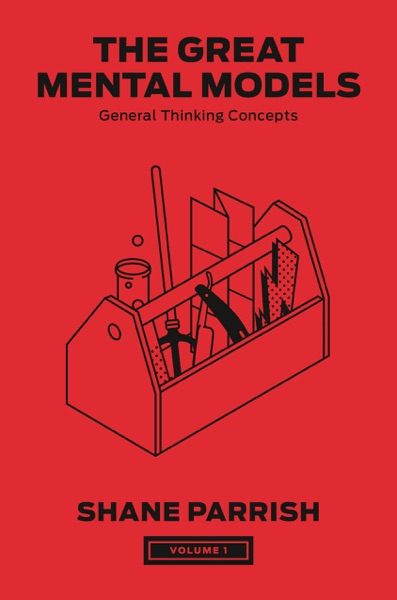
The Great Mental Models is the first volume in Shane Parrish's series drawn from his Farnam Street blog, which he built into one of the most widely read sites on thinking and decision-making.
Shane Parrish · 2019 · 4h 0m
Full summary and key takeaways →The 12 questions
- 1.
Parrish argues that a handful of models from different disciplines can improve reasoning across all domains. Is that claim overstated, or does your experience support it?
- 2.
Which of the models in the book have you actually used — consciously or not — in a real decision? What happened?
- 3.
Think of a recent decision you got wrong. Which mental model, applied earlier, would have changed the outcome?
- 4.
The book emphasizes knowing the edges of your circle of competence. How do you actually know where your competence ends?
- 5.
Parrish draws heavily on Charlie Munger and other investment thinkers. Do mental models that are useful for investing translate cleanly to other domains? Where do they break down?
- 6.
Second-order thinking requires imagining what happens after what you expect. What's a domain in your life where you consistently underestimate second-order effects?
- 7.
Inversion — thinking about how to guarantee failure — is one of the book's recurring tools. Apply it to something you're currently trying to accomplish. What do you find?
- 8.
The book is a curated survey, not original research. Is there value in well-organized curation of ideas that already exist, or does that feel like a shortcut to you?
- 9.
Parrish says good thinkers hold multiple models simultaneously and choose among them. How do you avoid model-shopping — selecting the model that confirms what you already believe?
- 10.
Which mental model from the book do you most frequently see violated in your professional environment? What would change if it were applied more consistently?
- 11.
The series is now multiple volumes. Does the format — one model per chapter, self-contained — suit the subject matter, or would you have preferred a more integrated argument?
- 12.
Munger, Feynman, and other figures Parrish draws on were generalists in a specializing world. Is the multidisciplinary approach they modeled more or less feasible for someone entering a career today?
How to run the discussion
- Pick six to eight, not all of them. An hour of real discussion covers fewer questions than anyone expects, and racing the list is what makes a book club feel like homework.
- Open with what people noticed, not what they concluded. Asking for a verdict first hardens opinions before anyone has heard each other.
- Let the disagreement run. The questions below that split a room are the ones worth the time; the ones everyone answers the same way can be skipped.
- Ask the quiet person a specific question. A direct, narrow question is far easier to answer than an open invitation to contribute.
Themes worth steering toward
If the conversation stalls, these are the threads that usually restart it.
Common questions
What are good book club questions for The Great Mental Models?
Here are 12 book club questions for The Great Mental Models by Shane Parrish, ordered to open easily and end somewhere worth arguing about. The strongest openers ask what each reader noticed rather than what they concluded, and the discussion usually turns on mental models, decision-making, critical thinking.
How long should a book club discussion of The Great Mental Models last?
Most groups run 60 to 90 minutes of actual discussion. That is roughly six to eight questions, not all of them, so pick the ones that suit your group rather than working down the list in order.
What are the main themes in The Great Mental Models?
Mental models, Decision-making, Critical thinking, Systems thinking, Reasoning. Those are the threads most likely to divide a room, which makes them the useful places to steer a discussion that has gone quiet.
Picking the next one? See books like The Great Mental Models or questions for other book club picks.
