Economics · Book club
The Great Transformation book club questions
Here are 11 book club questions for The Great Transformation by Karl Polanyi, ordered to open easily and end somewhere worth arguing about. Copy them, print them, or bring them up one at a time.
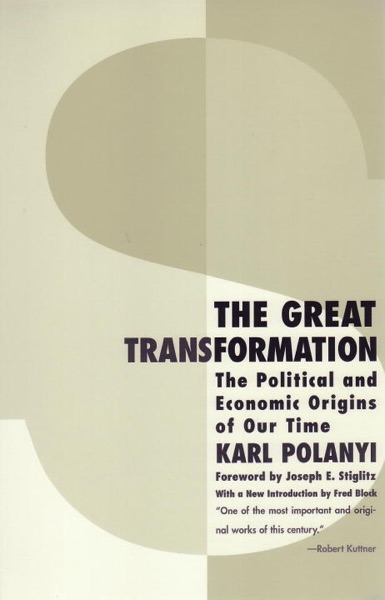
The Great Transformation is Karl Polanyi's 1944 account of how a self-regulating market economy emerged in nineteenth-century England, what social catastrophe that emergence caused, and why the market society created its own political reaction.
Karl Polanyi · 1944 · 6h 40m
Full summary and key takeaways →The 11 questions
- 1.
Polanyi argues that markets were 'embedded' in social relations before the Industrial Revolution and became 'disembedded' by the nineteenth-century transformation. Is that a useful distinction, or does it romanticize pre-industrial economies?
- 2.
The concept of fictitious commodities — treating labor, land, and money as ordinary tradeable goods — is central to Polanyi's argument. Does this concept hold up when you examine contemporary labor markets or financial systems?
- 3.
The double movement suggests that market expansion automatically generates protective counter-movements. Do you see evidence of this dynamic in contemporary politics — in responses to globalization, gig work, or AI displacement?
- 4.
Polanyi is sympathetic to the protective counter-movement but acknowledges it can lead to fascism as well as social democracy. What determines which form the counter-movement takes?
- 5.
He argues that the gold standard contributed to the political crises of the 1920s by preventing countries from using economic policy to respond to downturns. Does this analysis apply to analogous institutions today — the Euro, for example?
- 6.
Polanyi wrote in 1944, when the outcome of the war was still uncertain. How does knowing the subsequent history — the postwar settlement, the Bretton Woods system, the welfare state — change how you read his analysis?
- 7.
He argues that naive liberalism equates freedom with the absence of regulation, but genuine freedom requires social institutions. Is this distinction persuasive, or does it risk justifying unlimited intervention?
- 8.
The book is often invoked by both left and right critics of free markets. What is it about Polanyi's framework that makes it available to critics across the political spectrum?
- 9.
Polanyi's treatment of England in the nineteenth century is detailed; his treatment of other countries is less so. Does the English case generalize, or is there something specific about English industrialization that limits the framework's applicability?
- 10.
The Speenhamland system is Polanyi's key example of how social protection can produce perverse outcomes. Can you think of contemporary equivalents — cases where protective institutions have had unexpected market effects?
- 11.
If Polanyi's double movement thesis is correct, what does it predict about the next decade of political economy in countries most affected by automation and deindustrialization?
How to run the discussion
- Pick six to eight, not all of them. An hour of real discussion covers fewer questions than anyone expects, and racing the list is what makes a book club feel like homework.
- Open with what people noticed, not what they concluded. Asking for a verdict first hardens opinions before anyone has heard each other.
- Let the disagreement run. The questions below that split a room are the ones worth the time; the ones everyone answers the same way can be skipped.
- Ask the quiet person a specific question. A direct, narrow question is far easier to answer than an open invitation to contribute.
Themes worth steering toward
If the conversation stalls, these are the threads that usually restart it.
Common questions
What are good book club questions for The Great Transformation?
Here are 11 book club questions for The Great Transformation by Karl Polanyi, ordered to open easily and end somewhere worth arguing about. The strongest openers ask what each reader noticed rather than what they concluded, and the discussion usually turns on markets, society, capitalism.
How long should a book club discussion of The Great Transformation last?
Most groups run 60 to 90 minutes of actual discussion. That is roughly six to eight questions, not all of them, so pick the ones that suit your group rather than working down the list in order.
What are the main themes in The Great Transformation?
Markets, Society, Capitalism, Economic history, Political economy. Those are the threads most likely to divide a room, which makes them the useful places to steer a discussion that has gone quiet.
Picking the next one? See books like The Great Transformation or questions for other book club picks.
