Literary fiction · Book club
The Handmaid's Tale book club questions
Here are 12 book club questions for The Handmaid's Tale by Margaret Atwood, ordered to open easily and end somewhere worth arguing about. Copy them, print them, or bring them up one at a time.
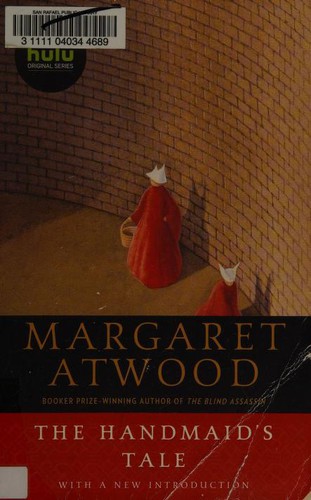
The Handmaid's Tale is set in the near-future theocratic Republic of Gilead, carved out of what was once the northeastern United States after a coup by a fundamentalist Christian movement.
Margaret Atwood · 1985 · 6h 0m
Full summary and key takeaways →The 12 questions
- 1.
Atwood insists that everything in Gilead has a historical precedent. Looking at the novel's specific institutions — Handmaids, Marthas, Aunts, the Wall — can you identify what real practices each might derive from?
- 2.
Offred's narrative is framed, in the historical note, as recorded tapes whose authenticity scholars cannot fully verify. What does that frame do to how you read her account?
- 3.
The Aunts — particularly Aunt Lydia — are women who enforce the system on other women. How does the novel account for this phenomenon? Is Aunt Lydia a villain, a victim, or something else?
- 4.
Offred says 'I compose myself' — using both senses of the word. How does the act of narrating her experience function as survival? Is narration presented as a form of agency in the novel?
- 5.
Nick is a figure of moral ambiguity throughout. By the end of the novel, do you trust him? Does Offred?
- 6.
The Ceremony — the institutionalized rape at the center of the novel — is rendered with deliberate emotional flatness by Offred. What does that flatness tell us about what she has had to do to survive?
- 7.
Serena Joy was once a television evangelist who advocated for women to return to the home. She is now confined to the home by the world she helped create. How does the novel treat that irony — satirically, tragically, or something else?
- 8.
The Republic of Gilead rose quickly, while many people were not paying attention. Does the novel's account of how the coup happened feel credible or contrived?
- 9.
Offred chooses not to join the resistance movement in the way Moira does. Is that a moral failure, a realistic choice, or something the novel refuses to judge?
- 10.
The historical note mocks the tendency to treat women's testimony with methodological skepticism rather than as direct evidence. Does that feel dated in 2026, or has the dynamic it describes persisted?
- 11.
The TV series extended the story significantly beyond the novel. If you've seen it, how does the adaptation change your reading of the source material?
- 12.
The novel is often read as a warning about the religious right. Atwood has also said it's about all forms of authoritarian control. Which reading feels more accurate to you after reading it?
How to run the discussion
- Pick six to eight, not all of them. An hour of real discussion covers fewer questions than anyone expects, and racing the list is what makes a book club feel like homework.
- Open with what people noticed, not what they concluded. Asking for a verdict first hardens opinions before anyone has heard each other.
- Let the disagreement run. The questions below that split a room are the ones worth the time; the ones everyone answers the same way can be skipped.
- Ask the quiet person a specific question. A direct, narrow question is far easier to answer than an open invitation to contribute.
Themes worth steering toward
If the conversation stalls, these are the threads that usually restart it.
Common questions
What are good book club questions for The Handmaid's Tale?
Here are 12 book club questions for The Handmaid's Tale by Margaret Atwood, ordered to open easily and end somewhere worth arguing about. The strongest openers ask what each reader noticed rather than what they concluded, and the discussion usually turns on patriarchy and control, bodily autonomy, resistance and complicity.
How long should a book club discussion of The Handmaid's Tale last?
Most groups run 60 to 90 minutes of actual discussion. That is roughly six to eight questions, not all of them, so pick the ones that suit your group rather than working down the list in order.
What are the main themes in The Handmaid's Tale?
Patriarchy and control, Bodily autonomy, Resistance and complicity, Language and power, Memory and survival. Those are the threads most likely to divide a room, which makes them the useful places to steer a discussion that has gone quiet.
Picking the next one? See books like The Handmaid's Tale or questions for other book club picks.
