Self-help · Book club
The Happiness Trap book club questions
Here are 12 book club questions for The Happiness Trap by Russ Harris, ordered to open easily and end somewhere worth arguing about. Copy them, print them, or bring them up one at a time.
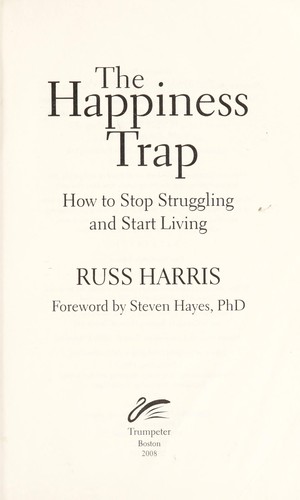
The Happiness Trap is Russ Harris's accessible introduction to Acceptance and Commitment Therapy (ACT), a psychological framework developed by Steven Hayes at the University of Nevada.
Russ Harris · 2007 · 4h 15m
Full summary and key takeaways →The 12 questions
- 1.
Harris argues the pursuit of happiness is itself a trap. Do you find that counterintuitive, or does it match your experience?
- 2.
Think of a negative thought you have frequently. What does it feel like to observe it as a mental event rather than a fact? What's the difference in practice?
- 3.
Cognitive behavioral therapy and ACT take different approaches to negative thoughts: CBT challenges their accuracy, ACT defuses from them without evaluating them. Which approach feels more useful to you?
- 4.
Harris says difficult emotions are the natural cost of caring about things. What difficult emotion in your life might be a signal about something you actually value?
- 5.
The book distinguishes clean pain (the natural suffering that comes with life) from dirty pain (the suffering that comes from fighting against clean pain). Can you identify an example of each in your own experience?
- 6.
Avoidance behaviors — things we do to not feel uncomfortable — often look like productivity, socializing, or self-care. What avoidance behaviors have you noticed in yourself?
- 7.
ACT puts values clarification at the center. How clear are you about your own values, and how much do your daily choices reflect them?
- 8.
The defusion techniques in the book (labeling thoughts, saying them in silly voices, noticing the mind as a storytelling device) can feel artificial. Have you tried any of them? What happened?
- 9.
Harris writes for a general audience rather than a clinical one. Does the self-help framing feel appropriate for a clinical psychology framework, or does something get lost in translation?
- 10.
What's the difference between acceptance and resignation? How would you explain that distinction to someone who worried that accepting difficult feelings meant giving up?
- 11.
Think of someone you know who seems psychologically flexible — able to act in accordance with their values even in difficult circumstances. What do they do differently than others?
- 12.
The book says the goal is a rich, meaningful life, not a comfortable one. What would a rich, meaningful life look like for you in the area where you're currently most stuck?
How to run the discussion
- Pick six to eight, not all of them. An hour of real discussion covers fewer questions than anyone expects, and racing the list is what makes a book club feel like homework.
- Open with what people noticed, not what they concluded. Asking for a verdict first hardens opinions before anyone has heard each other.
- Let the disagreement run. The questions below that split a room are the ones worth the time; the ones everyone answers the same way can be skipped.
- Ask the quiet person a specific question. A direct, narrow question is far easier to answer than an open invitation to contribute.
Themes worth steering toward
If the conversation stalls, these are the threads that usually restart it.
Common questions
What are good book club questions for The Happiness Trap?
Here are 12 book club questions for The Happiness Trap by Russ Harris, ordered to open easily and end somewhere worth arguing about. The strongest openers ask what each reader noticed rather than what they concluded, and the discussion usually turns on acceptance, mindfulness, values.
How long should a book club discussion of The Happiness Trap last?
Most groups run 60 to 90 minutes of actual discussion. That is roughly six to eight questions, not all of them, so pick the ones that suit your group rather than working down the list in order.
What are the main themes in The Happiness Trap?
Acceptance, Mindfulness, Values, Psychological flexibility, Cognitive defusion. Those are the threads most likely to divide a room, which makes them the useful places to steer a discussion that has gone quiet.
Picking the next one? See books like The Happiness Trap or questions for other book club picks.
