Science · Book club
The Hidden Reality: Parallel Universes and the Deep Laws of the Cosmos book club questions
Here are 12 book club questions for The Hidden Reality: Parallel Universes and the Deep Laws of the Cosmos by Brian Greene, ordered to open easily and end somewhere worth arguing about. Copy them, print them, or bring them up one at a time.
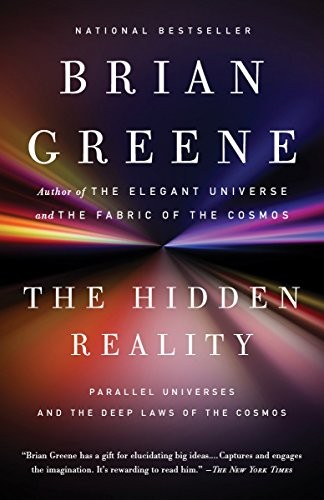
Brian Greene, a string theorist at Columbia University and the author of The Elegant Universe, devoted this book to a single sprawling question: does our universe have company?
Brian Greene · 2011 · 8h 45m
Full summary and key takeaways →The 12 questions
- 1.
Greene surveys nine distinct multiverse proposals. Which one did you find most scientifically plausible, and why?
- 2.
The book distinguishes between theories that are currently untestable and theories that are in principle untestable. Does that distinction matter for whether something counts as science?
- 3.
Many-worlds proposes that every quantum measurement creates a branch where each outcome occurs. Is that a more or less disturbing idea than the Copenhagen interpretation's collapse of the wave function?
- 4.
The string landscape contains an enormous number of possible universes with different physical constants. Does that seem like an explanation of fine-tuning or an abandonment of the desire for a unique fundamental theory?
- 5.
Greene writes as a string theorist. Does his professional investment in string theory affect how you read his treatment of string-based multiverse proposals?
- 6.
The simulated multiverse is the most radical proposal in the book. What evidence, if any, could in principle distinguish a simulated universe from an 'real' one?
- 7.
Inflationary cosmology, which most cosmologists accept, predicts an eternally inflating multiverse as a consequence. Is accepting inflation without accepting the multiverse intellectually consistent?
- 8.
The book is longer and more demanding than most popular physics. Did the depth feel justified, or did some of the nine multiverse variants feel repetitive?
- 9.
Greene argues that untestable theories can still be scientifically valuable. Do you agree, and under what conditions?
- 10.
The fine-tuning problem motivates many multiverse theories. If the constants of nature were different, complex structures and life could not exist. Is that a physics problem or a philosophical one?
- 11.
Everett proposed many-worlds in the 1950s and was largely ignored. It gained more adherents decades later. What does that history suggest about how scientific acceptance works?
- 12.
After reading this book, do you think the multiverse is a scientific hypothesis, a philosophical speculation, or something in between?
How to run the discussion
- Pick six to eight, not all of them. An hour of real discussion covers fewer questions than anyone expects, and racing the list is what makes a book club feel like homework.
- Open with what people noticed, not what they concluded. Asking for a verdict first hardens opinions before anyone has heard each other.
- Let the disagreement run. The questions below that split a room are the ones worth the time; the ones everyone answers the same way can be skipped.
- Ask the quiet person a specific question. A direct, narrow question is far easier to answer than an open invitation to contribute.
Themes worth steering toward
If the conversation stalls, these are the threads that usually restart it.
Common questions
What are good book club questions for The Hidden Reality: Parallel Universes and the Deep Laws of the Cosmos?
Here are 12 book club questions for The Hidden Reality: Parallel Universes and the Deep Laws of the Cosmos by Brian Greene, ordered to open easily and end somewhere worth arguing about. The strongest openers ask what each reader noticed rather than what they concluded, and the discussion usually turns on multiverse, cosmology, quantum mechanics.
How long should a book club discussion of The Hidden Reality: Parallel Universes and the Deep Laws of the Cosmos last?
Most groups run 60 to 90 minutes of actual discussion. That is roughly six to eight questions, not all of them, so pick the ones that suit your group rather than working down the list in order.
What are the main themes in The Hidden Reality: Parallel Universes and the Deep Laws of the Cosmos?
Multiverse, Cosmology, Quantum mechanics, String theory, Parallel universes. Those are the threads most likely to divide a room, which makes them the useful places to steer a discussion that has gone quiet.
Picking the next one? See books like The Hidden Reality: Parallel Universes and the Deep Laws of the Cosmos or questions for other book club picks.
