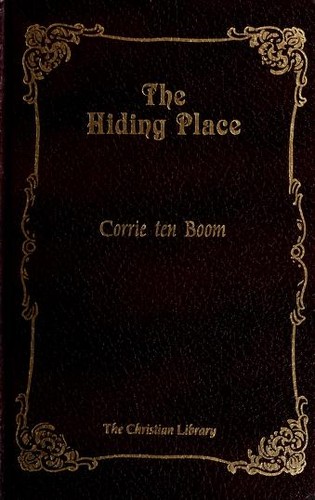
The Hiding Place by Corrie ten Boom is a 1971 memoir book about faith, survival, resistance. Faith that costs nothing is faith that proves nothing. The ten Boom family's decision to hide Jews was predicated on a theological conviction that was tested almost immediately to its limits.
Summary
Corrie ten Boom's memoir of her family's decision to hide Jewish people in their Haarlem home during the Nazi occupation of the Netherlands, and of the arrest, imprisonment, and concentration camp ordeal that followed, has been continuously in print since its 1971 publication and is one of the most widely read Christian testimonies of the twentieth century. It was written with assistance from Elizabeth and John Sherrill and draws on Corrie's own diaries and the recollections of surviving family members.
The ten Boom family were Dutch Reformed Christians who ran a watch repair shop that had been in the family for generations. Corrie's father Casper was a man of deep and unperformative faith who, when asked after the occupation began whether harboring Jews was worth risking his children's lives, replied that it would be an honor to give his life for God's people. The family's decision to help was not primarily political; it was theological. They believed they were commanded to do it.
The hiding place itself was a false room built behind a bedroom wall by a network of resistance workers. It could conceal six people and was equipped with a ventilation system and food supplies. The ten Booms hid over 800 Jewish people over two years before being betrayed in February 1944. Casper ten Boom died ten days after his arrest; his son Willem died shortly after the war; Corrie's sister Betsie, her closest companion through the camps, died in Ravensbrück concentration camp in December 1944, weeks before liberation.
Betsie's death and Corrie's survival form the memoir's climax. In Ravensbrück, Betsie developed the conviction that after the war they would open a house to help those damaged by the experience of the camps, and she articulated this vision to Corrie repeatedly in the final weeks of her life. Corrie survived and spent the rest of her life doing precisely what Betsie had described. The memoir ends not with liberation but with the beginning of that mission, and its argument is that Betsie's vision, formed in the worst place imaginable, was more accurate than any vision formed in safety.
Talk to The Hiding Place like its author wrote you back.
Get the ideas that fit your life — not generic summaries.
- Chat with the book
- Audiobook-style main ideas
- Adapts to your life and goals
- Helps you take action
Key takeaways
- 1.
Faith that costs nothing is faith that proves nothing. The ten Boom family's decision to hide Jews was predicated on a theological conviction that was tested almost immediately to its limits.
- 2.
Betsie ten Boom's spiritual radiance under extreme suffering is the book's most challenging and most discussed element. Whether it is edifying or unnerving depends substantially on the reader's prior convictions.
- 3.
Forgiveness as a concrete practice: the book's most famous passage describes Corrie's post-war encounter with a former Ravensbrück guard, and her inability to shake his hand until she prayed for the ability to do so.
- 4.
Resistance begins with small decisions. The ten Booms did not plan to become resistance workers; they responded to specific people with specific needs and the commitment grew from there.
- 5.
Community sustains resistance. The network that built the hiding place and supplied its inhabitants was broad, ordinary, and courageous — watchmakers and housewives, not professional heroes.
- 6.
Camp experience does not produce uniform responses. Corrie and Betsie were in the same camps and had radically different inner lives. The difference between them is the book's implicit argument about faith's role in suffering.
- 7.
The memoir is a piece of Christian testimony, not just a Holocaust narrative. Readers who share ten Boom's faith read it differently from those who do not, and both readings have merit.
- 8.
Survivor's obligation: Corrie understood her survival as imposing a specific duty — the house Betsie described. That obligation gave her life meaning and direction for the next thirty-five years.
Discussion questions
Use these on your own, with a book club, or as chat starters in Superbook. Book club version, ready to copy or print →
- 1.
Casper ten Boom says he would consider it an honor to give his life for God's people. Does the book show the full weight of that statement, or does it make the decision seem too easy?
- 2.
Betsie is portrayed as almost saintly — serene and forgiving even in the camps. Do you find this portrayal convincing, or does it idealize her in ways that make her less human?
- 3.
The forgiveness scene with the former guard is the book's most famous passage. What do you make of Corrie's account of it? Is the experience she describes theologically coherent, psychologically plausible, or both?
- 4.
The book is explicitly Christian testimony. Does the theological framework help or hinder the memoir's accessibility to non-Christian readers?
- 5.
The hiding place held six people. Is there a moral difference between hiding six people and hiding sixty? How do you evaluate the scale of what the ten Booms did?
- 6.
Many Dutch people collaborated with the occupation, and some were responsible for the ten Booms' arrest. How does the memoir handle the existence of collaborators and bystanders among the Dutch?
- 7.
Corrie survived and Betsie did not. How does the memoir handle the question of why one survived and not the other?
- 8.
Betsie's vision of a post-war house — formed in Ravensbrück — is presented as prophetic. How do you interpret that claim?
- 9.
The book was written with collaborators more than twenty years after the events. How does that temporal distance and that collaborative process affect what you take it to be?
- 10.
The Ravensbrück section is full of lice, which Betsie interprets as providential because the guards won't inspect their barracks. What does this passage suggest about the memoir's view of providence?
- 11.
Is there something troubling about a narrative that finds meaning in the Holocaust? Or is meaning-making the only available response to catastrophe?
Themes
Frequently asked questions
-
Is The Hiding Place a historically reliable memoir?
The essential events are documented and corroborated. Some details, particularly the conversations and Betsie's specific words, were reconstructed from memory and the Sherrill collaboration. It should be read as sincere memoir rather than documentary testimony.
-
Is this book appropriate for secular readers?
Yes, though the Christian framework is central to the book's argument, not peripheral. Secular readers often find Corrie and Betsie's inner lives fascinating as psychological portraits even when they do not share the theological premises.
-
How does this compare to other Holocaust memoirs?
Unlike Night or The Diary of a Young Girl, which focus on the experience of being targeted as Jewish, The Hiding Place focuses on the experience of Gentile resisters. It is more explicitly redemptive in tone than most Holocaust literature and more theologically framed.
-
What happened to Corrie after the war?
She spent thirty-five years traveling and speaking about forgiveness and faith. She opened a rehabilitation center in Bloemendaal for camp survivors. She wrote extensively. She received numerous awards. She died on her ninety-first birthday in 1983.
-
What is the significance of the title?
It refers primarily to the hiding place built in the ten Boom house for Jewish fugitives. Corrie also uses it metaphorically — as a reference to Psalm 119:114, where God is described as a hiding place. Both meanings are present throughout the book.