Science · Book club
The Hour Between Dog and Wolf book club questions
Here are 12 book club questions for The Hour Between Dog and Wolf by John Coates, ordered to open easily and end somewhere worth arguing about. Copy them, print them, or bring them up one at a time.
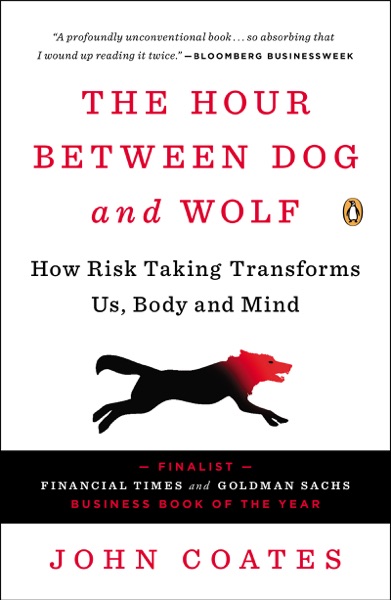
The Hour Between Dog and Wolf is John Coates's argument that financial markets are driven partly by biology, and specifically by the hormonal systems — testosterone and cortisol in particular — that evolved to prepare the body for physical challenges and that now operate on traders making millisecond decisions.
John Coates · 2012 · 6h 15m
Full summary and key takeaways →The 12 questions
- 1.
Coates measured testosterone in traders and found it predicted afternoon performance. What would it mean for finance regulation if that finding were replicated consistently?
- 2.
The winner effect produces a cycle: winning raises testosterone, which produces more risk-taking, which eventually produces a crash. Do you recognize that dynamic in domains outside trading — sports, competition, entrepreneurship?
- 3.
Efficient market theory assumes that mispricing is corrected by rational arbitrageurs. What does the hormonal argument say about whether that correction mechanism is reliable?
- 4.
Coates suggests that the demographics of trading floors — predominantly young men — make collective irrationality worse. What evidence would you need to test that claim seriously?
- 5.
The stress response evolved to prepare the body for physical confrontation. In what other modern environments are you relying on a system designed for physical threats to navigate psychological or economic ones?
- 6.
Cortisol elevation in a sustained downturn produces excessive risk aversion. Have you experienced a sustained period of bad outcomes that made you risk-averse beyond what was rational?
- 7.
The book argues that market crashes have a biological component that policy ignores. What would a regulator need to know about physiology to intervene more effectively?
- 8.
Coates says bulls and bears are physiological states as much as psychological ones. Does that reduce or increase your sympathy for traders who made bad decisions at the top of a bull run?
- 9.
The book draws a parallel between the physical state of a predator about to strike and a trader entering a position. Is that analogy illuminating or misleading?
- 10.
If you knew that your cortisol levels were elevated from unrelated stress when you were making a major financial or business decision, how would you use that information?
- 11.
Coates recommends more diverse trading floors as a way to reduce hormonal correlation. Is that a plausible policy lever, or does it underestimate how fast a diverse floor homogenizes under shared incentives?
- 12.
The book was published in 2012. Has subsequent research on finance and neuroscience supported or complicated the central argument?
How to run the discussion
- Pick six to eight, not all of them. An hour of real discussion covers fewer questions than anyone expects, and racing the list is what makes a book club feel like homework.
- Open with what people noticed, not what they concluded. Asking for a verdict first hardens opinions before anyone has heard each other.
- Let the disagreement run. The questions below that split a room are the ones worth the time; the ones everyone answers the same way can be skipped.
- Ask the quiet person a specific question. A direct, narrow question is far easier to answer than an open invitation to contribute.
Themes worth steering toward
If the conversation stalls, these are the threads that usually restart it.
Common questions
What are good book club questions for The Hour Between Dog and Wolf?
Here are 12 book club questions for The Hour Between Dog and Wolf by John Coates, ordered to open easily and end somewhere worth arguing about. The strongest openers ask what each reader noticed rather than what they concluded, and the discussion usually turns on neuroscience, risk-taking, financial markets.
How long should a book club discussion of The Hour Between Dog and Wolf last?
Most groups run 60 to 90 minutes of actual discussion. That is roughly six to eight questions, not all of them, so pick the ones that suit your group rather than working down the list in order.
What are the main themes in The Hour Between Dog and Wolf?
Neuroscience, Risk-taking, Financial markets, Biology and behavior, Stress physiology. Those are the threads most likely to divide a room, which makes them the useful places to steer a discussion that has gone quiet.
Picking the next one? See books like The Hour Between Dog and Wolf or questions for other book club picks.
