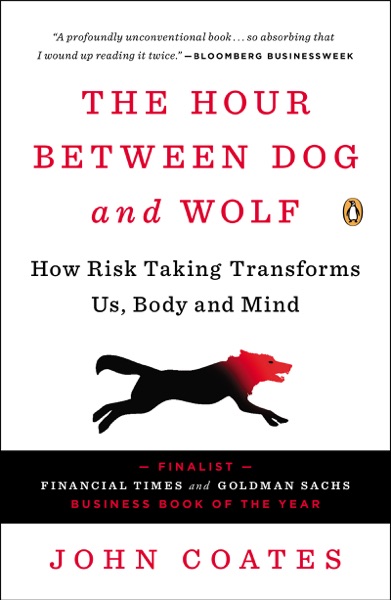
The Hour Between Dog and Wolf by John Coates is a 2012 science book about neuroscience, risk-taking, financial markets. Testosterone levels in the morning predict trading profitability in the afternoon. This correlation suggests that bodily state — not just information processing — shapes financial decision-making.
Summary
The Hour Between Dog and Wolf is John Coates's argument that financial markets are driven partly by biology, and specifically by the hormonal systems — testosterone and cortisol in particular — that evolved to prepare the body for physical challenges and that now operate on traders making millisecond decisions. Coates, a neuroscientist at Cambridge who spent a decade as a derivatives trader on Wall Street, ran field studies on a trading floor in London and measured the correlation between morning testosterone levels and afternoon trading profits. The results were striking enough to reshape how he thought about the relationship between bodily state and financial decision-making.
The core finding is what Coates calls the winner effect: winning trades increase testosterone, which increases risk appetite and confidence, which increases the likelihood of more wins — up to a point. Beyond a threshold, elevated testosterone leads to over-confidence, excessive risk-taking, and eventually the kind of catastrophic losses that precede market crashes. The same feedback loop operates on the way down: losing trades spike cortisol, which increases anxiety and risk aversion beyond what the situation rationally warrants, producing the paralysis and flight that amplifies crashes.
Coates extends the argument beyond individual traders to the market as a whole. If thousands of traders share similar physiology and similar reward structures, their hormonal states will be correlated. A sustained bull market raises testosterone across the trading floor; a crash spikes cortisol. These shared biological states create the irrationality that efficient market theorists attribute to bad information processing but that Coates argues is better understood as a biological phenomenon — the market's body responding to perceived threat.
The book draws on evolutionary biology, endocrinology, and neuroscience alongside financial history and Coates's own trading experience. It is not primarily a policy book, though Coates does suggest that the dominance of young men in trading and the monotony of floor culture amplifies rather than dampens these hormonal dynamics. Regulators who want to understand market crashes, he argues, need to understand physiology as well as incentives.
Talk to The Hour Between Dog and Wolf like its author wrote you back.
Get the ideas that fit your life — not generic summaries.
- Chat with the book
- Audiobook-style main ideas
- Adapts to your life and goals
- Helps you take action
Key takeaways
- 1.
Testosterone levels in the morning predict trading profitability in the afternoon. This correlation suggests that bodily state — not just information processing — shapes financial decision-making.
- 2.
The winner effect: winning raises testosterone, which raises confidence and risk appetite, which increases the likelihood of more winning — until the testosterone spike produces overconfidence and catastrophic losses.
- 3.
Cortisol is the stress hormone. In sustained losing conditions, cortisol elevation produces excessive risk aversion that goes beyond rational reassessment: traders stop making decisions that have clear expected value.
- 4.
If hormonal states are correlated across a trading floor because the same stimuli affect everyone simultaneously, market irrationality is not just an individual failure but a collective biological phenomenon.
- 5.
The hormone hypothesis challenges the rational agent model not by pointing to cognitive biases but by pointing to physiology. Markets are moved partly by bodies, not just by minds.
- 6.
Bulls and bears are not primarily psychological types but physiological states. The same trader can be a rational bull in one hormonal state and a paralyzed bear in another.
- 7.
The evolutionary origins of the stress response — preparing the body for flight or fight — are maladaptive in financial markets where neither running nor fighting is available as a response to a position going against you.
- 8.
The demographic homogeneity of trading floors — young men with similar risk profiles and reward structures — amplifies hormonal correlation and makes collective irrationality more likely than a more diverse population would produce.
Discussion questions
Use these on your own, with a book club, or as chat starters in Superbook. Book club version, ready to copy or print →
- 1.
Coates measured testosterone in traders and found it predicted afternoon performance. What would it mean for finance regulation if that finding were replicated consistently?
- 2.
The winner effect produces a cycle: winning raises testosterone, which produces more risk-taking, which eventually produces a crash. Do you recognize that dynamic in domains outside trading — sports, competition, entrepreneurship?
- 3.
Efficient market theory assumes that mispricing is corrected by rational arbitrageurs. What does the hormonal argument say about whether that correction mechanism is reliable?
- 4.
Coates suggests that the demographics of trading floors — predominantly young men — make collective irrationality worse. What evidence would you need to test that claim seriously?
- 5.
The stress response evolved to prepare the body for physical confrontation. In what other modern environments are you relying on a system designed for physical threats to navigate psychological or economic ones?
- 6.
Cortisol elevation in a sustained downturn produces excessive risk aversion. Have you experienced a sustained period of bad outcomes that made you risk-averse beyond what was rational?
- 7.
The book argues that market crashes have a biological component that policy ignores. What would a regulator need to know about physiology to intervene more effectively?
- 8.
Coates says bulls and bears are physiological states as much as psychological ones. Does that reduce or increase your sympathy for traders who made bad decisions at the top of a bull run?
- 9.
The book draws a parallel between the physical state of a predator about to strike and a trader entering a position. Is that analogy illuminating or misleading?
- 10.
If you knew that your cortisol levels were elevated from unrelated stress when you were making a major financial or business decision, how would you use that information?
- 11.
Coates recommends more diverse trading floors as a way to reduce hormonal correlation. Is that a plausible policy lever, or does it underestimate how fast a diverse floor homogenizes under shared incentives?
- 12.
The book was published in 2012. Has subsequent research on finance and neuroscience supported or complicated the central argument?
Themes
Frequently asked questions
-
Is The Hour Between Dog and Wolf worth reading?
Yes, particularly for readers with an interest in behavioral finance, neuroscience, or financial history. Coates's dual background as a trader and a neuroscientist gives the book a credibility that most books in either domain lack. The science is accessible and the trading anecdotes are vivid.
-
How technical is the neuroscience in this book?
Coates explains endocrinology and neuroscience clearly for a general audience. The chapters on testosterone, cortisol, and the stress response assume no prior knowledge but don't shy from the actual biology. It is more scientifically grounded than most books on behavioral finance.
-
What is the 'hour between dog and wolf' in the title?
It's a French expression — l'heure entre chien et loup — referring to dusk, when you can no longer tell a dog from a wolf. Coates uses it as a metaphor for the ambiguous zone between rational risk-taking and the kind of biologically-driven overconfidence that precedes crashes.
-
Does the book argue that trading floors should employ more women?
It implies that more diverse trading floors — diverse by age, sex, and presumably hormonal profile — might reduce the correlated biological states that amplify crashes. Coates does not make this a prescriptive policy argument, but the logic is present.
-
How does this relate to the 2008 financial crisis?
Coates argues that the 2008 crisis had a biological dimension that conventional economic explanations underweight. The sustained bull run of the preceding years would have raised testosterone across the financial sector, producing the kind of overconfidence and excessive risk-taking the crisis revealed — a collective winner effect that turned catastrophically.
Similar books
Thinking, Fast and Slow
Daniel Kahneman
Misbehaving: The Making of Behavioral Economics
Richard H. Thaler
Behave: The Biology of Humans at Our Best and Worst
Robert M. Sapolsky
The Undoing Project
Michael Lewis
