Literary fiction · Book club
The House of the Spirits book club questions
Here are 12 book club questions for The House of the Spirits by Isabel Allende, ordered to open easily and end somewhere worth arguing about. Copy them, print them, or bring them up one at a time.
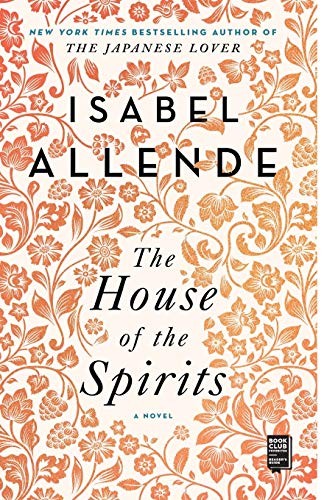
The House of the Spirits begins with Clara del Valle, a clairvoyant child who stops speaking for nine years after a family tragedy and grows up to become the center of a sprawling Chilean family chronicle.
Isabel Allende · 1982 · 13h 0m
Full summary and key takeaways →The 12 questions
- 1.
Esteban Trueba commits rape and other brutalities but is also rendered with enough sympathy that readers often find him compelling. Is this a failure on Allende's part or the novel's central argument about how political violence is actually produced?
- 2.
The magical elements — Clara's clairvoyance, the moving furniture, the spirits — feel natural in the early sections and fade as the coup approaches. What is Allende saying by making magic incompatible with military dictatorship?
- 3.
The women of the family are more interesting than the men in almost every case. Is this a deliberate structural choice or a consequence of autobiographical material?
- 4.
How does the dual narration — Esteban and Alba — shape what you believe? Are there moments where you find yourself trusting Esteban's version over Alba's?
- 5.
Clara stops speaking for nine years as a child. When she starts again it is to announce her engagement, on her own terms. Is her silence a form of power or a form of damage?
- 6.
Compare The House of the Spirits to One Hundred Years of Solitude as uses of magical realism. What does Allende do differently, and does the comparison illuminate or diminish her novel?
- 7.
The torture scenes in the final section are detailed and disturbing. Some readers find this necessary and honest; others find it exploitative. Where do you land?
- 8.
Alba, writing from detention, is the frame narrator. How does knowing she survived change how you read the novel's political violence? Does the survival feel earned or convenient?
- 9.
Esteban supports the coup that ultimately destroys his own granddaughter. Does his eventual regret change the moral weight of his choices, or does the novel make clear that regret is insufficient?
- 10.
The women in the novel are consistently the ones who preserve memory, nurture community, and resist. Is this a feminist political argument or a kind of essentialism that the novel can't quite escape?
- 11.
Allende published this novel in exile, unable to return to Chile. How does that biographical context change how you read the political content?
- 12.
The house itself — its physical space, its spirits, its eventual transformation — is as much a character as any of the people. What does it represent by the end?
How to run the discussion
- Pick six to eight, not all of them. An hour of real discussion covers fewer questions than anyone expects, and racing the list is what makes a book club feel like homework.
- Open with what people noticed, not what they concluded. Asking for a verdict first hardens opinions before anyone has heard each other.
- Let the disagreement run. The questions below that split a room are the ones worth the time; the ones everyone answers the same way can be skipped.
- Ask the quiet person a specific question. A direct, narrow question is far easier to answer than an open invitation to contribute.
Themes worth steering toward
If the conversation stalls, these are the threads that usually restart it.
Common questions
What are good book club questions for The House of the Spirits?
Here are 12 book club questions for The House of the Spirits by Isabel Allende, ordered to open easily and end somewhere worth arguing about. The strongest openers ask what each reader noticed rather than what they concluded, and the discussion usually turns on political violence and memory, female resilience, magical realism.
How long should a book club discussion of The House of the Spirits last?
Most groups run 60 to 90 minutes of actual discussion. That is roughly six to eight questions, not all of them, so pick the ones that suit your group rather than working down the list in order.
What are the main themes in The House of the Spirits?
Political violence and memory, Female resilience, Magical realism, Generational trauma, Love and power. Those are the threads most likely to divide a room, which makes them the useful places to steer a discussion that has gone quiet.
Picking the next one? See books like The House of the Spirits or questions for other book club picks.
