Literary fiction · Book club
The Human Stain book club questions
Here are 12 book club questions for The Human Stain by Philip Roth, ordered to open easily and end somewhere worth arguing about. Copy them, print them, or bring them up one at a time.
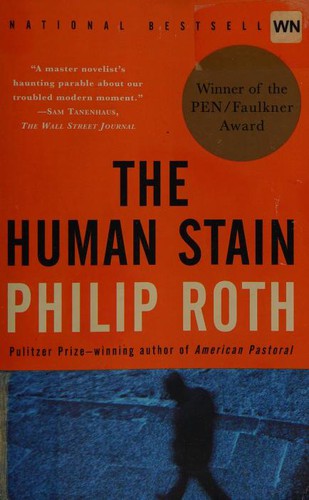
Coleman Silk is a seventy-one-year-old classics professor and former dean at Athena College in western Massachusetts who has been driven from his position by a racially charged accusation.
Philip Roth · 2000 · 9h 0m
Full summary and key takeaways →The 12 questions
- 1.
Coleman Silk chose to pass as white/Jewish rather than live as Black in postwar America. The novel presents this as an exercise of freedom rather than betrayal. Do you agree with that framing? What does it cost him that he perhaps didn't fully reckon with?
- 2.
The accusation against Silk is technically wrong — 'spooks' was not used racially — but he can't defend himself without revealing his secret. Does the irony make the injustice worse, or does it complicate any simple outrage?
- 3.
Zuckerman openly acknowledges that he is inventing significant portions of Silk's interior life. How does that admission change your relationship with the narrative?
- 4.
The Clinton-Lewinsky scandal runs through the novel as a kind of moral atmosphere. How does Roth use it? Is the parallel he draws between public moral spectacle and private hypocrisy convincing?
- 5.
Faunia may or may not be genuinely illiterate — her literacy might be a performance of its own. What does that ambiguity add to the novel's argument about identity?
- 6.
Silk's family doesn't know his secret. His Black relatives are given a brief, moving scene in the novel. How does the novel handle the loss and damage of his passing on the people he left behind?
- 7.
Lester Farley's chapters give him interiority and a kind of sympathy — his damage is real and has a history. Does that complexity make him more or less frightening?
- 8.
Roth has been accused of writing women primarily as they are perceived by his male characters. Does Faunia feel like a full character or a projection? Does it matter for the novel's arguments?
- 9.
The title, the human stain, refers to the impossibility of purity. Is Roth arguing for a kind of moral realism — accept your stain — or for something more specific about the American racial situation?
- 10.
The novel ends with an image of Lester Farley on the ice. What is Roth doing with that image? Is it a resolution or a threat?
- 11.
Compare The Human Stain to The Plot Against America as Roth novels about race in America. Which argument feels more urgent?
- 12.
Silk reinvents himself completely and succeeds for decades. Is his life story a tragedy, a success, or both?
How to run the discussion
- Pick six to eight, not all of them. An hour of real discussion covers fewer questions than anyone expects, and racing the list is what makes a book club feel like homework.
- Open with what people noticed, not what they concluded. Asking for a verdict first hardens opinions before anyone has heard each other.
- Let the disagreement run. The questions below that split a room are the ones worth the time; the ones everyone answers the same way can be skipped.
- Ask the quiet person a specific question. A direct, narrow question is far easier to answer than an open invitation to contribute.
Themes worth steering toward
If the conversation stalls, these are the threads that usually restart it.
Common questions
What are good book club questions for The Human Stain?
Here are 12 book club questions for The Human Stain by Philip Roth, ordered to open easily and end somewhere worth arguing about. The strongest openers ask what each reader noticed rather than what they concluded, and the discussion usually turns on race and passing, political correctness and accusation, identity and reinvention.
How long should a book club discussion of The Human Stain last?
Most groups run 60 to 90 minutes of actual discussion. That is roughly six to eight questions, not all of them, so pick the ones that suit your group rather than working down the list in order.
What are the main themes in The Human Stain?
Race and passing, Political correctness and accusation, Identity and reinvention, Desire and self-destruction, American shame. Those are the threads most likely to divide a room, which makes them the useful places to steer a discussion that has gone quiet.
Picking the next one? See books like The Human Stain or questions for other book club picks.
